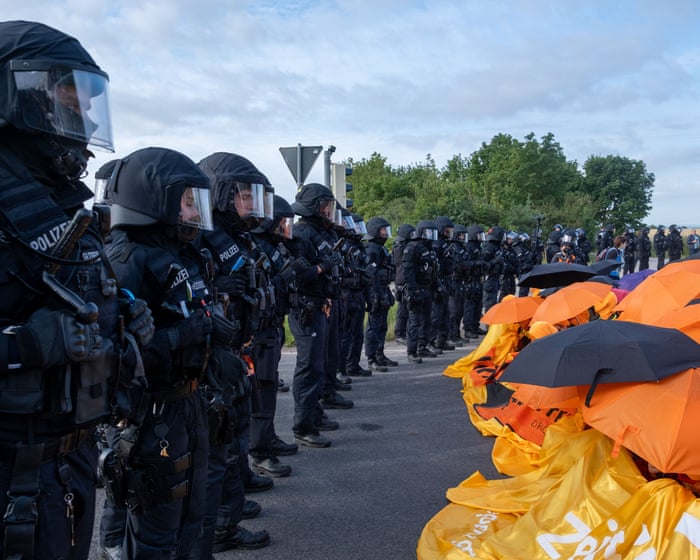
At 5 a.m. on a Saturday, I found myself jogging across a field with a few hundred strangers, heading to block a highway. We were just outside the east German city of Erfurt, one of several groups setting up roadblocks to try to stop delegates from reaching the far-right Alternative für Deutschland (AfD) party conference. We lined up facing a row of police in riot gear—helmets on, batons ready—who filmed us with cameras on monopods.
A few years ago, I would have been covering an action like this as a reporter, standing behind the police lines. In journalism school, I was taught to be objective. But I can’t pretend to be impartial when it comes to the AfD—so instead, I chose to join the demonstrators, most of them decades younger than me, chanting together: “Siamo tutti antifascisti (We are all antifascists)!” As a foreigner who has called Germany home for nearly 30 years, and as the father of two daughters growing up here, I have a personal stake in this.
The AfD is flirting with Nazi history—but moral outrage alone won’t stop the far right | Katja Hoyer
And the AfD terrifies me. The party supports what it calls “remigration”: a policy that critics warn could go beyond deporting undocumented migrants and asylum seekers, targeting a broader vision of who belongs in Germany. The fear isn’t only felt by migrants, asylum seekers, and non-citizens like me. Some leading figures in and around the AfD have discussed removing German citizens with migrant backgrounds, arguing they aren’t truly German. The Bavarian AfD parliamentary group has called for a German deportation police force modeled on the US’s notorious Immigration and Customs Enforcement (ICE).
Polls now show the AfD as Germany’s most popular party, with support nearing 30%. This autumn, there are crucial elections in two eastern German states, and the AfD could win both. In one, Saxony-Anhalt, polling suggests it’s close to securing an absolute majority, which would make it the first far-right party to take state office in Germany since the end of the Nazi dictatorship.
So, along with several thousand others from across Germany, I came to Erfurt to resist: to say no. I didn’t come expecting to stop the AfD conference. I came because, for the first time in years, a movement was offering ordinary Germans something the political establishment no longer seems able to provide: a way to resist.
The blockades were organized by Widersetzen, a loose coalition of trade unionists, climate activists, anti-racist groups, queer organizations, and local networks committed to civil disobedience. The name can mean both “sit down” and “resist.”
Conservative media here like to portray Widersetzen as dangerous, potentially violent, far-left radicals. But my blockade felt more like a street party or a school trip. The twenty-something next to me wore a bright pink T-shirt printed with a unicorn, a rainbow, and the ironic slogan “Alpha Male.” A medical student brought her urology textbook to study during downtime. The only moment of violence I saw came from the police: a handful of protesters ran through a gap in the cordon and were met with swinging clubs and pepper spray. A few demonstrators were hurt, but thankfully none seriously.
Instead of aggression and fear, what I felt in the middle of that group of protesters was something missing from German politics for far too long: hope. Until now, the rise of the AfD has felt inevitable and unstoppable, and Germany’s mainstream parties have largely responded by chasing the same voters. Chancellor Friedrich Merz has moved to the right on immigration and social issues, using dog-whistle language to refer to racial and gender minorities. All while cutting social funding and boosting military spending with a clear neoliberal economic agenda. Meanwhile, the AfD has only grown stronger.
View image in fullscreen: AfD co-leaders Alice Weidel (R) and Tino Chrupalla applaud after singing the national anthem at the end of the conference.At their party congress in Erfurt, eastern Germany, on July 5, 2026. Photograph: John MacDougall/AFP/Getty Images
What struck me most in Erfurt was how strong Widersetzen’s grassroots campaign was. For months before the AfD conference, their activists went door to door, talking to local residents and building ties with community groups. It was exactly the kind of old-fashioned, on-the-ground politics that Germany’s mainstream parties have neglected in the east, leaving the far right to take over.
Skip past newsletter promotion. Free newsletter | Weekly. Sign up to This is Europe. The most pressing stories and debates for Europeans – from identity to economics to the environment. Preview latest. Enter your email. Sign up.
After newsletter promotion. German riot police clash with protesters trying to block the far-right AfD conference. Read more.
These efforts paid off. After my blockade broke up, I walked through Erfurt with hundreds of other protesters. All along our route, people waved from windows and cheered us on. An older woman leaning on her garden fence, tears in her eyes, gave us a thumbs up. We were a bunch of left-wing activists protesting fascism in what’s seen as the AfD’s stronghold. But for a moment, we felt like the majority.
That’s why Erfurt felt different. Widersetzen didn’t stop the AfD conference. Delegates slipped into the convention center before dawn to avoid the blockades. But the movement I joined achieved something Germany’s mainstream parties haven’t: convincing thousands of ordinary people that democracy is worth putting your body on the line for.
It won’t be enough on its own to stop the AfD. But after years when the far right’s rise seemed unstoppable in Germany, this felt like the start of a fightback.
Scott Roxborough is a Canadian journalist based in Cologne.
Do you have an opinion on the issues raised in this article? If you would like to submit a response of up to 300 words by email to be considered for publication in our letters section, please click here.
Frequently Asked Questions
Here is a list of FAQs based on the statement Through the teargas I saw something that has been missing from German politics for too long hope
BeginnerLevel Questions
Q What does the quote Through the teargas I saw hope mean
A It means that even during a violent or chaotic protest the speaker saw a positive change or a reason to be optimistic about the future of German politics
Q Who said this and why is it a big deal
A It was said by a protester or observer during a recent demonstration in Germany Its a big deal because it suggests that a new hopeful energy is emerging in a political system that many felt was stuck or hopeless
Q Is hope a bad thing in politics
A No In this context hope is positive It means people believe they can actually change things for the better which is something many felt was missing in Germany for years
Q What kind of protests are we talking about
A The quote likely refers to protests about climate change housing or social justiceissues where young people and activists feel the government hasnt acted fast enough
IntermediateLevel Questions
Q Why was hope missing from German politics for too long
A Many Germans felt their political system was too stable cautious and focused on keeping the status quo Big problems like the climate crisis or digitalization werent being solved with urgency leading to a feeling of political stagnation
Q How does teargas relate to hope Isnt teargas a bad thing
A Teargas is a symbol of conflict and repression The speaker is saying that despite that violence and conflict they saw something powerful people willing to stand up for change That collective action is what gave them hope
Q Is this hope just about one protest or a bigger trend
A It seems to be part of a bigger trend Movements like Fridays for Future and recent protests against farright extremism have shown a new more active generation of Germans who are demanding real change
AdvancedLevel Questions
Q How does this hope differ from the optimism in Germany after the fall of the Berlin Wall