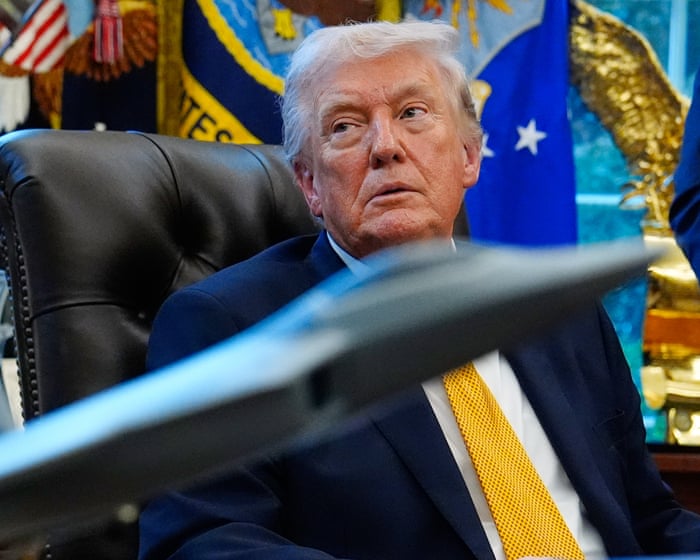
Donald Trump’s claim that Iran was responsible for a deadly strike on an elementary school originated from an early U.S. intelligence report that was quickly retracted, according to two sources familiar with the matter.
Initially, the CIA informed the president that the missile which hit the school did not appear to be American, as its fins were positioned lower than those on a Tomahawk cruise missile. However, within a day, the agency corrected itself after reviewing additional video footage from different angles, confirming the weapon was indeed a U.S. Tomahawk.
Despite this update, Trump had already decided to blame Iran by the time he spoke to reporters on Air Force One the following Saturday. Defense Secretary Pete Hegseth was more reserved, stating only that the incident was under investigation. Trump reiterated his accusation at a news conference the next day, even while acknowledging the missile was a Tomahawk—a weapon used only by the U.S. and a few allies—by suggesting it belonged to Iran.
It is unclear when Trump received the corrected intelligence, but former officials criticized both the president and his briefers for the misstep. One former CIA officer noted that providing Trump with preliminary information is risky, as he may publicly commit to it, making later corrections difficult and embarrassing.
The president’s insistence on blaming Iran coincides with an ongoing Pentagon investigation that has reached similar conclusions: the missile was a U.S. Tomahawk, launched based on outdated intelligence. The strike killed at least 175 people, many of them children, marking one of the deadliest targeting errors in recent decades. The investigation is examining why the intelligence was obsolete and whether it was properly verified.
In response, White House spokesperson Anna Kelly stated that the investigation is ongoing and reiterated that the United States does not target civilians, unlike what she described as the “terrorist Iranian regime.” The CIA declined to comment.
The school in Minab was located on the same block as an Iranian Revolutionary Guard naval base. Although the building was once part of the military compound, it had been separated and converted into a school several years prior.
Targets for airstrikes are typically identified years in advance by agencies like the Defense Intelligence Agency and the National Geospatial-Intelligence Agency, which use satellite imagery to compile databases. Once a building is listed as a potential target, it may not be reviewed again until a strike is planned.
Military planners can then generate target lists from these databases, sometimes using artificial intelligence tools to prioritize factors like distance or likelihood of destruction. In the early stages of the conflict with Iran, the list of potential targets numbered in the thousands. It remains unknown whether each target was verified before strikes were authorized.
Frequently Asked Questions
Of course Here is a list of FAQs about the claim that former President Trump used unverified intelligence to accuse Iran of a deadly school attack written in a natural tone with direct answers
BeginnerLevel Questions
1 What is this story about
This story is about a claim that in 2020 thenPresident Donald Trump publicly accused Iran of being behind a deadly rocket attack on a school in Afghanistan despite US intelligence agencies warning him that the information was unverified and potentially unreliable
2 What exactly did Trump say
In a tweet on December 12 2020 Trump stated Iran killed an American contractor in a rocket attack on a US Embassy in Afghanistan He linked this to a separate attack on the US Embassy in Baghdad Iraq and suggested a forceful response
3 Was the attack actually on a school
Yes The specific attack in question targeted the Kawsare Danish educational center in Kabul Afghanistan It was a horrific attack that killed two dozen people mostly students The initial unverified intelligence suggested the attackers may have had ties to Iran
4 What does unverified intelligence mean
It means the information had not been confirmed or checked thoroughly enough by intelligence agencies to be considered reliable or factual It could have been based on rumors singlesource reports or fragmentary data
5 Why is using unverified intelligence a problem
Using unverified intelligence to make public accusations especially against another country is dangerous It can escalate tensions lead to misguided policy or military responses and damage the credibility of the government if the information later proves false
Advanced Contextual Questions
6 What was the reported source of this intelligence
According to reports the initial tip came from Israeli intelligence The US intelligence community had not yet been able to corroborate it through its own sources and methods before the Presidents tweet
7 How did US intelligence agencies react
Officials at the CIA Pentagon and State Department were reportedly alarmed and frustrated They had explicitly warned the White House that the intelligence was not solid and advised against publicly blaming Iran until more investigation was done
8 Did this lead to any direct consequences or retaliation
While it did not trigger an immediate largescale military conflict the accusation came during