When Willem Dafoe took over as the creative director of the Venice Theatre Biennale last year, he shaped the program around his own interests. He chose experimental theater companies that had influenced him as a young actor and performed in a strange, rather stiff two-person play by Richard Foreman, which involved reading random notes from index cards. It felt less avant-garde and more nostalgic.
This year’s 54th edition is thankfully very different. Dafoe’s program is broad and outward-looking, with real cultural variety and an interesting mix of theatrical traditions. The lineup stretches from Europe to Indonesia (including Yusril Katil’s Under the Volcano) and India (Sharmila Biswas’s Mischief Dance). Shows like Satoshi Miyagi’s Mugen Noh Othello, which blends Noh theater with Shakespeare, and Christos Stergioglou and Alex Drakos Ktistakis’ Cries, which combines physical theater with musical storytelling and modern themes with ancient Greek drama, are full of bold hybridity.
The only stiff thing about this year’s program is its title, Alter Native, which Dafoe says refers to “encounters between cultures – moments when what is familiar enters into dialogue with you and becomes a catalyst for transformation.” If that sounds high-minded and confusing on paper, it carries real purpose in practice.
A recurring theme runs through Dafoe’s program: giving voice to the marginalized and focusing on lesser-heard stories. Emma Dante, a celebrated Sicilian playwright who has created work about outcasts and social outsiders, receives this year’s Golden Lion for lifetime achievement, which itself becomes a bold statement.
And the latest production by Davide Iodice embodies this focus in the most monumental way. Iodice is an Italian playwright who has previously made shows in a psychiatric hospital, a women’s prison, and a homeless shelter. His new work, Promemoria, is easily the highlight of this year’s lineup.
It takes audiences inside the San Giobbe, a care home for elderly people in Venice. We walk through its corridors and interact with 21 residents who have cognitive decline, Alzheimer’s, or are no longer fully self-sufficient. Carers are beside them, along with nine actors performing around them. We listen to their stories and watch them dance.
The show is the result of a year-long workshop process and a project of extreme tenderness – though it is not as unflinching as Alexander Zeldin’s play Care, set in a nursing home, which is currently at the Young Vic in London.
When asked about his preference for the upbeat and hopeful, Iodice says the pain is all there in unspoken ways: “What struck me most about these extraordinary actors was their incredible attachment to life, a strong desire to be part of it even in a condition of extreme vulnerability – a strength that gives strength. I sought to pay tribute to this kind, gentle force. Fragility, pain, illness, emergency are present in every corner of the hallway, in the smells, in the ceaseless sounds of running medical equipment, in the bells that call for assistance, in the constant movement of doctors and nurses, in the everyday life of this place. Yet even in this place, humanity manages to strenuously maintain its beauty, however residual. It is this beauty that always interests me.”
Cries by Stergioglou and Ktistakis distills the voices of migrants and those enslaved or displaced across time, from Hecuba after the sacking of Troy to the present day. It is presented mostly through song and staged by a six-piece band of performers at the open-air venue Teatro Verde, which resembles an amphitheater and is located on an island off the mainland. It comes alive in its angriest song about the experience.Migrants who reluctantly flee their homes, often in desperate circumstances, are met with hostility and prejudice in the West. “You have to understand: no one puts their children on a boat unless the water is safer than the land … no one chooses refugee camps or strip searches,” one performer sings in a piece that becomes more of a forceful shout.
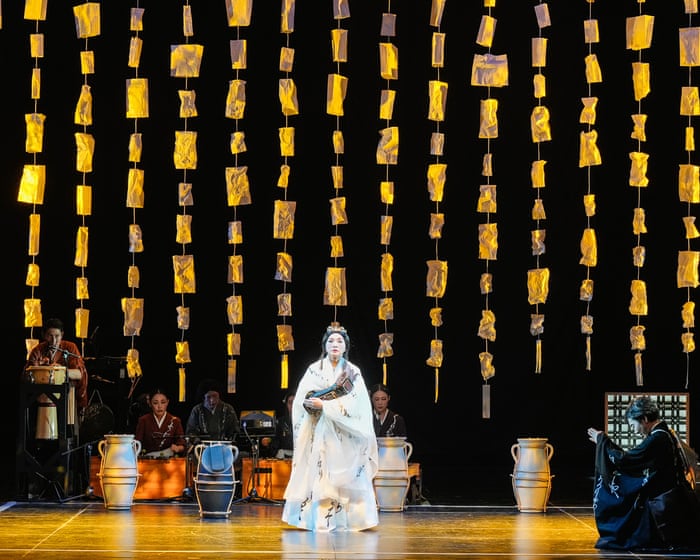
Miyagi gives voice to a marginalized Shakespearean character in Mugen Noh Othello, which reimagines the play to center on Desdemona, Othello’s murdered wife. A Japanese experimental artist who has previously reworked several Western classics, he uses the ritual of Mugen-Noh theatre, which dates back to the 13th century.
Miyagi explains that the main character in Mugen-Noh is always a ghost trapped in a repeating story. The goal of this dramatic ritual is to free this suffering figure from their purgatory, partly through the act of storytelling itself: “Telling stories helps them resolve their anguish.” For Miyagi, this links the Noh tradition to Shakespeare’s ghosts and their desire for revenge in plays like Hamlet.
A recognizable Noh chorus, with drumming and percussion, tells Othello’s backstory, including his heroic deeds in war. But the focus is on Desdemona’s ghost—a spirit forever outraged by being killed by her accusing husband for an affair she never had. Since she barely speaks in Shakespeare’s original play, this reworking completely shifts the story’s focus. It’s no longer about a deeply flawed war hero and his violent jealousy, stirred by Iago’s cunning tricks. Instead, it’s about a faithful wife and a wronged spirit, consumed by a sense of injustice and stuck in her own painful story. She, not Othello, becomes the tragic heart of the play.
Miyagi isn’t the only one bringing the dead back to life. Dorcy Rugamba’s Letter to the Absent is an adaptation of his book Hewa Rwanda, dedicated to his family who died in the 1994 Rwandan genocide. He suggests that theatre is a medium where the dead can be reborn, and he wanted to bring back those who died in a way that isn’t defined by their killers. “The genocide kills people twice: first it kills the body, but after that, their very existence can disappear in how you tell their story. If you look at movies and books [about the genocide], the violence is so dramatic that it becomes the story of the murderer. For me, it’s necessary to find a way to give the victims their full story. So they can become the main characters of the story and stop being just sufferers seen only through the horrific conditions of their deaths.”
Several works have immersive elements. In Iodice’s piece, a maximum of 30 audience members per performance move through the rooms and gardens of the home. They become active participants, invited into an art workshop to hear what residents have created, or sitting with a group of elderly women who offer tea and share memories of their former working lives and families.
On a smaller scale is Mario Banushi’s Ragada, the first part of a wordless trilogy about family loss, memory, and burial rituals. Banushi, a Greek playwright of Albanian heritage, is seen by many as the new face of Greek theatre and is the winner of this year’s Silver Lion at the biennale. The trilogy, titled Romance Familiare (which includes Goodbye, Lindita, and Taverna Miresia alongside this first part), is being shown together for the first time at the festival. Ragada takes place in what looks like a family living room, with audience members seated in a space that surrounds the room, some on the floor near the actors.I was completely caught up in the intense emotional drama happening in such a small, intimate space.
Beyond the main program, there’s a six-hour performance of Samuel Beckett’s How It Is. Audiences can watch it all at once or take breaks throughout the day. It’s a word-for-word staging of Beckett’s three-part novel, first published in French in 1961. Known for being puzzling, the text is written in unpunctuated verses and features a lone figure in a muddy landscape who hears voices both inside and outside himself.
[Image: Fullscreen view]
In it for the duration … Stephen Dillane in Beckett’s How It Is. Photograph: Grant Gee
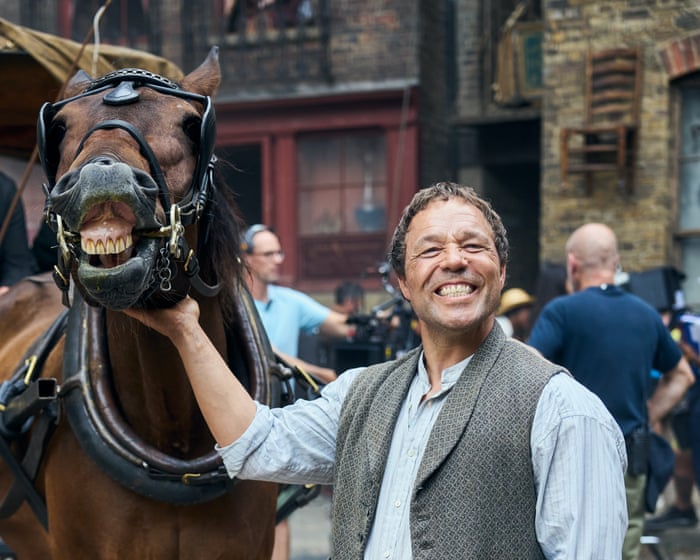
Even though it’s not part of Dafoe’s biennale, it fits well with the hands-on, immersive feel of his program. This “live art event,” a collaboration between Gare St Lazare Ireland and Berggruen Arts & Culture, takes place on the top floor of Palazzo Diedo. Directed by Judy Hegarty Lovett, with design help from artist Michael Craig Martin, it stars Stephen Dillane and Conor Lovett. “It’s a very oral text – it works well on stage,” says Hegarty Lovett. Gare St Lazare has been working on this for ten years, and next year they’ll be staging Waiting for Godot with Gary Oldman.
With this biennale, Dafoe finishes the minimum two-year term required of its artistic director. The question now is whether he’ll stay for another two years or more. Given this year’s program, it seems like he’s really hitting his stride. Watch this empty space? The Venice Theatre Biennale runs until June 21. Arifa Akbar’s trip was provided by the festival.
Frequently Asked Questions
Here is a list of FAQs about In
BeginnerLevel Questions
1 What exactly is In on the periodic table
Answer In is the chemical symbol for Indium Its a soft silverywhite metal that is very rare in the Earths crust
2 Is Indium a solid liquid or gas at room temperature
Answer Its a solid metal but its very softso soft you can cut it with a knife It also has a very low melting point for a metal
3 Where is Indium most commonly found
Answer Its not found as a pure nugget Its usually a byproduct of mining other metals like zinc lead and tin The biggest producers are China South Korea and Canada
4 What is Indium used for in everyday life
Answer You probably use it every time you touch a smartphone or a computer screen Its a key ingredient in Indium Tin Oxide which makes touchscreens conductive and transparent
Advanced Technical Questions
5 Why is Indium so important for touchscreens and solar panels
Answer When you mix Indium with Tin you get Indium Tin Oxide This material is both transparent and electrically conductive Its also used in thinfilm solar cells for the same reason
6 Is Indium toxic or dangerous to handle
Answer Pure Indium metal is generally considered nontoxic and safe to handle However some of its compounds are toxic and can cause lung damage if inhaled as dust
7 Why is Indium so expensive and hard to find
Answer Its not that its incredibly rare in the Earths crust but its dispersedmeaning its spread out in tiny amounts Its very hard to mine economically on its own Supply is also heavily controlled by a few countries making prices volatile