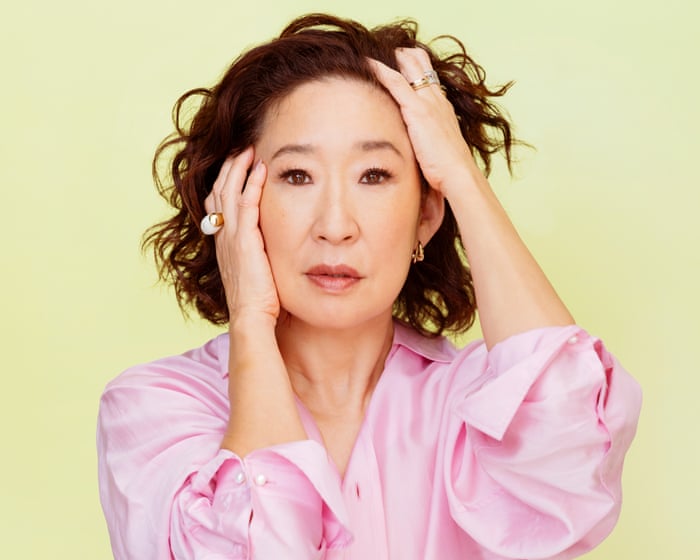
Sandra Oh bursts into a back room at the National Theatre in London, buzzing with post-rehearsal energy. At 54, she’s long been one of Hollywood’s most stylish actors. Today, she’s wearing brown linen, a herringbone jacket, a hat, and sunglasses. She takes them off, collapses into a chair, and throws her head forward, arms stretched out, hair spread across the table. “It’s just the fucking process of it,” she groans. “We just finished our first stagger-through. If anyone’s an actor—it’s early days, so making it through was great. It’s brutal. We started in the Lyttelton, and it’s interesting to be in that space and hear verse. You can really hear it. It’s not just about volume or speed. It’s not even just about intention. You learn so much just being in that space, but the big thing is—sorry.” She catches herself. “I’m just marching on.” And she bursts into laughter.
Oh has been in London for just over a month, rehearsing her role as Alice in a modern reimagining of Molière’s Le Misanthrope. It’s a happy return. Eight years ago, she was in the capital filming the first of four series of the hit show Killing Eve, which became a phenomenon and changed her life as an actor forever. Oh played Eve Polastri, the messy but brilliant British intelligence agent who, along with Jodie Comer’s Villanelle, made for one of the best spy capers in recent years. Now, she’s playing a novelist—gender-swapped from the 17th-century original, in an adaptation by Martin Crimp—who’s fed up with the flattery and dishonesty of the people around her. It’s a deliberate move toward theatre. Last summer, she appeared as Olivia in a star-studded production of Twelfth Night at the Delacorte Theater in Central Park, New York. In the fall, she made her debut at New York’s Metropolitan Opera in a production of Donizetti’s comic opera La Fille du Régiment. Unlike the sometimes tense self-focus of screen work, Oh says working in theatre in general, and at the National in particular, “is a collaborative thing”—not least, she adds dryly, because no one does it for the money. “Everyone has to bring their best and most open selves. And everyone else loves watching everyone succeed.”
It’s a dynamic that suits Oh in her current phase. In the last few years, she’s become that rare figure in Hollywood: a famous woman who has only grown more powerful with age, a champion of younger performers, and something of a truth-teller in an industry full of people encouraged by flattery to talk absolute nonsense. She’s funny, shrewd, insightful, and above all, generous with her insights. A few years ago, in the New Yorker, she spoke about surviving years of racism as a woman of Asian origin trying to get ahead as an actor. (On white male directors not casting her, she said: “It’s like getting over a bad boyfriend. They’re not going to call. Just move on and hang out with the young women who want you to be their mom.”) Later, she told the New York Times about a sense of being “deep into this very rich middle part of [my] life,” where “only now do [I] have enough strength and hopefully curiosity to go into the places of asking the question: why did I do that? Who has been steering the ship? Because now, in this back half of my life, I’m the captain of the ship.”
In the diaries Oh has been keeping since she was a child—excerpts of which have appeared in papers and podcasts—you get a sense of an introspective, literary person with a deep connection to where she came from: a suburb of Ottawa, Canada, where Oh still has friends from grade school. If we loved her 20 years ago as Dr. Cristina Yang in Grey’s Anatomy—a blunt, brilliant cardiothoracic surgeon—these days Oh comes across as a wise person very much in her prime, which, she tells me…She finds it “incredibly liberating and also, like, enraging.” We’ll get to that. Two weeks before I meet Oh at the theater, I see her in a studio on the eve of the first week of rehearsals. As an actor preparing to appear at the National for the first time, Oh had, a few weeks earlier, the amazing luck to run into Fiona Shaw at a grocery store in her LA neighborhood, where her Killing Eve co-star happened to be living while filming. “She’s one of the greatest stage actors of her generation and knows the National,” says Oh. In the supermarket aisle and later, over breakfast at Oh’s house, Shaw gave her a bunch of tips about the stage at the Lyttelton. “She said, ‘If you’re going to be on this stage, watch out for [the sight lines] in this area,’ or, ‘This is the strongest area on stage, do this technical thing this way.’ She was giving me the gold. I couldn’t believe it.”
In the studio that first day we meet, Oh is wearing a cropped leather jacket and soft leather shoes that are “good and supportive. I need structure.” Don’t we all, I say, and Oh cackles. In fact, while she enjoys the structural and technical aspects of theater work, it’s TV that made Oh. Her jump to leading roles came relatively late. These days, it’s strange to stumble across Oh in old movies in parts that seem way too small for her—the other day, while watching the 2001 film The Princess Diaries with my kids, I was surprised to see Oh as the cartoonish Vice Principal Gupta. Other credits from that period include “fourth fired employee” from something called Full Frontal and “marketing person” from the movie For Your Consideration.
Despite enjoying great early success in TV in Canada and becoming a key ensemble player for nine years on Grey’s Anatomy (2005-14), it wasn’t until Killing Eve that she really rose to leading role status. Famously, when her agent called her with the script for the show, Oh assumed she was reading for a minor character. “‘So Nancy, I don’t understand, what’s the part?'” Oh recalled saying to her agent at the time. “And Nancy goes: ‘Sweetheart, it’s Eve, it’s Eve.'”
View image in fullscreen: Oh with Ellen Pompeo in Grey’s Anatomy, 2006 (above), and with Jodie Comer in Killing Eve, 2019 (below). Photograph: Michael Desmond/five. View image in fullscreen: Photograph: Parisa Taghizadeh/BBC/Sid Gentle.
“Isn’t that just the question and the challenge of life? How do you deal with life not being fair, or turning out the way you want?”
Oh as Eve was a revelation; by turns sardonic, baffled, digging into every nuance of what it’s like to be a frustrated, overlooked cog in the machine, all while carrying a star quality that came through in her electric chemistry with Comer.
Eight years and another big show—Netflix’s excellent comedy drama The Chair—later, Oh’s attitude to all this history is by turns philosophical, resigned, and increasingly tired of being asked to relive it. She’s that rare actor willing to say blunt political things like “Patriarchy runs within all of us” or “If you’re going to put all your stock in waiting for the white dude to give you the opportunity… that’s destructive.” But at the same time, going over and over the bad times gets old. When I ask what makes her angry these days, she says: “Isn’t that just the question and the challenge of life? How do you deal with life not being fair, or turning out the way you want? You’ve got to figure it out. You have to find different ways to work out what’s going on subconsciously and consciously. Typically women have—I shouldn’t say ‘typically women’.” She thinks for a moment. “No, I will say that. I think this is the one thing that particularly straight men have a much harder time with, which is—”I want friendships where we have deep conversations and can really talk things through. I have that kind of relationship with friends, both men and women. I’m lucky, but also, when you’re an artist, you’re always trying to figure that out in your work.”
Figure out what, exactly?
“Figure out what you’re saying—like, how do I deal with my anger? Or how do I deal with what’s happening in the world? You can work that out physically, through talking, or through art. I’ve been putting that into every single project I do.”
Talking is really important to Oh, who is a “big believer in therapy” and stays close with her oldest friends. In the early 2000s, she was married to director Alexander Payne for two years, and they worked together on the 2004 movie Sideways. She won’t discuss her personal life, but she will talk about her other relationships. Oh grew up as one of three children. Her mother was a biochemist, and her father worked in business. They moved to Canada from South Korea in the 1960s. She thinks being the middle child has something to do with her self-appointed role as a “bringer-inner.” She says, “I’m a keeper of people. I’m not an outsider in that way. I like harmony and community.”
Just that morning, she says, she was on a video call with her oldest friend in Canada, a woman she has known since she was six. They’ve been through many phases of friendship. “You have to grow out of your teenage years, and then you hit another stage in your 30s.” During that time, she and her friend went to a therapist together because, “we were growing into different people and trying to figure out how to stay close.” And, “I gotta tell you,” she says, “it was really hard.” Was there a chance it might not have worked out between them? “No. I feel like the people closest to me have to be able to face things.”
She bursts out laughing at my expression. “Look how nervous you got.”
I did!
“You thought about who you’re anxious about and then thought, could I [confront them]? That would be really bad. But then…” She’s not far off.
It’s helpful to remember that Oh isn’t American. While Canadians can be as avoidant as the British when it comes to emotional honesty, she reminds me that “Korean people are pretty confrontational. There’s a different dynamic within the [Korean] family structure—although I do think I’m different, even within my family.” It took her time to learn how to confront people without losing her temper. “I had to go through so much therapy not to be so reactive.”
Her general rule for relationships is, “openness, confidence, willingness. Being non-judgmental. I just think the freer you are, the freer you let everyone else be.” She says, “I have a lot of long-term friendships. I cherish them and I’m good at keeping them going. I’m the connector between different groups. I’ll start the WhatsApp group, or I’ll start the Zoom during Covid. I’m often the one saying, ‘OK, let’s all go somewhere!’ You need to put in the effort, you can’t just coast by.” These things take work, of course. There’s the issue of resentment. “Yes. You think it only happens in romantic relationships, but that’s not true.”
When Oh had just finished theatre school, someone said something to her that she never forgot. Acting wasn’t her first goal, or rather, she had hidden from her family how serious she was about pursuing it. “I’m the only person in my family who doesn’t have a master’s degree,” she has said. She got into university to study journalism, and she promised her parents she’d go back to it if acting didn’t work out.After graduating from the National Theatre School of Canada in Montreal, Oh was immediately cast in the 1994 Canadian premiere of David Mamet’s Oleanna. “A good friend said to me: ‘Oh my God, congratulations, I’m so happy for you. I’m so jealous, and I’m so happy.’ And I saw that she meant both things and that she held both things, and that I could hold both things as well.”
[Image: Photograph by Stephanie Sian Smith/The Guardian]
“I like dancing; I like moving my body. I think there are answers in the body.” The key lesson Oh took from this exchange is that jealousy can be neutralized if you admit to it. This has been important for her in keeping old friends. “I kept all my friends from early childhood and my theatre school mates, and my working relationships with people in Canada. I’m hopefully going to shoot something in Toronto and went out to dinner with the producer and I was ‘cheersing’ him, like, you know darling, this is our 30-year relationship. That means a lot to me.”
She thinks and adds: “Life can be destabilizing, so you have to figure out: what are your stabilizers?”
During those early years of her career in Canada, Oh enjoyed a lot of success. After the Mamet play, she was cast as the lead in a critically acclaimed TV movie called The Diary of Evelyn Lau, which told the story of a teenage runaway. Then she played the title role in a CBC biopic of Adrienne Clarkson, a Chinese Canadian who became a well-known journalist and the governor general of Canada. For her lead role in a film called Double Happiness, Oh won a best actress award at the Genies, the Canadian equivalent of the Baftas. So she did what successful Canadian actors do: packed up and headed for Hollywood.
The crash was brutal and immediate. Soon after arriving in LA, an agent told her there were no roles for Asian actresses for at least another year and she’d be better off returning to Canada to “get famous” (she was already famous in Canada). Oh had to find encouragement wherever she could, as she had been doing since she was 10 years old, when she noticed every person of color on screen, or later, when she took heart from Yoko Ono’s example. She had two personal interactions “in very key moments” during those years that helped her keep going when it seemed like the breakthrough would never come. In 1997, Oh won a CableAce award for best actress in a comedy for her role in an HBO show called Arliss. At the ceremony, she ran into Alfre Woodard, the Oscar-nominated actor who is currently doing amazing work alongside Alfred Molina in the Netflix sci-fi hit The Boroughs. “She didn’t know who I was,” says Oh, “but she took me aside and said something very encouraging, which was basically, keep going, baby. And that meant a lot to me; I knew who Alfre Woodard was and respected her as an artist, and it was just someone saying, ‘Keep on going.'”
The second encourager was Jamie Foxx, whom she met at another awards event – Oh laughs, “that’s when you meet these people. And he also basically said keep going.” It doesn’t take much. “No. Sometimes when young people come to you, they are open and vulnerable, and it’s a certain responsibility as adults to guide them. It can be just a kind word, or you can actually invest in a moment and really talk to the young person.”
[Image: Photograph by Stephanie Sian Smith/The Guardian]
Oh does this admirably and with a certain amount of amused tough love. To those in her industry who complain endlessly about the cost of fame, she says mildly, “Nothing is free.” If it all gets too much – the attention, the speculation – she points out, “You can always go away.” (They never do.) Oh says she has never been particularly vulnerable when it comes to being addicted to fame, or to anything else.For that matter. “I don’t think I was ever in danger. I mean, even at my lowest points, they were normal lows—like being heartbroken or depressed because you don’t know what to do, just normal stuff. Maybe I’m not ready to say what my addictions are, but they’re not the usual ones. I’ve gotten to a point where—it’s so boring; it’s so boring,” she says with comic despair. “‘I have to drink less because of my stomach.’ It’s nonsense. It’s such a drag.”
She meditates. (“Everything you need to figure out in life is found sitting on that cushion.”) And she stays active. Before any new role, Oh focuses on the physical side of the piece—she’s a big fan of body work. “But not exercise; not sports. I like dancing; I like moving my body. I think there are answers in the body. I think there are things trapped in the body.” She prepares for roles on the move and often walks a loop to help memorize a script. “I always look for a park and a tree to learn my lines. It works better for me. When I was doing Killing Eve, I was in this garden and there was a specific tree.” She walked around and around until she had the part down.
She says good writing is the key to good acting, and I ask if Phoebe Waller-Bridge’s scripts for that first season of Killing Eve made her job easier. “Yes, and that has to do—especially with TV and film—with tone. With something like a play, you have a lot more room to interpret it. With something like TV, you need the tone to be right there on the page. To write tone, you have to come from a very specific point of view.”
What is it about a woman who speaks her mind and then gets shot down because of it?
While the new version of Le Misanthrope has been updated into modern language, the dialogue is still in verse, and Oh finds it thrilling—”the challenge of technical language is exciting for me, because you have to work a different muscle. It’s a different way of bringing in emotional discovery. It’s an old play!”
View image in fullscreen
With Tom Mison in rehearsal for The Misanthrope. Photograph: Marc Brenner
It is; Le Misanthrope opened in 1666 at the Théâtre du Palais-Royal in Paris, though Oh finds it relevant to our times. “Molière set it in his theater world, where there are artists and writers and gossip. It’s a lot about hypocrisy and Alice’s own search for honesty and truth, which has meaning in 2026—the difficulty in finding truth. I hope it has a broader meaning about what it means to want to tell the truth, to be honest, and how hard that is.” In the play, Alice gets into trouble for speaking her mind, and, says Oh, “I need to figure out what that means—not just for the character. What does it mean to speak your mind at this point in your life? What is it about a woman who speaks her mind and then gets shot down because of it?”
A few months ago, Oh voiced her support for Zohran Mamdani, the democratic socialist and newly elected mayor of New York, and was thrilled when he showed up at a performance of Twelfth Night in Central Park. “What was amazing, as a non-New Yorker, was to see how he affected our entire cast, which was very diverse—half over 50, half very young. And the way the cast lit up meeting Mamdani, it was like, oh, this is who he represents and this is how much hope he brings to New Yorkers.”
Oh is active in promoting authentic representation of Asian cultures on screen. In 2021, she gave a passionate speech at a Stop Asian Hate rally in Pittsburgh, where she repeated what has become a famous mantra: “I am proud to be Asian. I belong here.” In 2022, she wrote about her career for an online literary magazine, saying, “For the first time, I’m finally getting film roles where my character’s name is Korean.”
It has taken such aIt took her a long time to get here—both in terms of the industry she works in and the personal work she’s had to do to process years of being pushed aside. She admits she’s not fully there yet. And yet. “All that work you’re doing on your own time, with your own heart, in the middle of the night? That doubt, the raw depression, the questioning, the anger? It’s all turning into something.” When she talks about accepting all the different parts of herself—including the internalized racism and misogyny—she often concludes, “There is no self. Meaning you don’t have to be tied to a fixed idea of who you are. But that’s not easy.”
In the meantime, Oh is here to have fun. Backstage at the National, she’s doing what she does best: building community. On the table between us is a water bottle covered in stickers she made during the run of Twelfth Night, featuring all her co-stars—including Peter Dinklage and Jesse Tyler Ferguson—making funny faces. “Oh, that’s Jesse, tasting hot sauce,” she says, laughing. Later, she asks a production assistant if he can get candid photos of her current co-stars to turn into stickers for the same purpose—a spontaneous team-building activity that amuses her.
And when she leaves the theater? “I’m not kidding, I have to sleep,” she says, eyes wide with amazement. Oh, who is naturally full of energy, also knows her limits. “With this play, I need 10 hours of sleep. I get into bed at 8:30 PM and wake up at 7 AM.” It’s as focused as it gets, but after all those years of feeling out of place and being denied opportunities, that’s a luxury she’s happy to have. “I’m allowed to focus on just that one thing. I’m doing this for a reason. It’s a privilege to be able to concentrate on it. And then hopefully, you deliver.” The Misanthrope is at the Lyttelton at the National Theatre, London, until August 1st.
Shoot credits: Hair: Carlos Ferraz. Makeup: Sara Hill. Stylist’s assistant: Charlotte Gornall. Main image and final shot: pink shirt and white trousers, both Carven; bracelet, resin ring, and resin pendant necklace, all Dinosaur Designs; earrings and gold ear cuff, both Otiumberg. Fabric and sofa, House of Hackney. Sofa shot: midi dress and embellished shoes, both Simone Rocha. White and yellow dress shot: sequin dress, Huishan Zhang; earrings, Completedworks. Pink dress shot: organza dress, Cecilie Bahnsen; earrings, Completedworks.
Frequently Asked Questions
Here is a list of FAQs generated from the perspective of someone reading the article about Sandra Ohs approach to anger rage and midlife
BeginnerLevel Questions
Q What does Sandra Oh mean when she says she channels her anger into everything
A She doesnt suppress her anger Instead she uses that intense energy as fuel for her work her friendships and her personal drive Its a source of power not something to be ashamed of
Q Is it healthy to use anger as motivation
A Yes when done right Sandras approach is about channeling the feelingusing the energy to focus take action or createrather than exploding or bottling it up
Q I thought anger was a bad emotion Is Sandra saying its good
A Shes saying its a valid and useful emotion The problem isnt feeling anger but how you handle it She reframes it as a rage that gives her momentum especially in her career
Q What does this have to do with hitting her stride in midlife
A She suggests that in midlife you stop worrying about being nice all the time You become more comfortable with your full range of emotions including anger and use them to your advantage
IntermediateLevel Questions
Q How do you actually channel anger into work without being toxic or aggressive
A Its about directing the intensity For an actor it might mean bringing raw focused energy to a scene For anyone it could mean using the frustration to write a passionate email complete a difficult project or have a very honest conversation
Q How does channeling anger help with friendships as Sandra mentioned
A It can make you more authentic Instead of hiding your irritation you can use that energy to set a boundary address a conflict directly or be fiercely loyal and protective of the people you care about
Q Whats the difference between rage and just being angry
A In the article rage seems to describe a deeper more sustained and powerful form of anger Its not a fleeting annoyance its a core fuel source that you learn to harness over time