Good governments have a vision. They know what they want to achieve, can explain why, and work out in public how to get there. They don’t just repeat slogans about economic growth—because growth is meaningless unless we know what it’s for. They understand that solving social problems and boosting the economy aren’t in conflict, and they aim to do both, while avoiding rigid fiscal rules that defeat their own purpose by strangling public investment.
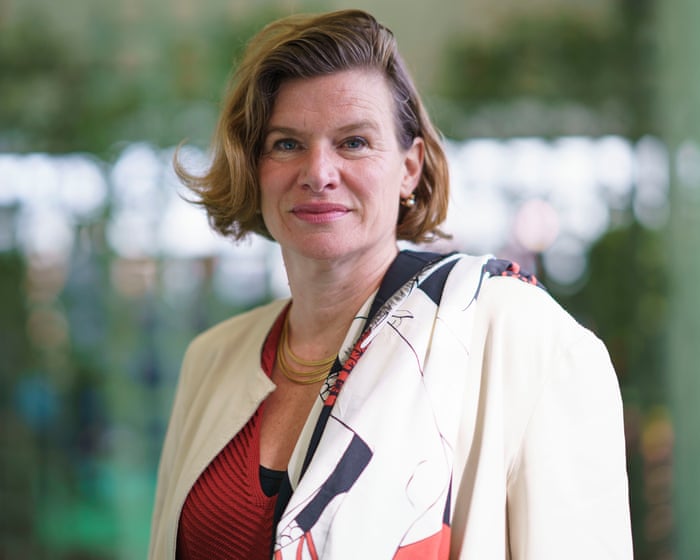
If this sounds like a critique of what went wrong with Keir Starmer’s government, it’s also much more than that. Mariana Mazzucato, a professor in the economics of innovation and public value at University College London, is a world-renowned economist, advisor to governments, chair of international commissions, prolific author, and PhD supervisor to at least one poet. She was the thinker who inspired Starmer to shape his political project around five key “missions,” now largely forgotten amid the scandals, U-turns, and infighting that have plagued his premiership.
Her judgment on Labour, and its lack of clear direction, is harsh. “Fine, come in, say the Tories were terrible, but once you’ve said it, move on!” she exclaims from the sunny garden of her north London home. “You’ve got five years, so what’s your plan? What’s the positive story? It was always half-baked … [now] it’s half-assed.”
But while Mazzucato is horrified at what Starmer’s government has become, her focus is global. In her new book, The Common Good Economy: A New Compass, she aims for nothing less than a remake of economic theory and government practice, centered on a new set of purposes that would tackle the global scourge of inequality and the existential threat of the climate and nature crises. Current economic models have failed us. She argues that the world needs to rediscover the idea of the common good—our shared fate that depends on fairly nurturing the bounty of our only planet.
To do that, governments need, in Mazzucato’s blunt words, to “get their mojo back.” Far from being passive fixers at the mercy of market economies, as the neoliberal consensus would have it, they are actually the supreme actors, shapers of markets, and arbiters of the economy. They need to start believing they can govern, wield their power without apology, and stop cowering in the face of bond markets.
“If there’s no purpose or direction, then what the hell are we doing? And who sets that purpose? It has to be co-created through real participation, not just tokenism,” she says. “We need an objective-oriented economy, where how we all relate to each other matters as much as what we’re doing.”
As for paying for it? “There’s plenty of money, it’s just not directed toward anything, and government is part of the problem.”
It’s thrilling, at a time when global problems seem too big to solve or too frightening to think about, to be told that governments hold such power.
“The reason I’m hopeful is that all of this is possible,” says Mazzucato. “You need a happy narrative for the common good that would inspire young people. Like the Artemis mission going to the moon—it doesn’t have to be space, but really ambitious missions make people dream. They’re all looking up at the sky.”
The common good went missing from political discourse in the early 1980s. Under Reagan-Thatcherism, people became consumers instead of citizens, “customers” on transport rather than “passengers,” clients of social services rather than families. Governments recast themselves as administrators, focused on efficiency.The focus shifted to efficiency and cost-cutting instead of civic well-being, and governments adopted business-school models of treating people like customers rather than caring for them as citizens.
This was supposed to bring private-sector discipline and efficiency. Instead, it cheapened the public sphere. Mazzucato has already written about the disasters that happen when governments stop actually governing. In her 2013 book, The Entrepreneurial State, she challenged the neoliberal idea that only the private sector can innovate, showing that economic success comes just as much from the public sector as from industry leaders. (One ironic example: the internet—the ultimate power source for libertarian tech billionaires—started as a government project.)
In The Big Con, published in 2023, Mazzucato and co-author Rosie Collington revealed how governments’ reliance on consultants “weakens our businesses, infantilises our governments and warps our economies.”
These are the kinds of messages that might appeal to Labour’s likely next leader, Andy Burnham. But will they scare the bond markets? “I don’t know any government in the global north that has ever been penalised by the bond markets for a smart strategic investment strategy,” says Mazzucato. “Liz Truss wasn’t penalised for that—she was penalised for having the most idiotic tax policy ever. It had nothing to do with investment.”
Governments need to “stop cringing in the face of the bond markets,” says Mazzucato.
Mazzucato may technically be an economist, but she draws ideas from everywhere—biology, Indigenous knowledge, and even how carnivals can help build a more creative common-good economy. This helps her see things differently.
Most economists have thought about the climate—when they’ve thought about it at all—in terms of a kind of planetary balance sheet of credits and debits, where environmental goods offset environmental harms.
In a common-good economy, it’s a goal we design and work on together.
Some activities—burning fossil fuels, over-extracting water, logging forests—have harmful effects on the natural world. These are called “externalities,” problems that exist outside the system of goods that the market puts a price on. Because the market doesn’t explicitly value “public goods” like clean air, clean water, or a livable climate, they aren’t taken into account. That’s a market failure, and market failures are supposed to be fixed with market methods—like pricing in the externalities by putting a tax on carbon.
This also fits with how economists have been trained for decades to see the climate crisis: as an example of the “tragedy of the commons.” Anyone can pollute the atmosphere, just as anyone can exploit common land, and no one bears direct individual responsibility for the harm. So fossil fuel companies keep making money while the planet burns.
According to Mazzucato, these ways of thinking get the problem backwards. “In the old economics, doing good is a correction,” she says in her latest book. “In an economics of the common good, it is an objective we design and work on together.”
Other radical economists, facing the same issues, have argued for abandoning the capitalist and “extractivist” obsession with endless economic growth altogether. The “degrowth” and “post-growth” movements have gained support, with proponents arguing that on a planet with finite resources, reducing production and consumption is necessary.Innovation is the only rational and possible way forward.
Yet Mazzucato firmly places her ideas within a capitalist framework. “The problem isn’t growth,” she says, “it’s that we’ve been growing in the wrong way.” And if the climate crisis can’t be solved within capitalist systems, as some argue, then “we should all go to bed and not wake up,” she adds. That’s because the kind of revolutionary political changes needed would take too long to prevent catastrophic warming.
Still, there’s mutual respect among these radical economists, and they essentially share the same goal: a more equal, functioning society and economy that saves the planet from ecological disaster. This is especially important when their real enemies—populist politicians who care about neither goal—are gaining so much power.
Mazzucato is careful to distinguish between her idea of the common good and what economists call public goods. Public goods are services that, in economic terms, are non-excludable (people can’t easily be kept from using them) and non-rivalrous (one person’s use doesn’t reduce what’s available for others). “Public goods are just fixes for what the private sector won’t do,” she writes. “The common good, however, is a shared objective.” She also warns governments that “pre-distribution”—making sure citizens get a fair share of state investments from the start—is better than trying to redistribute through taxes and benefits.
Beneath the hard economics and deep discussions of Aristotle and Adam Smith, her ideas come down to simple goals that shine through in her lively conversations: human flourishing and joy. She speaks passionately about self-expression and creativity. “We unfortunately talk too much to economists, too little to poets,” she says. She gets even more excited talking about swimming and football. Her beloved Arsenal won the Premier League just before our interview, sparking a spontaneous gathering at the team’s north London stadium, which she saw as an outpouring of community spirit. For Mazzucato, if we’re going to save ourselves, it will happen in public places—in the fun of carnivals, in community spaces where the common good is expressed, even if not always spoken.
She points to work in Camden, north London, where food banks are being turned into food cooperatives. People pool resources to buy food in bulk at lower prices. “Just look at the facial expressions I’ve seen in women—it’s mainly women who use it. There’s a Somali women’s food cooperative near here where they just feel good. Compare that to people walking into a food bank—they don’t feel good. It goes straight to our human soul.” Community involvement isn’t just essential to the common good; it is the common good. “The reason I wrote the book isn’t just academic. I truly believe people want that involvement. It makes them feel better about themselves. It’s joyful.”
Only being with other people can bring that kind of joy. Right-wing governments in the UK and around the world, focused on cutting costs and shrinking the public sphere in favor of private provision, have neglected—and in some cases destroyed—community spaces and the communities themselves. Shared spaces, Mazzucato makes clear in her book, are at the heart of any idea of the common good. “It’s about investing in those collective structures,” she says.
Arsenal FC also runs children’s football teams and training sessions around north London—an example of the common good in action. “My kids all used to play at nearby pitches,” she says.She says, “I used to go there on Friday nights, and I’d almost cry. You’d see hundreds of kids with their parents, many from the local housing estates, and I’d think, imagine if this was normal, imagine if this was everywhere—people having a place to go. It wouldn’t solve crime completely, but I honestly believe that if you invested heavily in things like soccer fields, public libraries, and public pools, and made them beautiful, you’d see better health, less crime, and lower costs for the state. We shouldn’t just do it because it’s good for people—which is reason enough—but ultimately, it also saves you money.”
Frequently Asked Questions
Here is a list of FAQs about building an economy that works for everyone based on the concept of Make People Dream
BeginnerLevel Questions
1 What does Make People Dream actually mean
It means creating an economy that gives everyone a real chance to build a better life Its not just about money its about hope purpose and feeling like you have a stake in the future
2 How is this different from the economy we have now
Right now the economy often feels like its designed to make the rich richer This approach focuses on sharing the wealth protecting the planet and making sure basic needs like housing healthcare and good jobs are available to everyone
3 Who is this economy for everyone supposed to help
Everyone It helps the worker who wants a fair wage the small business owner who cant compete with giants the young person drowning in student debt and the retiree who cant afford to stop working
4 Whats the first step to building this kind of economy
The first step is changing the goal Instead of measuring success by how much the stock market grows we start measuring it by how well people are doingthings like life expectancy happiness and access to education
5 Can you give a simple example of this working
Yes Think of a city that invests in free public transit and affordable housing near job centers That makes it easier for a single parent to get to work and save money Thats a small piece of an economy that works for everyone
Intermediate Advanced Questions
6 How do you fix the problem of trickledown economics not working
Instead of hoping wealth trickles down you build from the ground up This means things like raising the minimum wage taxing extreme wealth and giving workers ownership in the companies they work for
7 What about inflation Wont higher wages just make everything more expensive
Not if you also control corporate pricegouging and invest in local production When money goes into the hands of low and middleincome people they spend it locally which grows the economy Inflation happens when a few people have too much money or when supply chains break
8 How do you pay for things like free college or universal healthcare
Primarily by