When Danielle Gillam-Kirton’s parents, Pete and Fran Gillam, were killed in the wildfires in Spain in July, she thought her nightmare couldn’t get any worse. The much-loved couple had built their home in Bédar, in Almería, after retiring, and had become part of a close community. Fran, a former headteacher, loved organizing quiz nights to raise money for the local school, and the couple enjoyed playing padel at a nearby sports club.
Spanish police told Gillam-Kirton that the car her parents died in had been “inspected meticulously” and no belongings were found. But Gillam-Kirton, an assistant headteacher from Nottinghamshire, was sure her parents must have been wearing their wedding rings when they died. She was invited to search the vehicle herself, which was parked in a police compound in Mojácar. “You won’t find anything,” she was told.
Fran Gillam with her daughter Danielle Gillam-Kirton. Photograph: Danielle Kirton
She describes crying out in shock when she looked through the door of the burnt-out car. On the front seats were what appeared to be a human hip bone. “I honestly can’t describe what that felt like. I remember staring at what was in my hand, and the slow realization of what I thought I was looking at hit me. I shouted out in shock,” she says.
Map
She and her partner searched the car and found more bones, which appeared to be the remains of the couple. They also found her parents’ mobile phones, sets of keys, jewellery, money, and other personal items.
The Gillams were among 14 people killed in the fires, including Belgian, French, American, and Spanish nationals. Some of the bereaved families are now searching for answers and claim the Bédar authorities have mishandled the investigation into their deaths.
View image in fullscreen
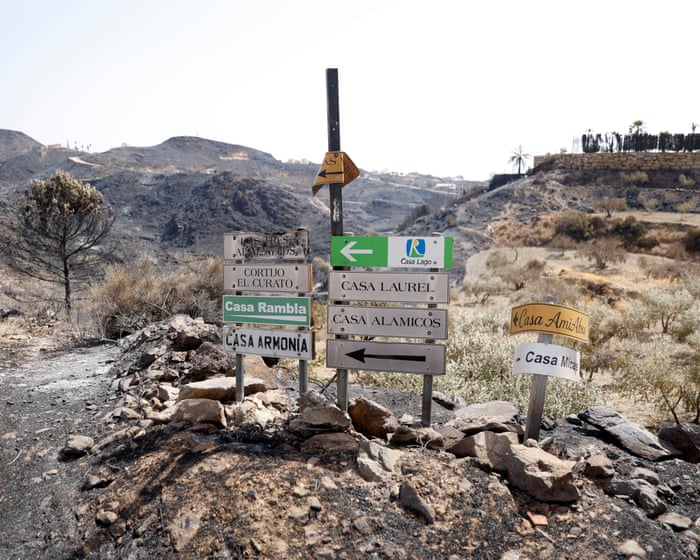
The names of villas amid Bédar’s burnt landscape. Photograph: Jorge Guerrero/AFP/Getty Images
There has already been a funeral for the Gillams. “It makes you wonder: who or what did we cremate?” Gillam-Kirton says. She is demanding answers from the Spanish government and asking the UK Foreign Office to hold the authorities accountable.
The bones she found have been sent for DNA testing after weeks of delay from the Bédar local authority. Forensic scientists who have looked at pictures of the bones have told Gillam-Kirton they appear to be human.
“The whole sequence is incredibly difficult to understand. We were told there was nothing left, and yet when we were finally able to look ourselves, we found significant personal belongings and what appeared to be human remains,” she says.
“We were initially told it was probably animal remains.” She says she had to push the Spanish authorities to send them off for DNA testing. “The bones were big. I can’t see how a large animal like a cow would have climbed into the passenger seat of the vehicle during a fire.”
View image in fullscreen
A Bédar house after July’s wildfires. Photograph: Ana Beltran/Reuters
Gillam-Kirton says she helped another family who were told their loved ones died while trying to escape the fires on foot and that their remains had been cleared by a forensic team. She arranged for a search party – including a police officer and one of the victim’s relatives – to travel to the hillside where they died. There they found what appeared to be human bones lying in plain view along with various personal belongings.
“These were people who were caught in the same horrific fire as my mum and dad,” she says. “They lost their lives in terrifying circumstances and they deserved dignity and respect, in the way they were treated at the time and afterwards. And for us and the other families, those personal belongings aren’t just objects. They’re the last physical things connecting us to the people we have lost.”
Pete Gillam with Danielle Gillam-Kirton (right). Photograph: Danielle Kirton
Gillam-Kirton has previously criticized the Spanish authorities for failing to alert her parents’ family and friends in time.Residents were warned about the fire in time. Although the fire alert came at 4.30pm, the evacuation order didn’t arrive until three hours later, and it was delivered by a single police officer who was “frantically driving from house to house.” Thirteen people from the Gillams’ village lost their lives.
Gillam-Kirton says she wants the UK government to “keep pressing the Spanish authorities for proper answers.” She adds: “Eight British people died in this fire, including my mum and dad, so I think it’s really important that the UK government continues to take an interest in what happened. After all, we’re talking about how British nationals are treated – both those who died and those who survived.”
She and the other families are asking the Spanish authorities for “a proper, thorough, and transparent investigation … and I mean the whole thing, not just what caused the fire, but what happened during the emergency response, what warnings were given, when they were given, who received them, what evacuation plans were in place, and what happened to the victims afterwards.”
At first, the Spanish authorities blamed the victims for not understanding or following evacuation instructions. However, it later came to light that no such instructions were ever given.
“That’s one of the things we’ve found hardest,” Gillam-Kirton says of the police response. “At the beginning, there seemed to be a lot of focus on the idea that the victims had ignored instructions or hadn’t evacuated when they were told to. That was incredibly painful for us. And now, months later, we’re still asking basic questions.”
She adds: “That, along with what seems to us to have been a lack of proper search-and-preserve procedures at the scene, has left us feeling that there’s been a real lack of empathy towards the victims and their families.”
The families hope that if there’s a proper investigation into their relatives’ deaths and how the authorities behaved afterwards, others won’t have to go through the unbearable situation they’ve faced.
“Wildfires are becoming more frequent and more severe, and communities will face these situations again,” Gillam-Kirton says. “There will be another fire somewhere, and there will be other people who need to be evacuated.”
“If you don’t properly investigate something, you can’t learn from it. We don’t want Mum and Dad to just become two names on a list of people who died in a wildfire. We want to understand what happened to them, and if something went wrong, we want the lessons to be learned.”
The Foreign Office said that any investigations are the responsibility of the Spanish authorities. A spokesperson said: “We are supporting the family of a British couple who died in Spain, and our thoughts are with those affected by the devastating wildfires.”
The Bédar local government has been contacted for comment.
Frequently Asked Questions
Here is a list of FAQs based on the scenario you provided ranging from basic questions to more complex legal and emotional ones
General Emotional Questions
1 If the bones werent the victims whose ashes were the family given
Answer That is the exact horror of this situation It means the family likely received ashes from someone elsepossibly another cremation that took place at the same facility around the same time or in rare cases industrial materials or cement dust that got mixed in It is essentially a case of misidentification
2 How can a crematorium mix up remains
Answer It usually happens due to human error or gross negligence If proper tracking protocols arent followed or if the cremation chamber is cleaned improperly between bodies bone fragments and ashes from a previous person can be left behind and mixed with the next persons remains
3 What are the bones found in the car Are they actual bones
Answer Yes they are actual bone fragments During cremation the body is burned at extreme heat but the skeleton doesnt turn to dust After the burn the remaining bone fragments are collected and ground into a fine powder If these fragments were found intact in the car it suggests they were not ground down properly or were swept up and discarded incorrectly
4 I thought cremation destroyed everything How are bones left over
Answer Fire burns soft tissue but bone is mineralized and very hard It takes a specialized machine called a cremulator to crush the remaining bone fragments into the fine ash we expect If bones are found intact it means the cremulation step was skipped or failed and the large pieces were simply thrown out with the trash
5 Why would a daughter find these bones in the car of the deceased
Answer This suggests the crematorium or funeral home disposed of the waste in a highly unprofessional wayperhaps putting them in a bag with the deceaseds belongings or leaving them in the vehicle that transported the body rather than placing them in the urn
Investigative Legal Questions
6 Is it possible the bones belong to an animal or are just medical implants