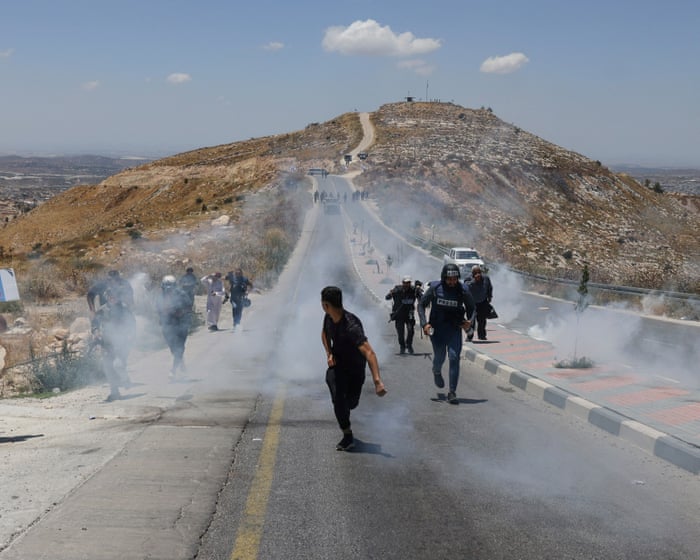
The UK foreign secretary, Ed Miliband, has said that Israeli “terrorists” are carrying out ethnic cleansing in the West Bank with the government’s quiet support. He announced wide-ranging sanctions on trade with Israeli settlements, joined by France and Canada.
In the strongest criticism ever made by the UK government, Miliband said it would now officially view Israel’s occupation of the West Bank as entirely unlawful. He said this recognition was “the least the people who face such suffering deserve. And it should be the prelude to justice.”
Miliband said the government would now introduce:
– A ban on importing goods from illegal settlements in the occupied territories.
– A full sanctions system against providing services like construction or financing for Israeli settlements.
– A ban on advertising illegal settlement properties in the UK.
– Personal sanctions against key individuals accused of encouraging settler violence.
– A new ban on arms licenses and other exports that “materially contribute to the occupation.”
The UK is one of 12 countries that said on Tuesday they would impose these sanctions on trade with Israeli settlements in the West Bank. The others are Canada, Denmark, Finland, France, Iceland, Ireland, Norway, Poland, Portugal, Spain, and Sweden.
Miliband said the action would show that “Britain is not silent in the face of deep injustice and nor is it powerless.” In an emotional speech, he described the suffering he had heard about from Palestinians in the West Bank whose homes were destroyed, and from doctors in Gaza who had seen children die while waiting for medical treatment.
The UK’s actions have become more urgent because of Israel’s plans to expand the E1 settlement project east of Jerusalem. This could effectively cut off the north of the West Bank from the south, threatening the possibility of any future Palestinian state.
Miliband said those who financed or helped illegal settlements would “face the full force of UK sanctions.” He expected the laws to enforce the trade ban and sanctions to be in place within nine months.
He did not go so far as to call Israel’s actions in Gaza a genocide, saying the UK would wait for the international courts to decide.
Speaking in the Commons on Tuesday, Miliband said: “The British government agrees that there is ethnic cleansing of Palestinians in areas of the West Bank, perpetrated by settler terrorists.”
He added: “All too often the Israeli government has turned a blind eye to this and worse, members of it have made statements and taken actions to support the forced displacement of Palestinians. I recognize the gravity of saying this, but the truth is the least the people who face such suffering deserve. And it should be the prelude to justice.”
He said the British government had previously called the settlements illegal but had not described the occupation itself as unlawful, and that would now change.
Miliband said he was taking this action as foreign secretary but also as a “proud British Jew” with relatives who had found safety in Israel after the Holocaust.
“I am proud of my Jewishness and unwavering in my support for the state of Israel,” he said.
“And there is absolutely no contradiction between this and my support for the state of Palestine. Indeed, quite the opposite. The two-state solution is based on an explicit belief that the only route to security for both peoples is to live side by side in peaceful coexistence with freedom, security and self-determination.”
He said that to respond to threats against Jews around the world, the UK would also impose sanctions on Lebanese Hezbollah’s financing arm, Al-Qard al-Hassan, and reimpose major economic sanctions on Iran, matching the EU and US.
Miliband said he felt a “deep sense of shame about what has unfolded.”In Palestine, under the watch of the international community, there has been unimaginable trauma and suffering over the past three years—death, destruction, and dehumanization on an appalling scale. The foreign secretary said this action marks the start of a new approach toward Israel and Palestine, one that not only condemns but also takes concrete steps.
“Our argument is not with the people of Israel, with whom the UK shares unbreakable bonds. Our argument is with the conduct of its government.”
A far-right Israeli minister has outlined a plan for the removal of all Palestinians from Gaza. Read more.
Miliband noted that the Israeli government’s actions in the West Bank have led to more settlements being approved in the last four years than in the previous 20 years combined. He believes most British people would support banning trade with illegal settlements. “Settlements are illegal. They should not be promoted in our country,” he said.
He acknowledged concerns about arms sales to Israel. The UK had already suspended over 30 arms licenses used by the IDF in Gaza, but would now go further. “We will now also refuse all license applications for arms and other exports that significantly contribute to the occupation, effectively creating a double lock against arms sales. This means the ban on such exports will stay in place as long as the occupation continues.”
He said the UK would support “full, robust, and fair judicial processes” to determine whether Israel has committed genocide, and the government would not prejudge that process. “This has been the case for all genocides since the 1948 genocide convention: Rwanda, Srebrenica, Cambodia, and acts against the Yazidi people. This will remain our policy. It is right that this issue has been brought before the ICJ, and I want to make clear that we support the court in reaching its decision.”
However, he noted that recent reports from international bodies found “increasing evidence that war crimes appear to have been committed, and we support legal processes to determine this.” The UK would use the UN General Assembly next week to “shine the clearest and harshest spotlight on what is happening and what must change.”
Speaking in the chamber, Miliband said the UK “should have acted earlier” to formally recognize the illegality of the occupation, and seemed to suggest it had been delayed under Keir Starmer. “It has taken the new prime minister to come in and recognize the gravity of the situation, to recognize the degree of public concern,” he told MPs.
Shadow foreign secretary Tom Tugendhat said “illegal settlements are wrong,” but accused the government of “enacting policies that the Foreign Office knows won’t work—but it does know they will harm innocents.” He warned of the risk of harming Palestinians who work in the West Bank, noting that “the economies of Palestine and Israel are too interconnected” for a ban on goods from illegal settlements to be effective.
However, veteran Conservative MP Sir Edward Leigh fully backed the sanctions. “I am proud to say, as the longest-serving member of the Conservative Friends of Israel, that I absolutely and fully support what he is doing today because it is about standing up for freedom, morality, and justice for all people in this world,” he said.
The steps outlined by Miliband fall short of the full demands made by Palestinian advocacy groups, but they signal that the UK is moving beyond traditional rhetorical support for a two-state solution toward active measures to prevent the expansion of illegal settlements in the West Bank.
Prime Minister Andy Burnham spoke with Donald Trump and key Gulf allies, such as Qatar, on Monday to brief them on the government’s plans in the region. Both the US and Israel have threatened retaliation against Britain for the sanctions. The US ambassador to Israel, Mick Huckabee,The US said it was weighing its options and warned that it might restrict the UK from trading with several US states that have laws against boycotting Israel. Israel’s president, Isaac Herzog, called it “a gross interference in the democratic elections of a sovereign nation” ahead of the country’s elections in October. Israel’s foreign minister, Gideon Saar, warned, “If Britain acts against Israel, Israel will act against Britain,” while finance minister Bezalel Smotrich called for the British ambassador to be expelled.
Frequently Asked Questions
Here is a list of FAQs based on the statement provided The questions are designed to clarify the terminology the political context and the factual basis of the claim
General Definitions
Q What does ethnic cleansing actually mean in this context
A It refers to the deliberate attempt to remove a specific ethnic or religious group from a specific area through force intimidation or violence In this context it means forcing Palestinian communities out of their homes and land in the West Bank to make way for Israeli settlers
Q Is the UK government officially calling Israeli citizens terrorists
A No The statement you are referring to is a specific accusation made by UK officials against individuals and groups involved in settler violence It does not label the State of Israel or the Israeli military as a whole as terrorist The accusation specifically targets extremist settlers and the government support they receive
Q What is the difference between Israel and the settlers mentioned here
A Israel is the sovereign state Settlers are Israeli citizens who live in the West Bankterritory occupied by Israel since 1967 but not officially part of the State of Israel The accusation is that the government supports these settlers but the terrorist label is aimed at the violent actions of specific settler groups
Q Does with support from the government mean the UK is accusing the Israeli Prime Minister of committing crimes
A The accusation implies that the Israeli government provides legal financial and military protection to the settlers who commit these acts It suggests that the government enables the violence by failing to stop it and by expanding settlements but it stops short of saying the Prime Minister personally carries out the violence
The UKs Role and Accusations
Q Why is the UK making this accusation
A The UK considers Israeli settlements in the West Bank illegal under international law The UK statement appears to be a response to a sharp increase in settler violence against Palestinian villages which the UK views as a threat to a future twostate solution
Q Is this a legal ruling that will lead to sanctions