Two events are coming up that will shape how I feel about Germany. One will be all over the news and is grim and unsettling. The other will go unnoticed by everyone except me and my close family, and it should have been a source of joy—but now that joy is mixed with confusion.
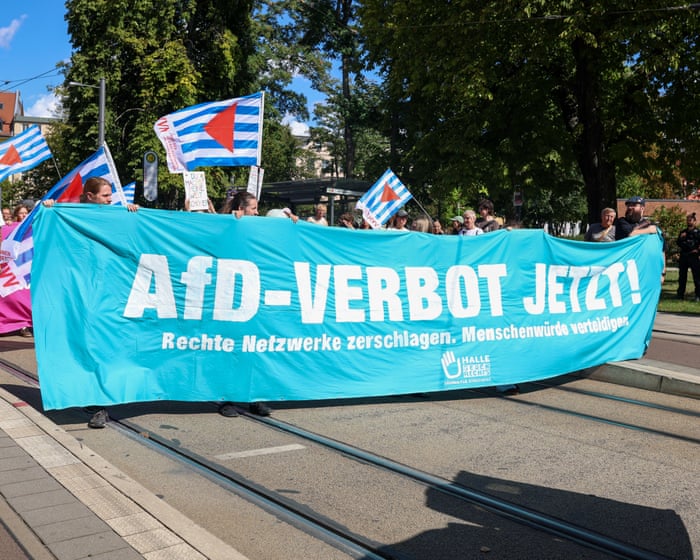
On September 6th, voters in the small eastern state of Saxony-Anhalt are expected to hand a decisive win to the far-right party Alternative for Germany (AfD). If the numbers line up a certain way, a far-right party could take power in Germany for the first time since the Nazis. It’s possible the AfD could just miss out, depending on whether enough centrist parties clear the 5% threshold to enter parliament. If they do, the usual mix of center-right to center-left parties might patch together a shaky coalition.
Two days after that election, I’ll mark five years as a German citizen. I still remember the pride I felt back in 2021. For most Brits scrambling to get a passport from an EU country, it was about winning back the freedom to move around. For me, it was that too, but it was also deeply emotional, just as it is now. My father was Jewish and German-speaking, so I’d always felt there was unfinished business between me and Germany. As a young newspaper correspondent in East Berlin from 1988 to 1990, I’d covered the peaceful revolution that brought down the Wall and led to reunification, and I’d admired it. In the years after, I was drawn to a Germany that took its duty to liberal democracy seriously. I respected the calm, serious tone of German society, the way its politics leaned on consensus, and its focus on community. Later, I compared that to the UK after Brexit—which my German friends used to call “clown country.” I felt ashamed of Britain.
When my book Why the Germans Do It Better came out in 2020, many Germans seemed puzzled. On the main morning radio show, Deutschlandfunk, the host kept asking me, “How could you possibly write that?” I’ve rarely met Germans who have much good to say about their own country, even when things were going well. In recent years, with economic stagnation and shaky mainstream governments, that tendency toward gloom has only grown.
Some of that gloom is fair. The AfD sits at the far edge of Europe’s right-wing groups, and in Saxony-Anhalt and nearby Thuringia, its organization has been officially labeled extremist by domestic intelligence. Its promises around “remigration,” its downplaying of Nazi history, and its friendliness toward the Kremlin are just three of many worrying stances. It’s also a favorite of the Trump administration, which in its national security strategy pledged to back “patriotic” parties across Europe to help prevent “civilisational erasure.”
The fallout from its rise is already visible. The coalition of center-right Christian Democrats and Social Democrats is fractious, and its reform plans—from pensions to healthcare to welfare—are stumbling and delayed. Friedrich Merz is widely seen as a chancellor on his last legs, yet his likely successor, Hendrik Wüst, the premier of the most populous state, North Rhine-Westphalia, is hesitant to take over at such a bleak moment. The problems go beyond the makeup or policies of the current government (or the one before it under Olaf Scholz). Many traits of postwar Germany that were long praised as strengths—coalitions, consensus, compromise—are now being attacked.
Public opinion is further poisoned by disinformation, fueled by the Kremlin and Silicon Valley. Merz’s disappointing time in office and his often sharp manner would, in an earlier media environment, have drawn strong criticism; now the tone ranges from contempt to outright hostility.
So how do I justify my continued, if battered, optimism? In the short term, the best we can hope for is that the existing order survives: the AfD just barely held off (I’d put that at 50/50) in Saxony-Anhalt and in other upcoming regional votes.Elections alone are just a temporary fix. In the long run, what we really need is a more aggressive approach to policy from the political center—a willingness to be bolder and take more risks, rather than just offering vague calls for democracy.
Germany was dismissed as the “sick man of Europe” in the late 1990s, only to go on and restructure its economy. It was widely seen as a paralyzed pacifist, yet within just a few years, it raised defense spending from barely 1% of GDP to over 3.5% by 2029—far ahead of the UK. Public opinion has been remarkably strong in backing this increase, though much less so in the former Communist east. The sacrifices are huge: hospitals and schools could really use that money. But a lively public debate has shifted how people see the threat from Russia. That takes courage, and we need more of it.
My home state is about to hand a major victory to the German far right. It’s a disaster that’s been building for decades.
The AfD is dominating the conversation, and for good reason—positive stories often go unreported because they don’t fit the narrative of unstoppable decline. After fifteen years of underinvestment in infrastructure, a massive half-trillion-euro spending push is starting to show results. A strong engineering base is being shifted into new fields like aeronautics.
Above all, in so many areas, community ties and solidarity remain strong. I’m reminded of something President Frank-Walter Steinmeier said five years ago about the good Germany: “The alien, the different, the new are not rejected or excluded; they are curiously and hungrily embraced and absorbed.”
Various surveys show public concern about democratic backsliding, paired with a determination to strengthen it, especially among the young. With the AfD at the door, the far right on the rise in France and across Europe, and still not fully defeated in Britain, Germany faces a choice—to give in to these forces, or to find in tough times a commitment to something better.
John Kampfner is a Berlin-based author and broadcaster. His latest book, Braver New World, is published by Atlantic.
Frequently Asked Questions
Here is a list of FAQs based on the articles themes written in a natural tone with clear answers
BeginnerLevel Questions
1 What is the AfD and why is it a big deal in Germany
The AfD is a farright political party in Germany Its a big deal because it has gained significant support recently and some of its members hold extreme views about immigration and German identity Many people are worried because its the first time in decades that a party with such radical ideas has become this popular since World War II
2 Why does the author say the shadow of the AfD looms over democracy
The author means that the AfDs rise is creating a feeling of fear and uncertainty Its like a dark cloud hanging over the country The partys success challenges the traditional democratic parties and makes people worry about whether the country will stay tolerant and open or become more nationalist and exclusive
3 What does it mean to believe in an adopted country
It means having faith and trust in the country you chose to live in not the one you were born in For the author it means believing that Germanys core valueslike human dignity freedom and democracyare strong enough to withstand the current political pressure from the far right
4 Is the author scared of the AfD
Yes the author is clearly worried They describe the situation as serious and unsettling However they are not giving up They are using their fear as a reason to speak up and defend the democratic values they believe in
Advanced Questions
5 What specific events or policies made the author feel the shadow more intensely
The article points to the AfDs electoral successes in eastern Germany and the increasing normalization of farright rhetoric in everyday political debate The author is particularly alarmed by the partys plans to deport millions of immigrants and its questioning of Germanys historical guilt for the Holocaust which the author sees as a direct attack on the countrys postwar identity
6 How does the author reconcile their worry about the AfD with their love for Germany
The author separates the German state and its people from the current political trend They love the