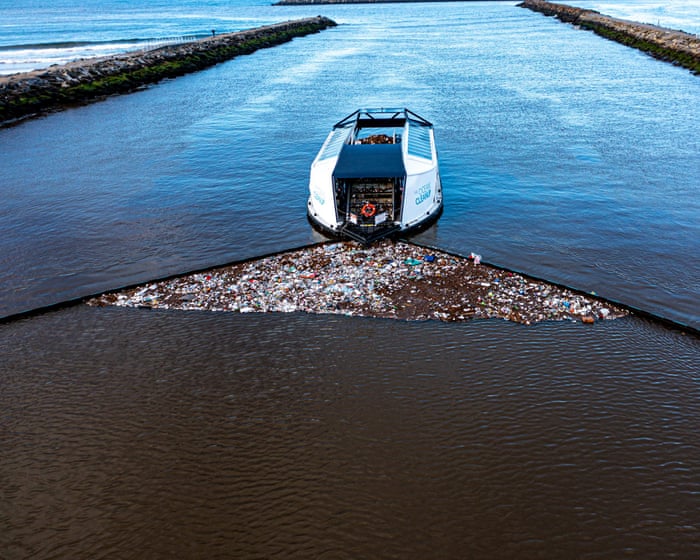
On a cloudy June morning, I step out of a rubber-sided Zodiac boat onto a floating barge at the mouth of Ballona Creek, where it meets Santa Monica Bay on the west side of Los Angeles. The first thing I notice? The only smell is salty air—despite six giant waste bins sitting on the barge, which is about the size of a tennis court.
The setup is actually two barges: a smaller platform sits inside the larger one. A floating barrier guides trash into the device, where a conveyor belt scoops it up. An automated shuttle then sorts the waste into six dumpsters on a separate barge and sends an alert to the crew when one is full. Above, solar panels form the ceiling, and a slow-moving conveyor belt drops bits of plastic and waste into each bin. The whole system can hold about 20,000 pounds (9,070 kilograms) of trash—the same as a fully loaded truck.
Since it’s the dry season in LA, not much waste is being washed down the river by rain. But I can still see the problems: polystyrene takeout containers, noodle cups, bottle caps, a yellow pencil, and a palm frond dotted with colorful bits of microplastics. All of them are caught on the boat’s conveyor belt. It’s a pretty typical mix, says James Patterson, operations manager for the nonprofit Ocean Cleanup, which created the system. “You get a wide variety of basic plastics—lots of bottles, cups, to-go containers, things from restaurants. That’s what we usually see out here,” he says.
Once the waste is pulled out, it’s sorted and sent to disposal facilities. “We want to make sure that from start to finish, we’re pulling the trash out responsibly and that it’s sorted or stored in a responsible way,” Patterson says. “We don’t want a circular trash problem here.”
This particular barge is a model for others being deployed around the world. Ocean Cleanup operates in 10 locations with 21 Interceptor systems—in countries like Malaysia, Indonesia, Vietnam, Guatemala, Jamaica, and the Dominican Republic. The goal is to clean up the 30 most polluted cities by 2030.
The big idea? Stop waste from ever reaching the ocean. “Instead of focusing on specific rivers, the goal is to clean up an entire area, because that’s how you make a real impact on society and the environment,” Patterson says.
In this creek—the end of a 130-square-mile urban drainage network in LA County—the boat stopped 143,710 pounds of trash from entering the ocean in 2025. Ocean Cleanup plans to launch two more boats in the LA area, on the San Gabriel River and the Los Angeles River. It’s already making a difference for coastal communities, Patterson says. Beach cities south of the project have lowered their budgets for beach grooming: there’s simply less waste on the sand, so they don’t need to clean as often.
Ocean Cleanup’s founder, Dutch inventor and entrepreneur Boyan Slat, was originally inspired to use technology to fight the Great Pacific Garbage Patch. He created skimming technologies that can scoop a soupy mix of waste off the water’s surface. But as they researched solutions, the nonprofit shifted focus to rivers—the pathways that carry trash into the world’s oceans.
Rivers are key. Ocean Cleanup’s research shows that just 1,000 of the world’s rivers are responsible for nearly 80% of plastic entering the ocean, and 90% of all ocean pollution comes from rivers. “We have to turn off the tap before we can scoop the ocean, or else we’re just taking out old trash and replacing it with new trash,” Patterson says. “Before you can clean up the Great Pacific Garbage Patch, you really need to stop the source.”
Work on designing the autonomous boat began in 2017, and this pilot project in LA started in 2022. It cost about $1.3 million to design and get permits, and anAn additional $1.5 million was needed to secure the boat and the booms in place. Annual maintenance costs $650,000, and the Interceptor is being provided to LA County for free by The Ocean Cleanup.
It’s not a perfect system. Standing on the barge, I point to a red plastic cup floating on the surface just outside the barrier. Patterson winces. “When something like that gets away, it hurts,” he says. But that cup is an exception. The public works employees agree that large logs are the hardest type of trash to deal with.
[View image in fullscreen: Ocean Cleanup’s boat processing captured waste in Ballona Creek to the west of LA. Photograph: Ocean Cleanup]
Each river needs its own custom setup. “There’s no one-size-fits-all solution,” Patterson says. “Every river behaves differently—where you can set things up, what the local government and permitting timelines look like, and just the natural conditions.”
Patterson adds that the boats rarely have problems with wildlife, except for birds. Seagulls like to sit and poop on the barge, which can corrode the metal.
As we step off the Interceptor and back onto the Zodiac that will take us to shore, I look back at the metal container and remark how simple it all seems: collect the floating trash, hold it for later disposal. From the outside, it looks complicated. “It may seem simple,” Patterson says, “but really, there’s a lot of engineering going on inside these.”
Frequently Asked Questions
Here is a list of FAQs about a solarpowered boat that cleans plastic from the ocean
Beginner Questions
1 What exactly is a solarpowered trasheating boat
Its a boat that uses solar panels for power and has a system to scoop plastic waste out of the water Think of it as a floating selfpowered garbage collector
2 How does it actually eat trash
It doesnt digest it The boat moves forward and a conveyor belt or a scoop at the front lifts floating plastic out of the water and dumps it into a storage bin on board
3 Does it hurt fish or other sea animals
Good designs are built to be safe They move slowly and the scoops are designed to let fish and animals escape However no system is 100 perfect so operators monitor closely
4 How does it get power
The boat is covered in solar panels Sunlight charges batteries which then power the electric motors and the trashcollecting mechanism It can run without burning any fuel
5 Can it clean the entire ocean by itself
No A single boat is small These are designed to work in specific areas like harbors rivers and coastlines where plastic accumulates before it reaches the open ocean They are one tool in a bigger solution
Advanced Questions
6 What happens to the plastic after the boat collects it
The boat stores the trash on board When its full it returns to a dock The plastic is then sorted cleaned and recycled into new products
7 How much trash can one boat collect in a day
It depends on the model and the pollution level Smaller boats can collect a few hundred pounds while larger industrial models can collect several tons per day
8 Can it operate at night or in cloudy weather
Yes The boats batteries store enough energy to run for a few hours in the dark or on overcast days However it relies on recharging during sunny periods to stay operational
9 How do they prevent the boat from just moving the trash around
The boat uses a slow steady forward motion The conveyor belt or scoop lifts the trash