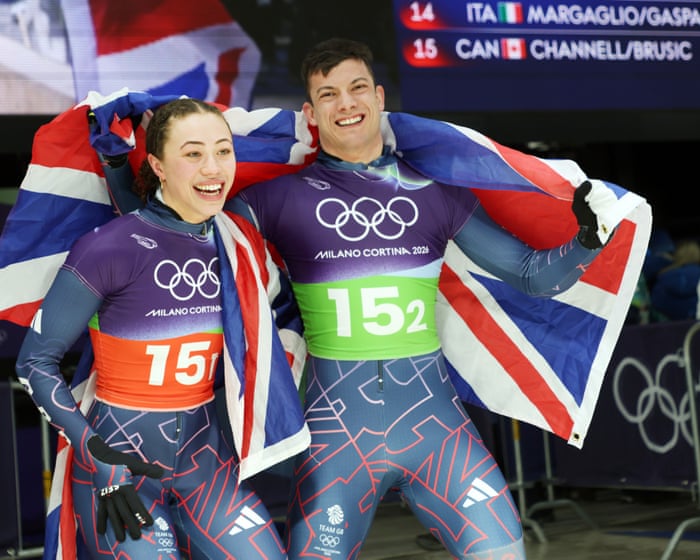
According to the British Bobsleigh and Skeleton Federation, 3,500 people have signed up to audition for their skeleton talent identification program in the past three days. This is an extraordinary surge of interest in a sport that has never been considered particularly accessible.
This surge follows Matt Weston and Tabby Stoecker winning Great Britain’s 10th and 11th Olympic medals in skeleton, continuing a legacy that dates back to 1928. Back then, it was the winter sport of choice for a set of reckless aristocratic adventurers. The 11th Earl of Northesk won bronze ahead of his teammate and the pre-race favorite, Lord Brabazon of Tara. It is quite a legacy. After a century of competition, skeleton is the only Winter Olympic sport where Britain leads the all-time medal table.
This makes sense. Skeleton is, believe it or not, a British invention, even though there is no track or enough snow in the country to dust its hundred or so miles of ski slopes. Like much of modern sport, it owes its origins to the Victorians, who took it up on the natural ice track in St. Moritz when the town was a regular stop on the Grand Tour. In the early 20th century, the speed limit on British roads was capped at 20 mph. If you wanted to go really fast, you needed to get to St. Moritz and the legendary Cresta Run.
At that time, the Cresta Run was the only skeleton venue in the world, which is why the sport was included when the Games were hosted in St. Moritz. The International Olympic Committee decided to make it a regular event starting with the 2002 Games in Salt Lake City. The small British federation secured just enough funding from UK Sport to set up a training base and hire Austrian former world champion Andi Schmid as head coach. This investment paid off when former track athlete Alex Coomber won bronze in the women’s event that year.
Great Britain won two medals at those Games. Because the UK had just introduced performance-related funding, Coomber’s bronze meant the program secured the money needed to build a 140-meter concrete practice track at the University of Bath and establish a talent identification scheme. For years, British sliding sports had relied on the close links between the original Cresta Run set and the armed forces for its athletes—Coomber was a serving RAF member—but now it was opened up to anyone who was fit and willing to try.
This is how Amy Williams, Lizzy Yarnold, Shelley Rudman, Laura Deas, Dom Parsons, Weston, and Stoecker came to the sport. Skeleton is well-suited to this sort of late start. Luge racers go feet first from a seated start, which is considered safer at a younger age, and top racers in that sport have typically been doing it since childhood. A skeleton racer, on the other hand, needs three key attributes.
The first is explosive launching ability. The second is an extraordinary sense of proprioception—the body’s unconscious, eighth sense—that allows them to make tiny steering adjustments to stay on the right line while traveling at 90 mph. Weston developed his through taekwondo, and Stoecker learned hers in circus school.
Here is the awkward part. The third requirement is money. A lot of it comes down to equipment, and Great Britain invests more in this area than almost any other nation. Skeleton got its name because the sled was originally rudimentary, but today the British program is a highly technical endeavor.
UK Sport spent £5.8 million on skeleton during the past Olympic cycle. That money paid for the services of the man widely regarded as the world’s greatest skeleton racer, Latvian six-time world champion Martins Dukurs, and all his proprietary sled technology, as well as cutting-edge sleds, suits, and training tools. This includes a flight simulator.Weston also mentions “the secret stuff” he uses in his training. The funding means, he says, “we operate differently from other nations.” Great Britain can maintain a centralized program that runs all summer.
The German team has a comparable budget and, unlike Great Britain, benefits from four operational ice tracks for practice. They also have €50 million in research and design support, though it is shared among luge, skeleton, and bobsled—sports they completely dominate. However, many other competing nations are surviving on very little.
Skeleton is costly: practicing in the U.S. costs just over $50,000 (£36,600) annually, and many athletes must raise that money themselves through crowdfunding. In Canada, athletes are also relying on charity after funding cuts to their federation.
Some of the men and women competing against the British in Cortina are using old sleds patched together with tape. Since funding for these sports is tied to performance, it creates a vicious cycle: poor results lead to less funding, and less funding leads to worse results.
Money makes a difference. As long as the funding continues, there is likely another British Olympic champion or two among those 3,500 volunteers.
Frequently Asked Questions
Of course Here is a list of FAQs about the article How British skeleton racing sped past the world to win Winter Olympic gold by Andy Bull written in a natural conversational tone
Beginner General Questions
Q What is skeleton racing
A Its a winter sport where an athlete rides a small sled headfirst lying on their stomach down a frozen track at speeds over 80 mph
Q Who won gold for Britain in skeleton
A The article focuses on Lizzy Yarnold who won backtoback Olympic golds in 2014 and 2018 and how the British system was built to create champions like her
Q I thought Britain wasnt a winter sports powerhouse How did they get so good at this
A Thats the key point of the article Britain succeeded through a unique datadriven and secretive program not by having natural ice tracks or a long tradition
Q Whats the main reason for Britains success according to the article
A A revolutionary scientific approach They treated skeleton like Formula 1 using advanced engineering wind tunnels and minute analysis of every aspect of the run to find tiny advantages
Advanced Detailed Questions
Q What was the secret weapon in British skeletons approach
A It wasnt one single thing but a system A major focus was on the start the initial sprint pushing the sled They used cuttingedge technology and biomechanics to optimize push times which set up a faster run down the track
Q Did they have any technological advantages
A Yes They pioneered the use of carbonfibre sleds and spent hundreds of hours testing athletes and equipment in wind tunnels to perfect aerodynamics something other nations were slower to adopt
Q What role did UK Sports National Lottery funding play
A It was crucial Consistent no compromise funding allowed them to build a longterm program hire top engineers and sports scientists and focus on relentless innovation without worrying about shortterm results
Q How did they keep their methods secret from competitors
A They were famously secretive They would cover their sleds with sheets in the finish area use code names for projects and often train separately This secret squirrel culture prevented rivals from copying their innovations