Ray Exworth spent six decades creating one of Britain’s most extraordinary collections of sculpture—and almost no one has seen it. Hidden inside a maze of sheds on a remote smallholding in Cornwall, his vast, obsessive creations have remained locked away from the world, visited only by a lucky few. Even his wife Susie, now 92, was mostly kept out. “I couldn’t visit without an invitation!” she recalls.
Exworth, who died in 2015 at age 84, had only one major exhibition in his lifetime, at the Whitechapel Gallery in 1975. Since then, the man who might rank among Britain’s most notable artists has almost completely disappeared. His works—sprawling, intricate, and wildly ambitious, built from a mix of salvaged materials—have stayed exactly where he left them: filling seven studio sheds and a scattering of shipping containers, unseen.
A new book by photographer Jem Southam, Ray’s Sheds, offers unprecedented access to Exworth’s stunning work for the first time. Southam believes only 20 people have ever seen inside Ray’s sheds. His book is not just a detailed record of an exceptional art practice that might never otherwise be seen, but also a fascinating exploration of what it means to be an artist—and what the purpose of art is—when it’s never publicly displayed.
View image in fullscreen
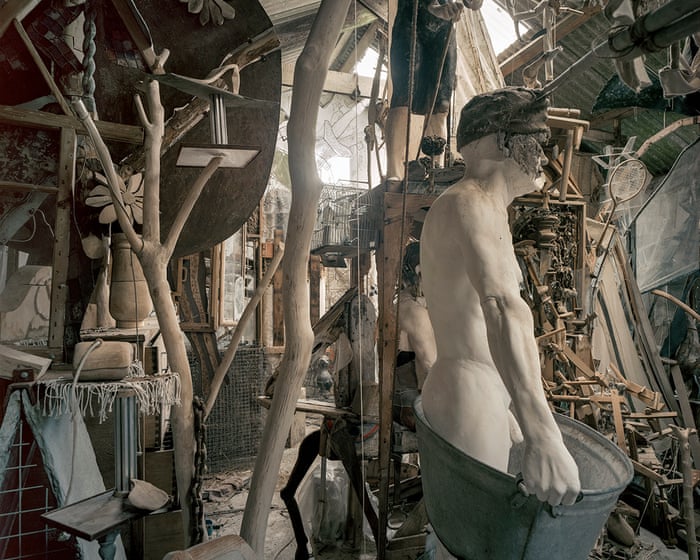
What is the purpose of art when it is never seen … part of The Circus. Photograph: © Jem Southam
Exworth was born in 1930 in Ipswich, the oldest of five brothers. His father, Southam tells me, was a highly skilled but poorly paid sandcaster who also made toys for his sons during the war. “Ray got his wonder at the skill and craft of making things from his father,” Southam says.
The family’s home was hit in a bombing raid and burned down in 1941; then their next home was also bombed. These traumatic wartime experiences left a mark on Exworth—his sculptures return again and again to childhood memories and objects: clowns, dolls, and even the garden at the family home his father rebuilt from scratch once they could return. Exworth made an exact one-to-one replica of the garden from memory, a 60-foot by 30-foot floor sculpture complete with forks, spades, lettuces, flowering roses, and bamboo beanpoles—all made from beaten lead. This work, one of three similarly massive lead pieces by Exworth, doesn’t appear in Southam’s new book—it’s so huge that it’s stored away in a container on the smallholding.
Southam first met Exworth in the 1980s. One day, Southam got a phone call from the artist inviting him to come and photograph his work. “I don’t know how he heard about me, but I went a bit reluctantly to his tiny cottage. He took me through the tangled garden to the first shed—and as soon as the door slid open and I looked inside, like anyone else who has been there, my jaw dropped. What was inside was astonishing. I knew I was in the presence of a remarkable artist.”
View image in fullscreen
‘He found the act of making far more rewarding than presenting’ … a larger-than-life clown. Photograph: © Jem Southam
The first shed Southam saw was known as the circus shed—a space vividly captured in Southam’s photographs in the book. It’s a sculptural environment (Exworth never called them “installations”) stacked and piled from floor to ceiling with pieces made from whatever Exworth could get his hands on—plaster armatures, layered with newspaper and rags, metal, wood, textiles, glass, string, and wax, all refined and finished with ingenuity and skill. Full-size ringmasters, performers, horses, magicians—and a juggler with a frozen cascade of balls in the air—are among the countless figures in this wonderland. For the juggler’s balls, Exworth repurposed steel nails from wooden builders’ pallets, hammering them out and welding them together to create an arch—a painstaking problem-solving process that would haveIt took months. Exworth worked on The Circus six days a week for an entire decade.
According to Southam, Exworth got the idea while working at the Meteorological Office as part of his national service in the RAF. He would regularly pass through Piccadilly Circus, both day and night. “Somehow that turned into a real circus – wherever he started from, his imagination took over.”
Even Susie remembers being “awestruck by his work” the first time she entered the sheds, several years after Exworth began working in them. “I couldn’t connect the man I knew in everyday life with the man he became when he went into the shed to work.” The photographs capture the dim lighting and the depth of the space, offering an unprecedented look at endless piles of works, some still unfinished and partly covered in sheets.
Across the seven sheds, each with its own atmosphere and theme, there are life-sized, realistic figures and animals, as well as miniatures, tableaus made from found objects, ladders, old papers, boxes, buckets, and complex assemblies of shapes and materials – some of which are hard to identify or incomplete. The workshop shed shows the scale and range of Exworth’s technical skill and thinking – everything from drills, jigsaws, sanders, and glass cutters to grinders, putty, and tiny paintbrushes.
He was a true artist. For him, making the work was more rewarding than showing it.
Southam first took 12 photos with a plate camera for Exworth’s grant application. The two became friends, but for the next 30 years, “no matter how much I tried, he would never let me into the sheds with a camera again.”
It was only after Exworth died that Southam asked Susie if he could photograph the work in the sheds to preserve it. The book took 10 years to make. Southam first shot everything he could with a digital camera, which let him squeeze into the tight corners of the packed sheds. “But I wasn’t happy with the pictures because they didn’t really show what it felt like to be inside those spaces, surrounded by the work.” He returned with a huge, 8×10 Victorian-style box camera and tripod, “with an extremely wide, almost strange lens” that allowed him to capture the spaces in a more complete way.
Southam’s book includes about 60 pictures, along with stories of his personal experiences with Ray and in his sheds. There are many more works that Southam couldn’t photograph or didn’t include – like 700 charcoal drawings Exworth made of the pair of blackbirds that visited the couple’s back door every day.
David Heseltine was a longtime friend and former colleague of Exworth’s at Falmouth School of Art, where Exworth was head of sculpture from 1959 to 1974. Heseltine remembers him as “well-read, with an exhaustive knowledge of art history. He found genius and inspiration in Henry Moore and Jacob Epstein, although his creative vision went against the work of many of his contemporaries, who he thought lacked compassion.”
When Exworth eventually quit teaching to focus entirely on his work, he seemed to have few ambitions beyond quietly tinkering alone in his sheds, working on his wild visions – which perhaps took him back to happier times.
“He was reclusive, and although described as irritable to the Arts Council purchasing committee, he was sensitive, compassionate, and deeply interested in people and all aspects of life,” Heseltine says. “He had absolute certainty about his vision, but an amazing humility about what it achieved.”
Ray’s Sheds, Heseltine adds, “is of course much more than an archival record and hugely important to Ray’s legacy.”Since the sculptures are nearly impossible to move, and Ray cared more about creating them than promoting them, this book will be essential for introducing his work to a much larger audience. It will help people recognize his importance, his contribution to 20th-century British art, and establish his rightful place as one of the truly original sculptors of our time.
The book also highlights the unique, unwavering dedication of an artist who focused purely on his craft, without any pretense. “For me, he was a truly genuine artist—always solving problems about how to make things. He was deeply involved in the act of making, and found that far more rewarding than presenting his work. Ray was simply absorbed every day in figuring out how to move forward and create something.”
As for Susie, she still visits the sheds often—because, she says, “there is a strong feeling of Ray’s presence in each one.”
Ray’s Sheds by Jem Southam is published by RRB Photobooks.
This article has been corrected: Exworth was born in 1930, not 1939.
Frequently Asked Questions
Here is a list of FAQs about the astonishing sculptures behind the phrase The door slid open and my jaw dropped
BeginnerLevel Questions
1 What exactly are these sculptures
They are incredibly detailed lifesized artworks hidden in a secret location Think of them as hyperrealistic statues made from an unknown luminous material that looks alive
2 Why has only 20 people seen them
Access is extremely restricted The creator and a small group of curators believe the sculptures are too emotionally powerful to be displayed publicly so they only invite a handful of people each year
3 Where are they located
The exact location is a closely guarded secret Its said to be in a private climatecontrolled bunker somewhere in the Swiss Alps
4 What do they look like
Witnesses describe them as humans and animals frozen in moments of extreme emotionjoy sorrow or awe They glow faintly from within and are so realistic they appear to be breathing
5 How do I get invited to see them
You dont apply The curator selects people based on their connection to art science or philosophy Some say it helps if youve contributed to a field that explores human consciousness
AdvancedLevel Questions
6 What material are the sculptures made of
It is a proprietary bioluminescent polymer that reflects light differently than any known substance It feels warm to the touch like living skin
7 What makes them astonishing beyond just being realistic
They seem to shift slightly when youre not looking directly at them Visitors report feeling a distinct emotional echoas if the sculpture is remembering the moment it depicts
8 Why dont the 20 people whove seen them share photos
All visitors sign a strict nondisclosure agreement More importantly witnesses claim that photos and videos do not capture the sculptures true effectthey look like cheap plastic in images
9 Are there any theories about who created them
The creator is anonymous but speculation points to a reclusive billionaire and former special effects artist Some believe the sculptures are actually a form of frozen time using advanced holography
10 What happens if you try to touch one
Touching is forbidden One visitor accidentally brushed a sculptures hand and