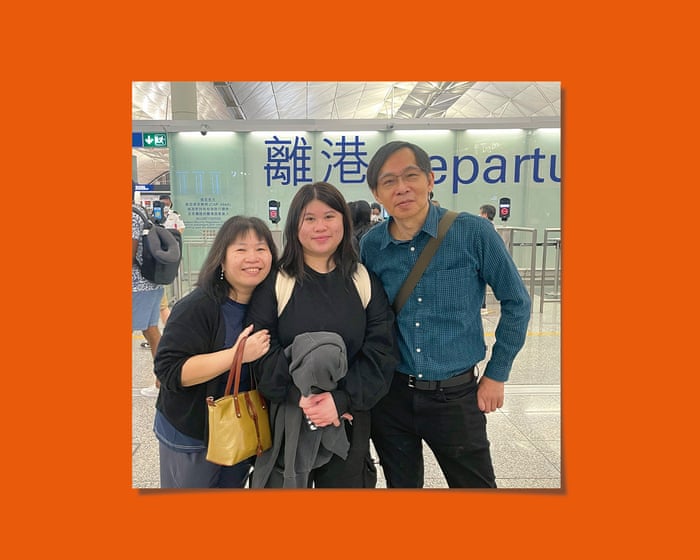
As a young teenager, one of Luna Wong’s favorite things was to walk to a bridge near her home in Hong Kong and sit there for a while, listening to the traffic and the water below, watching the lights and the city’s activity. She had a unique way of seeing the world, which she expressed through photography. Her photos were mostly landscapes, ordinary corners of Hong Kong, but she could spot an image in the same place that no one else would have seen. She was a curious kid who loved making people laugh and was deeply interested in the world around her. Then in 2019, when she was 13, political unrest in Hong Kong, quickly followed by Covid lockdowns, shrank that world to the size of her bedroom. For a long time, Luna barely left her family’s apartment. School became a screen; friends were only available online. She stopped sleeping properly, started having panic attacks, and was diagnosed with depression and anxiety. When the world opened up after Covid, Luna had changed too much to step back into it easily. She was often so anxious she couldn’t attend school and fell seriously behind. Her psychiatrist prescribed antidepressants, anti-anxiety medication, and sleeping pills. Later, ADHD medication and an anti-psychotic drug were added. This heavy mix of prescription drugs left her tired during the day—though still often awake at night—and caused weight gain, which upset her. But Luna kept her curious streak. Eager to understand her own issues better, she read about psychology, ordering textbooks to teach herself about the human mind. When her friends had problems, she offered advice and dreamed of becoming a psychologist. But it was hard to see how this would be possible as she struggled to attend school. In 2022, two years into her mental health struggles, Luna had an idea: a move overseas. A close friend had decided to do A-levels at boarding school in the UK, and Luna wanted to go, too. Luna’s English was fluent—since infancy, her parents had read her bedtime stories in English as well as Cantonese—and she wanted to do an A-level in psychology, which wasn’t offered in Hong Kong. But there was a bigger reason, too. This could be a fresh start, a way for Luna to decisively open up her world again. View image in fullscreen Luna, age eight, with her parents at Yuen Long Wetlands Park, Hong Kong, in 2014. Photograph: Courtesy of Thomas and Hilda Wong At first, her parents, Hilda Leong and Thomas Wong, were apprehensive. Luna was still fragile. But seeing their daughter excited and motivated about this plan was enough for them to get behind it. “I hoped it would change her life, because it seemed that Hong Kong was very difficult for her at that time,” says Thomas. After consulting Luna’s psychiatrist, who said she was sufficiently recovered to travel, they decided to press ahead. In September 2022, when Luna was 16, she moved to the UK to study for her A-levels at Wrekin College, a leafy boarding school set on 100 acres of land in Shropshire. Thomas and Hilda discussed Luna’s depression and anxiety with Wrekin before she was admitted and felt confident the school was equipped to support her needs. Nonetheless, Hilda did not sleep well while her daughter was abroad. There is an eight-hour time difference between Hong Kong and the UK, and Hilda kept her phone on the bedside table every night in case Luna rang. “I didn’t know how her life was there, and I was nervous about it,” says Hilda. But she reassured herself that this was what Luna wanted. “I told myself, she is growing up, she needs to go out into the world, she has her own life. I told myself, I will let her go.” As it turned out, they were right to worry. Luna struggled to adjust to life at boarding school. Soon after finishing year 12 at Wrekin College, Luna travelled to London for a summer school placement. It was there that, in July 2023, she took her own life. View image in fullscreen Aged nine with her parents atUniversal Studios Singapore, 2016. Photograph: Courtesy of Thomas and Hilda Wong
What happened to Luna reflects the mental health struggles of many young people, but it is also partly a story about money: a private education industry that has become increasingly dependent on the fees international students bring, propped up by a patchwork of private companies that profit from these children while carrying almost none of the legal obligations that would normally come with caring for them. Recalling her daughter’s death, Hilda breaks down in tears. “When she left for the UK, I didn’t know she would leave us for ever.”
Almost exactly three years after Luna’s death, I speak to Thomas and Hilda via a video call. They are in their apartment in Hong Kong, a framed studio portrait photo of Luna, smiling, on the wall behind them. Their grief is still raw and unresolved, and Thomas weeps as he tells me it took 14 years to conceive Luna. “We waited a long time to have this child,” he says. When their longed-for baby was born, they gave her the Cantonese name Lok Tung, which translates to “happy child”. For most of her life this was an apt description: she loved kindergarten and then school, made friends easily, and was doted on at home. “She brought happiness to the whole family,” says Thomas. It is common for people in Hong Kong to adopt an English name. Lok Tung’s first choice was Penguin, after her favourite animal, but she eventually settled on Luna, which is the name she used in the UK.
Luna was close to her parents, and it was painful for them to see her retreat into herself as her mental health worsened. “Sometimes she refused to talk to us,” says Hilda. “Maybe she thought we didn’t understand her.” Thomas showed his care by cooking Luna’s favourite meals – tofu, cucumber with vinegar and sour ginger, butterfly cookies – and through his physical presence. “If she didn’t want to talk, I didn’t talk, but just stayed near her,” he says. He often sat just outside her room when she withdrew inside.
Luna’s parents chose Wrekin College for its beautiful grounds, extracurricular activities and lack of intense academic pressure
View image in fullscreen
Wrekin College in Shropshire. Photograph: David Bagnall/Alamy
Sending her to boarding school in the UK was a big financial decision; Thomas and Hilda do not consider themselves wealthy. Until his retirement, Thomas worked in IT customer care, and Hilda, who is younger, still works in a hospital lab. Hoping it would be the fresh start she desperately needed, they decided to cash in Thomas’s pension to cover the cost. He took the lead in researching schools, looking for ones with beautiful grounds and lots of extracurricular activities – something he felt Luna had missed out on – and where academic pressure wouldn’t be too intense. An education agent helped with the application; a service that is free for parents, because schools pay a commission of around 10% of the first-year fees for each successful applicant. Before too long, Luna was interviewed and then accepted by Wrekin College, a co-ed school founded in 1880 that describes itself as “proudly non-academically selective”. It seemed like the perfect fit.
Over the last few decades, the number of British students who board at independent schools has declined significantly, with most attending as day pupils. To fill beds and balance the books, boarding schools have become increasingly reliant on overseas students, who by definition need to board, and who sometimes pay higher termly fees. At Wrekin College, for instance, UK boarders in year 12-13 pay £15,725 a term, while international boarders pay £17,025. Today, around 40% of boarders at British boarding schools are international students, with around half of those from China and Hong Kong. A 2024 write-up of an education fair in Hong Kong in a schools industry magazine described “aThere was “an air of desperation,” with representatives of British schools “resorting to aggressive tactics, pulling parents away from other stands.” There is a lot of money at stake throughout this process – not just for schools, but for the industries that have sprung up around them. Most schools also require that parents appoint an education guardian, someone in the UK contracted to act in loco parentis. This can be a friend or relative, but many employ professional agents, who are typically paid a few thousand pounds a year. Their main job is arranging holiday homestays with host families, who are paid a separate nightly fee, and stepping in for emergencies. Thomas and Hilda appointed someone from the White House Guardians agency, discussing Luna’s mental health issues beforehand and sharing a letter from her psychiatrist. “We thought the guardian could take care of her – not just practical things like registration and holidays, but take care of her mind, help her with difficulties at school, make her feel at home,” says Hilda. “We hoped the guardian would be like a mum or dad. But, actually, it wasn’t the case.” Luna arrived in the UK in the early hours of 7 September. After her first day of lessons, teachers at the school observed that she was visibly distressed, and she contacted her parents to say she was overwhelmed. Homesickness is normal, but it soon became clear Luna was not coping. Struggling with insomnia at night, she regularly fell asleep in class, and sometimes slept through the day in the school’s wellbeing centre. On 20 September, she told a school nurse that she had previously self-harmed and experienced suicidal thoughts. This history, along with her ADHD diagnosis, had not been disclosed to the school or guardianship agency beforehand – only her depression, anxiety and panic disorder, which had been detailed in a letter from her psychiatrist. A later safeguarding review into Luna’s death attributed this to cultural differences in what her parents understood needed to be shared, rather than any attempt to conceal issues. Two days later, staff discovered that she had self-harmed. It was decided that Luna would benefit from a few days away from school – common practice at boarding schools – and staff phoned her education guardian to arrange it. Luna’s guardian was contracted to “respond appropriately to all emergency situations” on her behalf, and to visit her within two weeks of her arrival. However, this was Luna’s third week and she had not made contact. In a later statement for the inquest into Luna’s death, Wrekin’s safeguarding lead noted that when the school rang that evening, the guardian “did not seem to know much about Luna (not even that she went by the name Luna)”, and said she would need to contact her head office “due to White House Guardians host families not being trained to look after a pupil with mental health difficulties”. The next day, the guardian confirmed that White House would not place Luna with a host family. There is a reasonable argument that an untrained host family is no place for a child in crisis, which is the view White House Guardians took. But, according to the safeguarding review, the guardian did not offer to visit or find another solution. In a written statement, White House Guardians said that the name confusion arose because Luna had signed up to the agency under her Chinese name, Lok Tung, and that the guardian assigned to Luna had not visited because she was seriously ill with Covid. White House said it recommended Luna should be taken to A&E, although this does not appear in Wrekin’s own account of the incident. Either way, Luna never met her first guardian. View image in fullscreen Luna, age 12, at school in Hong Kong. Photograph: Courtesy of Thomas and Hilda Wong Education guardians have a heavy responsibility, and unrestricted access to the children in their care, but the law does not require them to have training in child welfare, safIn 2022, the Independent Inquiry into Child Sexual Abuse flagged this as a serious concern for the 26,000 international children who board in the UK each year, noting that even someone convicted of offences against children could work as an education guardian. Only last year did the government require criminal record checks for holiday host families; it still requires nothing of guardians. Some attempts have been made to regulate the sector: White House Guardians is accredited by a charity called the Association for the Education and Guardianship of International Students (Aegis). Aegis members must hold enhanced criminal record checks and safeguarding training, but signing up is entirely voluntary, and many guardians and companies still operate with no oversight at all.
School staff phoned Luna’s parents in Hong Kong to tell them about the self-harm and the plan to find her a homestay. They tried repeatedly to reach her psychiatrist and contacted the local child and adolescent mental health service. That referral lapsed when Luna – who was 16 – refused to consent. The safeguarding review found that the referral could actually have proceeded without consent. Panicked about managing Luna’s risk over the weekend, staff suggested that Thomas and Hilda appoint a different guardian, recommending a woman who was originally from Hong Kong and spoke Cantonese. She already acted for other Wrekin students from China and Hong Kong. It was a high-pressure situation, and Hilda and Thomas went ahead.
The new education guardian was also Aegis-accredited but had no formal training in child mental health, self-harm or suicidal ideation. After being appointed, she came to school and spent two hours with Luna, then proposed a weekend homestay with one of her regular hosts, who was also a psychotherapist. Luna went, and returned to school somewhat calmer. What Luna’s parents did not know was that, from that weekend on, almost all communication about their daughter would run through the education guardian. Wrekin’s boarding housemistress later reflected that she spoke far more often to the education guardian than to the parents, a habit that the safeguarding review said had first become common during Covid. Although Thomas and Hilda speak warmly of the care Wrekin provided for Luna, they are frustrated they were not kept better informed. “It was absolutely not enough in my opinion,” says Hilda. “The system is that the guardian will take care of my daughter, and communicate with us. But, actually, she wasn’t doing that.”
In Japan, age 13. Photograph: Courtesy of Thomas and Hilda Wong
Reviewing a tranche of documents – witness statements provided to police and the coroner, WhatsApp messages, therapy notes and a council-commissioned safeguarding practice review – a picture emerges of poor communication, missed opportunities to flag risk and an ever-increasing bill. The education guardian was paid a base fee of £2,700 for the year with a £1,500 top-up because of Luna’s additional mental health needs. Soon after appointing her, Luna’s parents asked the education guardian to arrange counselling. She hired Luna’s host to see her for regular counselling sessions at school – a boundary issue the host herself flagged before accepting the role. The education guardian paid her for the sessions, while billing Thomas and Hilda at a higher rate and keeping the difference. This arrangement was not illegal, but it was not disclosed to either the counsellor or the parents, according to the safeguarding review. The education guardian told the inquest that she asked the counsellor to produce summary reports about Luna every other month, which were “sent straight to the parents”. One later homestay host overheard Luna voicing thoughts of ending her life, and told the education guardian they wanted her to leave. The safeguarding revieWe found that the education guardian did not tell Thomas, Hilda, or Luna about this. Instead, she gave “a false reason.” On other occasions, when families did not want to take Luna back, the review said the education guardian recorded that she had “pretended the host family was unwell and/or away.” As a result, Thomas and Hilda say they did not understand how serious their daughter’s crisis was.
It was only after Luna’s death that her parents saw how harsh the education guardian could be. In one troubling WhatsApp exchange in mid-October 2022, Luna wrote to say that another pupil had hit her. It was a Saturday night, and the education guardian agreed to raise it with the school on Monday. Then she changed direction, saying she was worried Luna would be asked to leave Wrekin because of her mental health issues. She forwarded Luna an internal email the school had sent her, a safeguarding update saying Luna had described having “a mental breakdown.” She told Luna that the language she was using suggested she needed to “go back to Hong Kong” or be in a medical facility, concluding: “This is no joke.” When Luna protested that she was trying her best and that she had been out of school for two years, the education guardian replied: “You are in someone else[‘s] country and they are [not] going to learn Chinese way to orbit around you.” And then: “You need to see a doctor or counsellor. I am only a guardian.” Shortly after 11pm, the education guardian said she was going to bed and stopped responding. Luna sent increasingly agitated messages into the silence, switching between English and Cantonese: “I trusted you. And now you’re just throwing stuff back at me … What do you want? I’m already trying to be a good student, a good daughter.” The education guardian did not reply, although she reported the hitting incident to Wrekin. “Ending the conversation this way, without any follow-up, seems very dangerous for a 16-year-old girl with depression and anxiety,” says Thomas.
Luna told her parents she liked school and was making friends. But in reality, she was struggling. Reading the counsellor’s notes, which Luna’s parents saw for the first time when they were disclosed to the coroner, a pattern emerges: flashes of intense distress – homesickness, panic attacks, despair about falling behind – followed by Luna insisting everything was fine. In early October, the counsellor reported to the school that Luna had spoken openly about self-harm and suicidal thoughts, saying “she felt comforted by the idea of death.” Elsewhere, she stressed that Luna had no plan to act on these feelings, and that in many respects she was a normal teenager. In one session she marvelled at how much pasta and potato English people ate. Teachers found her bright but under-equipped: two years out of the classroom had stripped her of the practical skills needed for academic study, and she froze in tests, sometimes writing almost nothing despite weeks of notice. Her nocturnal hours set her apart, and although she was making friends, other boarders were reluctant to share a room with her. According to the safeguarding review, the housemistress told colleagues she did not think Luna was suited to the boarding school environment. This concern does not appear to have led to any further action; instead, when her end-of-year exams went badly, Wrekin suggested she repeat the year.
Luna went home three times that year, and was always happy to see her parents and catch up with friends. On her last trip back, for the May half-term, she arrived with two penguin toys – one for herself and one to comfort Hilda while they were separated. Thomas and Hilda knew Luna was finding things tough, and she stayed longer than planned. Luna was unsure about retaking the year. “We told her that it doesn’t matter, we didn’t want to put any pressure on her,” says Thomas. “We said to her she can stay in Hong KShe could choose to study other things or return to the UK. It was her decision.” Privately, Hilda hoped her daughter would stay home—she had missed her terribly. Luna’s therapy notes show that, as she considered whether to go back, she felt a deep sense of failure and worried about how much another academic year would cost her parents. They are haunted by the thought that this is why she decided to give life in the UK one more try.
Luna’s summer had been on her education guardian’s agenda for a long time; the guardian had recommended a summer psychology course. Hoping it might help Luna get into university, her parents signed her up. Called the Young Psychologist Summer Experience, it was a two-week residential course in London costing £6,740. The education guardian told Thomas and Hilda via WhatsApp that it was “organised by UCL”; “They will be staying inside the uni accommodation and their facilities and more. excellent program.” It was true that Luna would stay in University of London accommodation, but that was where the connection ended. The course was actually run by InvestIN, a private company that sells what it calls “immersive career experiences” to teenagers. The education guardian was paid a commission by InvestIN for referring Luna. This arrangement was not illegal, but according to the safeguarding review, it was not disclosed to Thomas and Hilda. Residential summer programmes for international students are big business, and are even less regulated than guardianship. The adults who run them must be DBS-checked—but for children over eight, there are no statutory minimum standards for the setting itself, and no inspection regime like the one that governs schools.
As with Luna’s therapy, the education guardian handled everything related to her time with InvestIN. Instead of disclosing Luna’s mental health problems early so that risk could be assessed and support put in place, she waited until just before the course began and emailed a letter from Luna’s psychiatrist to a member of InvestIN’s team. An email sent by the education guardian on 5 July, the day before the course, was read out at the inquest: “She is a recover [sic] mental health patient and she worry people will reject her.” She did not mention that Luna had been flown home six weeks earlier because her mental health had worsened. Later, she told the independent reviewer that she was “worried that [Luna] would not be accepted on the programme due to the medication she had.” Hilda is bewildered by this decision. “If InvestIN couldn’t handle my daughter’s mental health problems, it didn’t matter,” she says. “She could have come back to Hong Kong.” At the inquest, the education guardian said that when she described Luna to InvestIN as “a recover mental health patient,” she meant she had improved, not that she was fully recovered. She also said she had asked the counsellor to help Luna with the pre-enrolment form detailing her medications, but that the form had never reached InvestIN for reasons she couldn’t explain.
On 6 July 2023, Luna arrived at University of London halls in King’s Cross with a large bag of psychiatric medication, and filled in the pre-enrolment form herself. At Wrekin, her medication had been looked after by the school nurse, and Luna visited twice a day to take it. InvestIN had only recently started offering residential courses and did not have processes in place for medication. Instead, they emailed Luna’s parents in Hong Kong to ask for their permission to let her handle the drugs herself. Thomas was alarmed, but as he understood it, Luna would not be able to take part in the course without this consent. He agreed. Luna was taken to her room on the seventh floor, with all her medication and no provision to support her.
“We were so shocked that our daughter was not missed for two days. They accepThey paid the money, but they didn’t take care of my child.
View image in fullscreen. Luna on Stanley Main Beach in Hong Kong, 2020, age 14. Photograph: Courtesy of Thomas and Hilda Wong.
Luna was unhappy almost right away. She told her parents the course was useless, but they didn’t sense an impending crisis. She talked excitedly about the summer ahead in Hong Kong, jokingly warning her parents that various packages were arriving for her at home: a textbook; some earrings. She called Thomas to say she’d found a great second-hand bookshop, asking if there was anything he’d like, and said she’d buy him a UCL T-shirt since he’d never had the chance to study in the UK. But separately, she was texting the counsellor. As the course went on, she described low mood, anger, numbness and insomnia. The counsellor shared these messages with the education guardian, who told the inquest she “forwarded it immediately” to Thomas and Hilda. On the afternoon of 11 July, Luna told her counsellor she wanted to leave. Thomas and Hilda say Luna’s desire to leave was not communicated to them, though the education guardian told the inquest “I think I did tell it” to the parents. On 11 July, she replied to the counsellor saying that Luna could go home but would have to tell her parents herself. Asked at the inquest why she had not arranged for Luna to leave the course, the education guardian responded: “The student has to be the one to request that. I can’t actually tell the parents, ‘Pull her out now.’ Who is going to pay the money back?”
Luna’s counsellor told the inquest that Luna did not believe her parents would be happy about her leaving the summer school early. This was painful for Thomas and Hilda to hear.
When Luna didn’t turn up for her sessions the next day, it didn’t trigger alarm. InvestIN would later tell the coroner’s court that its systems were failing that week, giving inaccurate attendance data. Still, it was flagged on a staff WhatsApp group that Luna hadn’t turned up, and at lunchtime on 12 July someone knocked on her door. There was no answer, and they left it at that. It was only around 3pm the next day that another staff member went to Luna’s room with a master key. She unlocked the room and found Luna dead; it later emerged that she had taken an overdose of prescription medication. It had been more than 40 hours since she was last seen alive.
It was late in the evening in Hong Kong when Thomas and Hilda got the call from InvestIN informing them that Luna was in an ambulance and “not breathing any more.” Within a few hours, they had booked flights to London and left home, arriving the next day. As they travelled, Thomas thought of his daughter’s longstanding habit of sleeping through her alarm in the mornings. Whenever she was home, he saw himself as a kind of human alarm clock, going into Luna’s room to gently shake her awake. As they travelled towards her, he prayed for a miracle, that he would be able to wake her up one last time. When they got there, it was painfully clear. “This miracle does not come,” he tells me, tears rolling down his face. “I have done it for the last time.”
They were in shock, in a country neither had visited before, navigating an unimaginable situation in a second language. Information and queries were relayed to them second-hand via the education guardian. “In the UK, we lost all the connection. We didn’t know what to do or how to do it,” says Thomas. Their isolation was so profound that, astonishingly, it was not even conveyed to them that Luna had lain undiscovered for two days. They only found this out months later, when the coroner’s court sent them a full tranche of witness statements and documents ahead of the January 2024 inquest. It is difficult to overstate how distressing this discovery was. Hilda felt like the floor had opened beneath her. She remains tormented by the idea that earlierAn intervention might have saved Luna. “We were so shocked that our daughter was not missed for two days,” says Hilda. “They accepted the money, but they didn’t take care of my child. We cannot forgive ourselves for letting her go to this summer school.”
The coroner concluded that Luna died by suicide. In her determination, she noted that in the UK Luna had never been referred to a mental health team or assessed by a clinician, instead continuing with medication prescribed in Hong Kong. Luna had refused to consent to one referral in September, and the adults around her treated that as the end of the matter; the safeguarding review found it should not have been, because the risk to Luna outweighed her unwillingness to engage. At the hearing, the coroner pressed the counsellor on why Luna’s overwhelming anxiety about the sacrifice her father had made to send her to the UK by cashing in his pension was not more central to their sessions. She said she didn’t have any direct contact with Luna’s parents, but assumed they knew how much she was struggling. Later, she defended her clinical approach, but under further questioning conceded: “I think if someone believed that she was going to take her own life then, yes, someone should have taken her to A&E. But I don’t think anyone believed that she was going to end her life.”
‘We lost all our hope for the future,’ Thomas says. ‘Life has become meaningless.’
Age 15 with her parents in Hong Kong in 2022, the year she moved to the UK. Photograph: Courtesy of Thomas and Hilda Wong
Wrekin College told the Guardian that Luna was “a much-loved and valued member of our community” whose death continues to have “a profound impact” on the school. InvestIN said its “thoughts remain with Luna’s parents, family and friends”, and that it had accepted the findings of two independent reviews and the inquest, putting in place “enhanced safeguarding protocols” as a result. Neither addressed the specific findings put to them. The education guardian and Luna’s counsellor did not respond to our request for comment.
For the first year after Luna’s death, Thomas cried every time he ate, thinking of his daughter and the food he cooked for her. “We lost all our hope for the future,” he tells me. “Life has become meaningless.” Still, three years later, he stays at home much of the time, not wanting to socialise or engage with the world. Luna is everywhere in their apartment. The penguin toy is still next to the bed. “It’s three years ago, but it’s like it happened yesterday,” says Hilda. “We know she has left us, but it’s hard to accept the truth.”
They are angry about what happened to Luna and how the systems set up to keep her safe failed. The safeguarding review into her death recommended, among other things, statutory regulation of the guardianship sector, a multi-agency approach to vulnerable international children, and clear rules for residential summer programmes. But it was published in 2024, as the government changed, and nothing has been enacted. There have been some smaller changes: InvestIN now has a policy of keeping children’s medication in a locked cabinet, and getting staff to administer it. Aegis, the accreditation body, has tightened its criteria to insist that guardians meet students within the first fortnight regardless of their package. But there is still no statutory regulation of guardians or residential summer schools.
Luna’s funeral was held at Telford crematorium on 10 August, near the school where she had spent her only year in England. It was the summer holidays, but more than 20 staff members and a handful of students came; Hilda remembers sunlight streaming in through large windows. Wrekin planted an oak tree for her, and held a memorial service during term-time. But beyond that, Luna’s parents feel her death went painfully unse”She just disappeared,” says Thomas, “and nobody in the UK noticed.” In the UK and Ireland, Samaritans can be contacted on freephone 116 123. In the US, you can call or text the 988 Suicide & Crisis Lifeline at 988 or chat at 988lifeline.org. In Australia, the crisis support service Lifeline is 13 11 14. Other international helplines can be found at befrienders.org.
Frequently Asked Questions
Here is a list of FAQs based on the topic of Luna Wongs death and the treatment of international students in the UK
Beginner Questions
Who was Luna Wong
Luna Wong was an international student from Hong Kong who died by suicide in the UK in 2022 Her case became a symbol of the mental health crisis among international students
What happened to her
She struggled with her mental health while studying Despite asking her university for help multiple times she didnt get the support she needed She died by suicide in her student accommodation
What does They took the money but didnt look after my child mean
Its a quote from Lunas mother It means the university happily accepted Lunas expensive international tuition fees but failed to provide the basic care and support she needed to stay safe
How much do international students pay in the UK
International students pay much more than UK students For example a UK student might pay 9250 a year while an international student can pay 20000 to 38000 or more for the same course
Do universities have a duty of care to students
In the UK universities have a legal and moral responsibility to keep students safe This includes mental health support However the law is not always clear on exactly how far this duty goes
Advanced Questions
What is the duty of care debate in UK universities
Its a legal and ethical argument about whether universities should be legally required to protect students from harm including suicide Currently there is no specific law that forces universities to do this which leaves gaps in support
Why do international students face unique mental health challenges
They deal with culture shock language barriers loneliness financial pressure and being far from family They also often cant access NHS mental health services easily and may fear that asking for help will affect their visa status
What is the money problem in this context
Universities rely on international student fees to fund their budgets Critics say this makes universities treat international students as cash cows rather than people who need care The focus is on recruitment not retention or wellbeing
What are pastoral care and welfare support
Pastoral care means looking after a students emotional and social wellbeing not just their grades Welfare support includes counselling mental health services and help with practical problems