Who knew? Apparently everyone but me: you don’t wear shoes on a superyacht. Now, about to step onto my first teak deck at the Monaco Yacht Show, I have to take off my trainers, and I’m panicking about my socks. Do they have holes? Do they even match? Do they smell?
To be honest, I’ve dressed completely wrong for Europe’s big annual superyacht trade show. The dress code for men seems to be crisp and tucked in: blazers and chinos, navy and white, styled hair and designer sunglasses. (I went colourful, loose and casual.) For women, it’s something like Riviera elegance. Everyone – whether Italian, French, English, German or American, exhibitors, buyers, brokers or charterers – seems to know each other. The international superyacht community seems close-knit, and I’m not part of it. Yet.
For now, though, I’m boarding my first vessel: a relatively modest Zeelander 8 – 23.9 metres (79ft) long, built in the Netherlands. It has a rather retro look, with pleasing curves and a rear end not unlike a Porsche’s. I could imagine James Bond at the wheel. It’s fast too, reaching 40 knots (46mph); I could be in Saint-Tropez in a little over an hour.
Downstairs there’s a huge owner’s cabin, plus a couple of double guest cabins, all en suite, with lots of nice details, such as a cream-coloured leather floor. In the less opulent crew quarters, there’s room for two or three. How much does it cost? This one isn’t actually for sale – some of the boats here are, others are for charter, some just for show. But I could order one just like it; it would take a year and a half to build and cost me about €9.5m (£8m).
Tempting, certainly, but I need to see a few more before rushing into anything. I can’t help noticing that, compared with some of the others packed into Port Hercules, the Zeelander 8 is a bit … well, small. Is it even a superyacht? There seems to be some debate about how long a yacht has to be to be super – some say 24 metres, others 30.
No question about this one – a Fast50, made by Italian builders Baglietto, with room for 12 guests and a crew of nine. It’s not as fast as the Dutch one, despite the name. Its four engines take it to 30 knots, but that’s actually very quick for a 50-metre boat. Perhaps more importantly, its gross tonnage, which refers to internal volume, is 499; a sub-500GT yacht isn’t subject to the stricter safety and environmental rules under the International Maritime Organization (IMO) that yachts over 500GT are, so they require less frequent surveys and have fewer restrictions on crew size and certification. My favourite features are the large “beach club” (the open deck at the back) and the Jacuzzi right up at the pointy end. Imagine it: sitting with a glass of fizz, in the bubbles, at 30 knots, Céline Dion blasting out … where do I sign?
Oh, again. Not for sale. The first Fast50, fresh from the shipyard, is already sold, but they won’t tell me how much for or to whom (superyacht owners can be quite shy). The search continues.
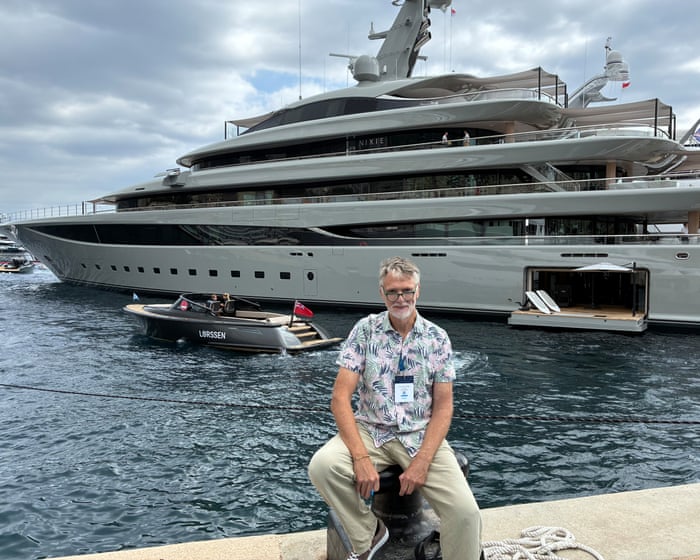
The trouble with superyachting, I’m finding here in Monaco, is that you think you’ve found the perfect vessel, and then you look over there and there’s a bigger, better one. It’s not just me – this is reflected in the Global Order Book, published by Boat International, which tracks construction projects. The 2026 GOB counts the number of yachts over 24 metres under construction globally at 1,093. In 2016, it counted 755 vessels under construction. This year’s figure is actually down 3.95% from last year, but that’s balanced by an increase in average length and gross tonnage. In other words, a few fewer, but they’re getting bigger. New prefixes are required, “mega”…and “giga,” but for simplicity we’ll stick with superyacht. Here at MYS 2026 there are 118 superyachts, with a combined length of 5,508 metres and a value of €4.5bn. Despite the sock shame, I’m beginning to feel more comfortable. Most people are friendly. It’s a lovely day on the Côte d’Azur – I’m offered ice-cream, branded fans and straw hats. It’s not just the yachts; there are stands for everything connected. Would I like to come to a wine tasting later “exploring superyacht wine trends”? Of course I would. Am I interested in yachting in Saudi Arabia? Hmmm, maybe next year. There are loads of toys on show – jetskis, eFoils, even submersibles. And if you still find life at sea boring, there’s a portable golf simulator with cameras and sensors, plus a screen with hundreds of real courses programmed into it. So after dropping anchor off St Barts you can play a round at St Andrews. It costs €170,000 (£143,000). View image in fullscreen ‘I could get used to this.’ Photograph: Sam Wollaston/The Guardian And so on to Nixie, built by Lürssen in Germany and owned by Revolut co-founder and CEO Nik Storonsky: 102 metres long, with a helipad, glass-bottomed infinity pool, dedicated spa and wellness zone, and a crew of 34, one of whom is busy polishing a stainless steel cleat on the lowest deck. Access, though, is “reserved exclusively for direct, potential clients,” says the Lürssen PR. Perhaps they think the average Guardian reader isn’t in the market to rent a boat the length of a football pitch. Nixie costs €2.4m a week to hire. A lot, I know, but if you split it between the 12 of you… Anyway, it’s not even the biggest here, which I will be allowed on. First though I pass another – Boardwalk V, only 76.5 metres long and five years old, but this one is for sale, at a discount price! Down €14m, to just €135m. Not including the helicopter. Boardwalk V… it’s ringing a bell. Got it! And now the twin flags on the helicopter’s tail – the American stars and stripes and the tricolore of Italy – make sense. This boat belongs to Tilman Fertitta, billionaire owner of restaurants, hotels, casinos and the Houston Rockets basketball team, and now Donald Trump’s ambassador to Italy. He made the news in June when hundreds came out to protest after he parked his brand new 117-metre yacht (also named Boardwalk, but without the V) in Venice. He’s got an upgrade – that’s why he’s selling this one. To be honest there are some proper horrors on show. This one looks like a supersized 80s caravan, that one more like a bridge than a boat, another is bright red – like some kind of firefighting ship. “I don’t understand the clients,” says Rick. “They just want something that’s big and flashy and comfortable, they don’t care about anything else.” Rick is also pretty disparaging about the people who sell these boats, the brokers. “They’re like real estate agents, they say: ‘Look at the master cabin, look at all the light, the big windows,’ it’s all about the interior space.” Guess what Rick does? Yup, yacht broker. It’s why we’ve changed his name. He also points out something about the way they look. “I don’t know if you’ve heard the analogy, but they look like irons.” As in electric irons, for doing the ironing with, and oh my God, he’s so right – that shape, pointy at the bow, then rising and widening as you go aft, with a squared-off swim platform… As Rick says, “once you see it, you can’t unsee it.” In a 2024 study, Oxfam identified 23 superyachts owned by 18 billionaires and estimated the average annual carbon footprint of each of these yachts to be 5,672 tonnes. For an average citizen of the world it would take 860 years to produce the same amount. View image in fullscreen Sink clearly… a bathroom on one ofThe superyachts. Photograph: Sam Wollaston/The Guardian
Oxfam then zoomed in on one family, the Waltons, heirs to the Walmart chain and owners of three superyachts (at this level, it’s not about the haves and the have-yachts—it’s about the have-yachts and the have-lots-of-yachts). They travelled 56,000 nautical miles in a year with a combined carbon footprint of 18,000 tonnes. That’s equivalent to the carbon emissions of about 1,700 Walmart employees.
Superyachts use an enormous amount of fuel—some of the bigger ones burn more than 500 litres of diesel per hour, releasing CO2 as well as nitrogen oxides and sulphur dioxide into the atmosphere. The recreational boating sector as a whole—including yachts—produces about 16 million tonnes of CO2 annually. And it’s not just when they’re moving; at anchor they run onboard generators to power their “hotel loads” (air conditioning, stabilisation systems, lighting, galleys, hot tubs, etc.), which emit even more CO2. On top of that, the vessels’ large anchors and chains act like the grim reaper’s scythe on the Posidonia seagrass that grows on the Mediterranean seabed—a vital habitat for sea life and a source of oxygen.
And there are more and more of them. The big increases came in 2022 and 2023 when, as Boat International puts it, “orders soared as UHNWIs sought private holiday cocoons.” UHNWIs, as you’ll know, are ultra-high-net-worth individuals. So why the boom? Because a superyacht is “the best way to practise social distancing in a very safe and very comfortable way,” says Grégory Salle. In other words, Covid was brilliant for the superyacht sector. Salle is speaking to me by video from Lille, where he works at the French National Centre for Scientific Research. He’s also the author of the thoroughly researched and surprisingly entertaining book Superyachts: Luxury, Tranquility and Ecocide, which has an entire chapter devoted to Posidonia seagrass.
View image in fullscreen
Jeff Bezos’s 127-metre Koru. Photograph: Giuseppe Catuogno/Alamy
Ecocide isn’t the superyacht’s only crime. “It has really become the symbol of excessive, unjustifiable wealth,” Salle says. Even though the gap between most of us and the people who own them is virtually unfathomable, “it looks like provocation, especially when all you’re hearing and reading about is crisis, austerity, poverty—including child poverty.”
Superyachts are also a kind of floating paradox that Salle calls “conspicuous seclusion. On the one hand they’re meant to be noticed—they’re massive, you can’t miss them. But at the same time the interior is hidden, and of course they can sail away and escape ordinary people.”
Salle uses words and phrases like “plutocracy,” “oligarchy” and the new “global super-bourgeoisie” to describe the people who own them—a “transnational capitalist class” who operate outside and above borders and rules. Look at the stern of the superyachts, under the name, and they’re almost all registered in places like the Cayman Islands, the Marshall Islands, the Isle of Man and Malta—flag states offering, among other benefits, tax neutrality.
It’s hard to hide a superyacht, or ownership of one. We know about Mark Zuckerberg’s 118-metre Launchpad and Jeff Bezos’s 127-metre Koru, estimated to have cost €444m. Koru caused a stir in 2022 when a historic bridge in Rotterdam, a Dutch national monument, was going to be dismantled to let it through. After the uproar, its masts were stepped downstream in the end. Koru is actually a sailing yacht, which might sound like a greener way of doing it, but Bezos also has a 75-metre support vessel—with additional crew accommodation, a helipad, a submarine, speedboats and cars—that follows Koru around like a loyal dog. Zuckerberg has a couple of support vessels too.
View image in fullscreen
The world’s longest superyacht… Azzam. Photograph: David Jalda/AlamyRoman Abramovich is another big yacht fan. Using leaked documents, Forbes counted 16 belonging to the Russian oligarch. My ship location app tells me that the biggest of his fleet – Solaris (140 metres) and Eclipse (162 metres), both registered in the Cook Islands – are now parked in the Sea of Marmara, near Istanbul. When western governments seized Russian oligarchs’ assets after the invasion of Ukraine, Turkey refused to join the sanctions and became a safe haven.Eclipse doesn’t even eclipse everything. The world’s longest superyacht, at 180 metres, is Azzam, launched in 2013 for Sheikh Khalifa bin Zayed Al Nahyan of Abu Dhabi, who died in 2022, but according to Boat International and the Superyacht Fan website, Azzam is still in the family. At this level it’s not always clear who owns a yacht, as they can be held in trusts or shell companies, sometimes across several jurisdictions.Take Dilbar for example – a little shorter than Azzam but the world’s largest by volume. In June Bloomberg reported that a court in Germany had ruled that sanctions no longer applied to the yacht after finding insufficient evidence that the Russian billionaire Alisher Usmanov controls The Sister Trust, which formally owns the vessel.Or Kosatka, formerly Graceful, the 82-metre yacht seen being escorted through Danish waters by Russian naval vessels in the summer and widely reported to be linked to Vladimir Putin. A bigger, 140-metre yacht, the €620m Scheherazade, which boasts two helipads, anti-drone technology and a cryotherapy room, remains impounded in Italy. Activists working for poisoned Russian opposition leader Alexei Navalny believe that one is also owned by Putin.There is no secret about who owns the aptly named Leviathan, the biggest boat at the Monaco Yacht Show. Co-founder and president of the video game company Valve, Gabe Newell, doesn’t just own the 111-metre Leviathan, he also owns the 93-metre support vessel Draak, parked up next door.I am allowed on to Leviathan and get a brief look around. I’m shown the huge mess area, which Newell and his guests share with the 42 crew. As well as the pool, there’s an outdoor cinema, basketball court, and a huge gaming lounge with consoles and race simulators, open to everyone. The crew are also keen to point out Leviathan’s diesel-electric hybrid propulsion and battery energy storage system. But it still has a 494,000-litre fuel tank. Fill ‘er up? Certainly sir, that’ll be roughly a million euros.View image in fullscreenLeviathan, the biggest boat at the Monaco Yacht Show. Photograph: Bloomberg/Getty ImagesIt’s not total eco denial at the Monaco Yacht Show however, there’s at least some acknowledgment of environmental impact. I drop in on the Blue Wake awards, “for solutions delivering measurable impact on yachting sustainability”. So there’s a prize for a company using more sustainable materials for yacht interiors. A yacht wins a Blue Wake for having sails, and a marina gets one for planting Posidonia plants.This is all good news … but actually, when you look at it, it’s not that good. In five years 3,000 sq metres of Posidonia have been restored – sounds impressive, but then by my calculations that’s an area of about 55 metres by 55 metres. The boat with sails? Great, but actually there are fewer sailing boats here than in previous years, the trend is towards power, more and more of it.It looks like greenwashing, token gestures. I have an Italian friend who calls these superyachts stronzi di mare – turds of the sea. And you know what you can’t do to a turd. There’s no escaping the truth: that they drink fossil fuels like there’s no tomorrow, which there won’t be if they’re allowed to carry on; that there’s no more monstrous symbol of inequality; and that they look like irons.But before storming off in disgust, maybe I’ll just pop into that wine tasting. In my socks.
Frequently Asked Questions
Heres a set of FAQs based on the articles themes of extreme wealth superyacht emissions and ecocide
1 What is a superyacht show
Its a large exhibition where shipbuilders and brokers display luxury yachtsoften over 24 meters longto wealthy buyers Europes biggest held in Monaco draws billionaires and industry insiders each year
2 How much does a superyacht cost
New yachts typically start around 10 million and can exceed 500 million On top of that running costs often reach 10 of the purchase price every year
3 Why are superyachts bad for the environment
They burn huge amounts of fuel A large yacht can emit more carbon in a year than hundreds of ordinary cars and many run on diesel with few pollution controls
4 How much do superyachts actually pollute
It varies by size and use but studies estimate a single large yacht can produce thousands of tonnes of CO annuallycomparable to the lifetime emissions of dozens of people
5 What is ecocide
Ecocide means severe widespread or longterm damage to the environment Some campaigners argue that extreme luxury emissions should be treated as a form of it it is not yet a crime under international law
6 Why do people buy superyachts
For privacy status entertaining and travel to remote places For many ultrawealthy buyers a yacht is also a visible sign of success
7 What are the main criticisms of the superyacht industry
Extreme emissions water and noise pollution anchor damage to seabeds and the gap between a tiny elites footprint and everyone elses
8 Are there greener superyachts
Yeshybrid and electricpropulsion yachts exist along with solar panels and shore power But most still rely on fossil fuels and the largest models remain highly polluting
9 What practical steps reduce a yachts impact
Slower speeds shore power instead of running generators in port better waste treatment avoiding fragile seabeds when anchoring and offsettingthough offsets are a weak substitute for cutting fuel use
10 Does extreme wealth drive extreme emissions
Research suggests the richest individuals emit far more than average citizens largely through aviation multiple