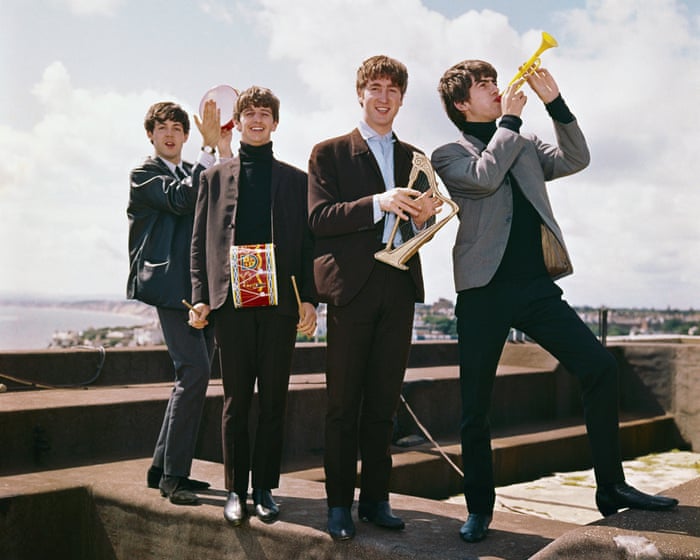
Relations between France and England have rarely looked better. The recent loan of the Bayeux Tapestry has become a symbol of renewed friendship between the two countries, further shown by the many smiles exchanged between Prime Minister Andy Burnham and French President Emmanuel Macron. However, a new book published in France earlier this month could soon cloud the bright skies of this revived entente cordiale. In Code Yesterday, author Michel Bussi suggests that every song credited to the Beatles was actually written by a woman of French descent. Before you get angry, rest assured: Code Yesterday is a work of fiction. “I hope British people have a good sense of humour,” says Bussi, sitting in the garden of his house near Rouen on a sunny morning. Bussi is one of France’s most successful thriller writers, whose books have sold millions of copies and been adapted into several films. Seven years ago, he wrote J’ai dû rêver trop fort (“I must have been dreaming too hard”), inspired by the story of American folk singer Sixto Rodriguez. His latest book, he says, comes from a lifelong fascination with the Fab Four, or the garçons dans le vent as they are called on his side of the Channel. View image in fullscreen Paperback writer … Michel Bussi. Photograph: Philippe Matsas “I discovered them through my older sister and the red and blue compilations when I was eight. A little later my sister came home with The White Album, and I assumed it was a third compilation, and could not figure out why it had all these songs that were already on the other two,” he remembers, laughing. While his desire to write a story around the most iconic of rock bands was something he’d envisioned for years, his starting point came from an observation: “There are absolutely no women among all of the classic rock bands. Things have changed, thankfully, but for a long time, rock was exclusively a male thing. So I wanted to give them a revenge.” That’s how his plot began. And Bussi went all in. According to his story, a certain Yvonne McKenzie (a relation to “Father McKenzie” in Eleanor Rigby is implied) meets John and Paul near St Peter’s church on 6 July 1957, the same fateful day the pair first run into each other. Yvonne, a customs inspector born in Normandy to a French mother and an English paratrooper and raised on Liverpool’s Penny Lane, develops a crush on them both. Hurt by their indifference, she one day starts humming a song while sat in front of the young McCartney on the bus: Love Me Do. View image in fullscreen Photograph: Presses de la Cité Macca can’t get the tune out of his head and has no qualms about passing it off as his own. When Yvonne hears it on the radio for the first time, she is overwhelmed, and when John and Paul come back to her to ask for more, she happily obliges. The collaboration that ensues is unconventional but professional: Yvonne sings melodies to them over the phone, they add middle-eights and vocal layers and churn out hits. The feedback on I Feel Fine? According to Bussi’s novel, that’s inspired by one of Yvonne’s household appliances interfering with the phone line. The rattle-and-shake of Can’t Buy Me Love? A rhythm she came up with while whisking an egg. “Ob-La-Di Ob-La-Da”? The first syllables uttered by her newborn son, of course. As a female songwriter of humble origins in the 1960s, Yvonne is resigned to remaining faceless. “However awkward my story may seem,” says Bussi, “it’s entirely credible that a female songwriter at that time would only have been able get her songs heard if they were sung by good-looking boys.” The only thing she demands in exchange for her silence is that the Fab Four include in their oeuvre a few nods to her French origins – hence La Marseillaise in the first bars of All You Need is Love, and Michelle, a tribute to her mother, Micheline. Bussi’s sHe says his wild fantasy is backed by years of deep reading into books, movies, and documentaries. His favorite albums are Rubber Soul and Revolver, “where you hear an energy that was still pure and simple; they go experimental yet remain accessible.” He remains deeply fascinated by the many myths surrounding the Liverpool quartet, and his story touches on many of the more mysterious parts of the Beatles’ history, such as the deaths of Stuart Sutcliffe and Brian Epstein. In the novel, a grumpy old rock critic (and devoted Stones fan) supports Yvonne when she decides to tell her side of the story. And just as the whole country starts to believe her—despite an MI5 disinformation campaign—there’s a twist, and Bussi’s outrageous story somehow makes sense after all. ‘It’s a more expansive, inclusive version’: how women reshaped the history of the Beatles Read more To the author, Code Yesterday is above all a tribute to the lasting charm of the Beatles’ music. The novel’s central premise may strain belief, but it shows that the Beatles’ appeal—especially the wild romanticism of the early years—is so universal precisely because their songs could just as well have been written by or about a woman. “What I find fascinating is that they have this image of nice-looking boys, yet they did things that were much bolder than artists who are considered avant-garde,” Bussi says. He pauses for a second, then adds: “I was pretty happy to come up with Yvonne’s French ancestry; it was good fun. But let’s be honest, we French are nowhere near as good as the English when it comes to rock music.” No hard feelings, then. France might even get the Bayeux tapestry back.
Frequently Asked Questions
FAQs Paul John and Yvonne What If a Woman Had Written the Beatles Greatest Hits
The Basics
What is Paul John and Yvonne
Its a thought experiment and the title of a French novel that asks a simple question what if the Beatles biggest songs had been written by a woman instead of Paul McCartney and John Lennon
Who is Yvonne
Yvonne is the fictional female songwriter at the center of the premise an imagined standin for the woman genius who never got credited published or remembered
Is this a real historical claim
No Its fiction and cultural criticism not a conspiracy theory The point isnt that a woman secretly wrote Hey Jude its to explore why we find that idea so hard to imagine
Why the Beatles specifically
Because theyre the ultimate example of male genius in pop music If you can swap in a woman there you can question the whole great male artist story
The Bigger Questions
Whats the point of asking what if
Counterfactuals expose hidden assumptions Asking what if a woman wrote this reveals how much our idea of genius depends on who gets to be remembered
Does the novel claim women couldnt be rock geniuses
The opposite It suggests women were just as capable but the system of credits publishers and hype kept them out of the spotlight
What does genius even mean here
Usually it means the person whose name we attach to the work The novel asks whether genius is really about talent or about who gets credit
Isnt this just erasing Paul and John
No Its not saying they didnt write the songs Its asking what we lose when we can only picture one kind of author
History and Context
Were there real women songwriters in the 1960s
Plenty Carole King Ellie Greenwich Cynthia Weil and many more Several wrote hits for malefronted bands and stayed behind the scenes
Did women ever write for the Beatles
Not their released songs but women worked throughout the 60s pop machine as writers demo singers and session players often uncredited
Why did so few women get famous as rock writers
Labels