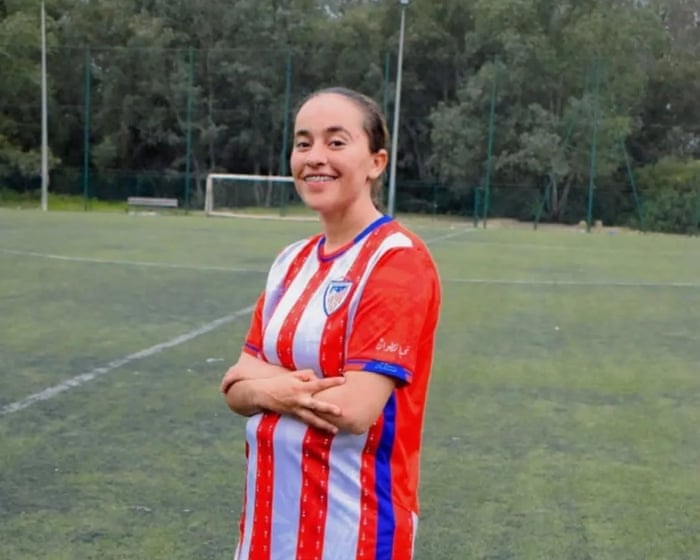
Football was everything Faten Ben Omar El Azizi had ever wanted. She had played for years in Morocco’s regional league with Maghreb Atlético Tetuán, a team whose kit mirrors the colors of the famous Spanish club Atlético Madrid.
In a heartbreaking twist, on the day she drowned last month—one of nearly 150 people who died in the illegal mass crossing into the Spanish enclave of Ceuta—her mother was told that Faten had just been granted a visa to go to Spain.
Her coach remembers how much she loved training: Tuesdays on the pitch and Thursdays at the beach near Tétouan in northern Morocco, where the 26-year-old lived with her mother and the rest of her family.
But making a living from women’s football in Morocco was out of reach for El Azizi. She earned only about 260 dirhams (£21) when her team won, and nothing when they lost—not enough to support her mother, two siblings, and other relatives. Her father had passed away when she was 12.
Alongside football, she worked at Tétouan’s oldest cemetery, cleaning graves and selling bunches of rayhan (basil) to mourners, a plant tied to blessings in Muslim funeral traditions.
“She dreamed of reaching Europe through football,” says her mother, Jamilla. Instead, El Azizi is now buried in the very cemetery where she once worked, after drowning on 30 July while trying to swim from Morocco to Ceuta, the Spanish enclave near Tétouan.
Jamilla, Faten Ben Omar El Azizi’s mother. Photograph: supplied
She was one of at least 141 people who died during last month’s extraordinary mass crossing to the Spanish territory in North Africa, according to the migrant rights group Caminando Fronteras. Most of those who died—either by drowning or being crushed at the land border—are believed to have been under 35.
Their deaths come less than a year after a wave of youth-led protests swept across Morocco, the largest since the 2011 Arab Spring. Protesters criticized the lack of funding for healthcare and education, while the government spent heavily on stadiums as the country prepares to co-host the 2030 World Cup with Spain and Portugal.
For Morocco, the 2030 World Cup has become a symbol of national pride, but it has also intensified the debate over spending priorities. Nearly 40% of young people aged 15 to 24 were unemployed in Morocco last year, and even those with jobs often earn very little—the minimum wage in the non-agricultural private sector is about £250 a month.
Simo, 20, who recently returned to Morocco after the mass crossing into Ceuta last month, says: “Like Faten, many of my friends and I can’t find work in our country. It’s hard to build a future here.”
Jamilla says her daughter dreamed of training and improving as a player, but the family couldn’t afford to help her.
On the morning of 30 July, Jamilla says she got a call from someone asking to speak to Faten. “No, I’m her mother,” Jamilla replied. An official then told her that her daughter’s Spanish visa had been approved, and Faten should go to the consulate in Tangier with her ID to pick it up.
El Azizi playing for Maghreb Atlético Tetuán. Photograph: Supplied
Jamilla says she didn’t know her daughter had applied for a visa, or why, if she had, she decided to try to reach European territory by crossing to Ceuta.
Her mother believes Faten had applied for the visa informally and didn’t expect it to be approved. She doesn’t know what type of visa it was or where her daughter planned to go.
In recent weeks, she says, her daughter had seemed increasingly desperate.She had become unusually quiet, sad, and distant. “She seemed switched off,” Jamilla says.
After Faten disappeared, her family says they searched all night. Eventually, a young man came to the house and asked if she had been wearing a tracksuit. He told them she had hit her head during the crossing.
Jamilla says she couldn’t bring herself to enter the room where the bodies of those who died were kept. “I didn’t want that image stuck in my memory,” she says. Instead, her sister went in to identify the body.
For Jamilla, the pain continues. After learning that Faten had made the crossing, she found out that her other two children had gone as well.
Her eldest son reached Ceuta and called her, but Jamilla is still waiting for news of her 14-year-old daughter, who is also believed to have arrived in Ceuta. “Now I am alone, without my children,” she says.
Frequently Asked Questions
Here is a list of frequently asked questions about this tragic story ranging from basic facts to deeper context
1 Who was the Moroccan footballer in this story
She was a young Moroccan woman who played football Her name has been reported by various news outlets though details can vary She was attempting to migrate irregularly to Ceuta a Spanish autonomous city on the African continent
2 What exactly happened to her
She drowned while attempting to swim around the border barriers or reach the coast of Ceuta The tragedy is compounded by the fact that her visa application to travel to Spain legally was approved on the very same day she died
3 Why was she trying to reach Ceuta by swimming
She was trying to reach European soil to seek a better life economic opportunities or to join family For many the visa process is slow uncertain or denied leading them to risk dangerous irregular crossings
4 How did people find out her visa was approved on the same day
Her family and local authorities confirmed it After her body was recovered her family checked her documents and found the visa approval notification dated that exact day This detail was later shared with Moroccan and Spanish media
5 Is Ceuta a common target for migrants
Yes Ceuta and Melilla are the only two land borders between the European Union and Africa Migrants frequently attempt to climb the border fences swim around them or hide in vehicles to enter
6 Why is this story considered so tragic or ironic
The devastating irony is that she was so desperate to reach Europe that she risked her life only to discover that the legal path she had been waiting for had just been granted Her death highlights the fatal consequences of bureaucratic delays and the extreme desperation of migrants
7 What are the typical reasons for such dangerous crossings
The main reasons include extreme poverty lack of job opportunities political instability and the desire to reunite with family members already in Europe Many feel they have no choice but to take lifethreatening risks
8 What is the difference between a visa and asylum
A visa is official permission to enter a country for a specific purpose for a limited time Asylum is protection granted to someone who has fled their home country due to persecution or war