For over 2,000 years, people have dreamed of connecting the largest island in the Mediterranean Sea to mainland Italy. This obsession started with the Romans. According to Pliny the Elder, in 251 BC, they built a bridge using boats and barrels across the Strait of Messina to move 140 war elephants they had captured from the Carthaginians.
Centuries later, the fascist dictator Benito Mussolini had the same idea. Then, right-wing prime minister Silvio Berlusconi made the bridge a key project. In 2022, after becoming Italy’s infrastructure minister, Matteo Salvini revived this ambitious dream. He claimed that ferry crossings "cost people more in a year than it would cost to build the bridge."
Since then, though, there has been more talk than action. Salvini initially said construction on the €13.5bn project would start in 2024, but that slipped to early 2025, and then to early 2026. In February, with critics openly laughing at the repeated delays, the leader of the far-right Lega party insisted that work would finally begin by this summer.
But in Torre Faro, a neighborhood on Sicily’s northeastern tip where work is supposed to start, there is still no sign of building. Families are still living in homes that are marked for expropriation.
View image in fullscreen
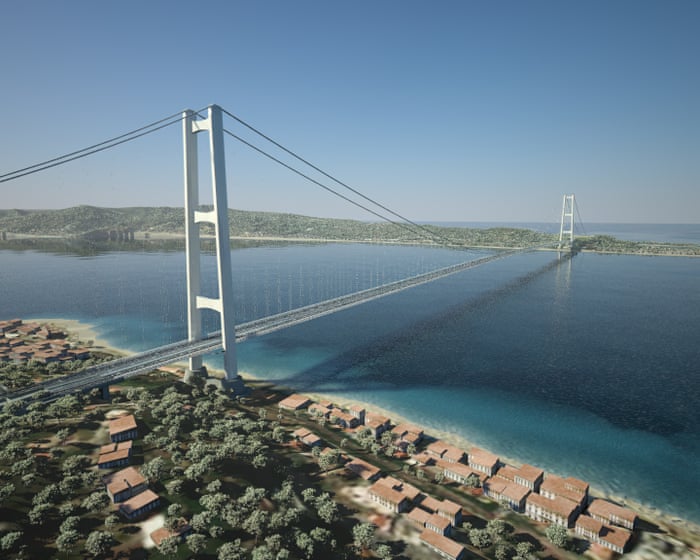
The bridge from Torre Faro to Villa San Giovanni in Calabria would be the world’s longest suspension bridge. Photograph: Webuild-Eurolink Image Library
"You’re surprised I’m so calm. Why should I worry?" said Mariolina De Francesco, a 76-year-old retired university lecturer. Her villa is one of over 400 properties slated for compulsory purchase. "If they didn’t build the bridge before, why would they now? It’s all talk. They’ll never build it."
According to official plans, the bridge from Torre Faro to Villa San Giovanni in Calabria would be the world’s longest suspension bridge, with a central span – the distance between the two main supporting towers – of 3.3km. Its deck would have six traffic lanes, two service lanes, and two railway tracks. No suspension bridge with a similar span exists. The closest is Japan’s Minami Bisan-Seto Bridge, opened in 1988, with a main span of 1.1km.
View image in fullscreen
Mariolina De Francesco, a 76-year-old retired university lecturer, whose house is facing expropriation. Photograph: Lorenzo Tondo/The Guardian
The delays are due to various growing obstacles: concerns from public bodies about the project’s environmental impact, a corruption investigation by prosecutors in Rome, an intervention by Italy’s court of auditors, which is checking its cost, and a long list of requirements from Italy’s Higher Council of Public Works.
In interviews with the Guardian, leading engineers, seismologists, and environmental experts all doubted that the bridge would ever become a reality.
"You might be able to build it," said Antonino Risitano, a former dean of engineering at the University of Catania. "But you cannot guarantee its long-term safety." Risitano said there is no current technology to test suspension cables of that size and length for a single-span bridge. "If you cannot test the suspension cables, you cannot build it. Given today’s scientific knowledge, the current project is not technically feasible."
Webuild, which leads the Eurolink consortium contracted to design and build the infrastructure, declined to comment but said that Risitano’s concerns had already been addressed and refuted in a 2025 technical report by the Strait of Messina company.
View image in fullscreen
The Romans first envisaged a bridge connecting Sicily to mainland Italy. This image shows a Roman bridge built by Julius Caesar across the Rhine in about 55 BC. Photograph: Interfoto/Alamy
The report said Risitano’s concerns about the main suspension cables were not supported by the historical performance of suspension bridges worldwide. It also noted that full-scaleFatigue testing of main suspension cables is not standard engineering practice.
Another major concern about the bridge is that it would be highly vulnerable to seismic activity in the Strait of Messina, one of Europe's most tectonically active areas.
"More than 5,000 low-magnitude earthquakes have been recorded within a 40km radius over the past 40 years," said Carlo Doglioni, one of Italy's leading geologists and former president of the National Institute of Geophysics and Volcanology. "The strait is also slowly widening, with Sicily and Calabria drifting 2-3mm apart each year."
The area is crossed by three fault systems capable of producing earthquakes of magnitude 7 or higher, similar to the one that struck Messina in 1908, killing over 80,000 people. "Although it is impossible to predict when, the region will inevitably experience further major earthquakes," said Doglioni.
"An earthquake of the magnitude expected here could affect not only the tower foundations but also the cable anchor blocks," said Federico Massimo Mazzolani, professor emeritus of structural engineering at the University of Naples Federico II. "Vertical ground motion could reduce cable tension and destabilise the bridge, while horizontal shaking could permanently rotate a tower foundation, leaving the structure damaged and potentially unusable."
View image in fullscreen
A view of the strait of Messina from the coast of Torre Faro, a district of Messina where the controversial strait bridge is slated to be built. Photograph: Lorenzo Tondo/The Guardian
Webuild insists "the bridge has been designed to withstand extreme conditions." They say seismic studies show it would remain structurally safe during earthquakes of up to magnitude 7.1. Pietro Ciucci, chief executive of the Strait of Messina company, said the bridge's foundations had been positioned to avoid active faults.
Tremors aside, opposition to the bridge is also building on other fronts. Last October, Italy's court of auditors blocked the project, saying the government had failed to demonstrate its financial sustainability and ordering revised cost estimates before it could proceed.
skip past newsletter promotion
Free newsletter | Every day
Sign up to Headlines Europe
A digest of the morning's main headlines from the Europe edition emailed direct to you every week day
Enter your email
Sign up
after newsletter promotion
In June, Rome prosecutors opened a corruption investigation into allegations that a lawyer and a businessman sought to influence court of auditors judges by promising support for future public appointments in exchange for approval of the project. The businessman is a former board member of Strait of Messina plc, the Italian state-owned company responsible for managing the bridge's design, construction, and operation.
Both men deny any wrongdoing and rejected the allegations, saying they never sought to influence the court or offered favours in return for decisions.
The court of auditors also raised concerns about compliance with EU environmental rules. The Strait of Messina company insists that environmental protection and biodiversity are "at the heart of the project." But, once again, experts disagree. The WWF argues the bridge would threaten the strait of Messina, a vital migration corridor for millions of birds and marine mammals.
View image in fullscreen
Mariella Valbruzzi and Daniele Ialacqua, founders of the No Ponte Capo Peloro committee. They have both campaigned against the project for a decade. Photograph: Lorenzo Tondo/The Guardian
"The strait of Messina is one of the world's 28 most important bird migration routes," says Gaetano Benedetto, WWF Italy's vice-president. "A 2006 study commissioned by the bridge company estimated that 4.3 million birds crossed the proposed bridge corridor in just six weeks of spring migration."
In early August, Italy's Higher Council of Public Works said the bridge could only go ahead if the government addressed more than 100 requirements, with particular attention to seismic risk and the tesThe construction materials involved are likely to force designers to significantly revise the project.
However, an even bigger concern than the bridge being built is the possibility that construction starts and then stops halfway, leaving permanent scars on the landscape, Benedetto added. The founders of the No Ponte Capo Peloro campaign share this fear.
"I'm convinced the bridge will never be built," said Mariella Valbruzzi, who has campaigned against the project for ten years alongside her husband, Daniele Ialacqua. "What worries me is that work on the roads and viaducts could still begin, burying this protected landscape under concrete, whether the bridge is completed or not."
Webuild claims the project would boost Italy's economy by over €23 billion, generate more than €10.3 billion in tax revenue, and create over 100,000 direct and indirect jobs.
Opposition parties argue that the money would be better spent upgrading Sicily's outdated road and rail networks, which are among the weakest in Europe. For example, traveling the 265km between Syracuse and Trapani by train takes 11 to 14 hours and usually requires three changes—enough time to fly from Rome to New York and clear passport control.
View image in fullscreen
Rosa Cattafi, 66, whose villa is scheduled for expropriation. Photograph: Lorenzo Tondo/The Guardian
Since Roberto Vannacci, a far-right former army general, left Salvini's League to start his own party, the bridge project has become increasingly tied to the infrastructure minister's political future. With Lega slipping in the polls and Vannacci's new party gaining ground, the bridge has taken on added importance for Salvini. An EMG survey puts Futuro Nazionale (National Future) at 7.2%, just 0.5 percentage points behind Lega, fueling speculation that Salvini's leadership within the rightwing coalition could face growing pressure.
"The bridge will never be built. Salvini has failed. He should resign," said Angelo Bonelli, an MP and leader of the Green-Left Alliance (AVS).
Rosa Cattafi wishes she could be as certain that the bridge will never happen. The 66-year-old's villa is another home marked for expropriation. "I bought this house 12 years ago, when the bridge seemed to have been abandoned," she says. "No one can give me absolute certainty that it will never be built. Until it is definitively declared unbuildable, I'll have to live with that uncertainty."
Frequently Asked Questions
Here is a list of FAQs based on the article title A bridge too far Why a link to Sicily remains a dream after 2000 years of proposals
General Historical Questions
1 Wait people have been trying to build a bridge to Sicily for 2000 years
Yes The first recorded idea came from the Romans In 251 BC the consul Caecilius Metellus devised a plan to connect the mainland to Sicily using barrels and wooden planks to transport war elephants Since then everyone from Roman emperors to Italian politicians has floated the idea but nothing has ever stuck
2 Is the bridge just a modern political pipe dream or is it actually feasible
It is technically feasible with modern engineering but its incredibly difficult and expensive The real problem isnt the engineering its the money the geological risks and the political will Its a pipe dream because no government has been willing to commit the massive resources needed to overcome these hurdles
3 What is the actual distance between Italy and Sicily at the narrowest point
The Strait of Messina is only about 31 kilometers wide at its narrowest point That sounds tiny but the conditions under the water are what make it a nightmare
Technical Engineering Challenges
4 Why is it so hard to build a bridge over just 3 kilometers of water
Its not the distance its the location The strait sits on a major geological fault line and is one of the most seismically active areas in Europe On top of that the water is deep and the area is famous for its violent winds and chaotic currents caused by the clash of the Tyrrhenian and Ionian seas
5 Whats the deal with the Messina Bridge that keeps getting announced
Thats the most recent plan named the Bridge over the Strait of Messina It was a massive suspension bridge project that was officially approved in the 2000s with construction slated to start in 2006 The Italian government cancelled it in 2013 due to budget constraints and corruption concerns It keeps getting resurrected by politicians but it has never actually broken ground
6 Could a tunnel be built instead of a bridge
Yes a submerged floating