Few actors show much concern for the audience’s well-being after a film ends. But with The Testament of Ann Lee, Amanda Seyfried is deeply involved. “Did you watch it with someone you could talk to?” she asks, tilting her head sympathetically. When I admit I saw it alone, she lowers her bright, expressive eyes and gives a worried look. “It’s nice to process it with somebody else.”
Her concern makes sense. Whatever feelings the film stirs, indifference won’t be one of them. Intense and rapturous, it’s an all-around oddity—the kind of daring, hallucinatory spectacle, complete with feverish visions and levitation, that once defined filmmakers like Lars von Trier or Bruno Dumont. I admit I wasn’t entirely sure what to make of it, but I knew I’d been through a singular experience. Its director, Mona Fastvold, seated beside Seyfried on a sofa in a London hotel room, looks delighted. “That’s my favorite sort of feeling,” she says.
Fastvold co-wrote the screenplay with her partner, Brady Corbet. Their previous collaborations include last year’s Oscar-winning drama The Brutalist, which Corbet directed. (The couple also handle second-unit directing duties on each other’s films.) Like that film, The Testament of Ann Lee is an immigrant story, though this one is based on fact. Seyfried delivers a fearless, high-intensity performance as Lee, the illiterate daughter of a Manchester blacksmith. In 1758, Lee joined the Shaking Quakers, a religious group named for the ecstatic, trembling dances through which followers responded to the infusion of God’s spirit. This was accompanied by soaring song and rhythmic, chanted incantations. For the film, British composer Daniel Blumberg—who won an Oscar for his score for The Brutalist—has powerfully adapted authentic Shaker hymns and spirituals.
In 1774, Lee and her fellow Shakers brought their religion to the U.S., built a village in Albany County, New York, and preached a gospel of pacifism, racial and gender equality—and celibacy. Just as there’s an austere beauty to the minimalist furniture the Shakers crafted, like ladder-back chairs with woven seats, other aspects of their lives were similarly pared down. “No one can love God while following the lust of the flesh,” Lee tells her disgruntled husband, with whom she had four children, each dying in infancy. Her maternal grief only deepened her religious devotion. “She decided to mother the world,” says Fastvold.
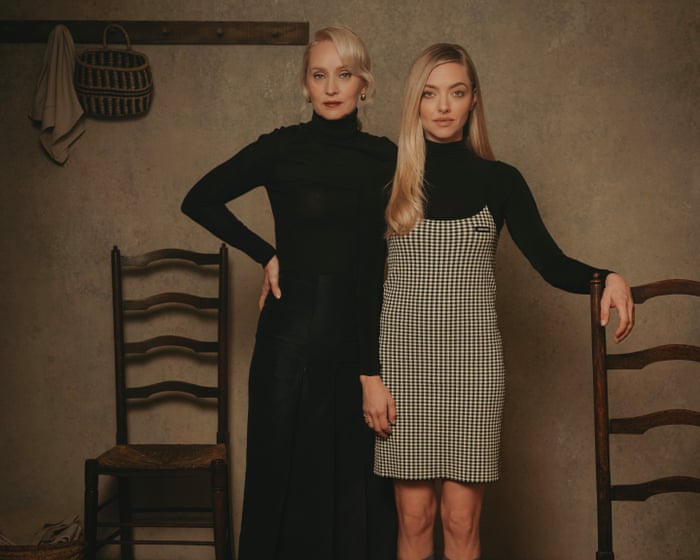
Aside from their similarly light-colored hair, Seyfried and Fastvold are a study in contrasts today. The 40-year-old Pennsylvania-born actor, wearing a black dress with a white collar, is relaxed enough to stretch out her bare legs and rest her black-shod feet on the coffee table. She gestures broadly as she speaks. Fastvold, 44, barely moves: the Norwegian former dancer perches on the edge of the sofa, hands clasped in her lap. Her outfit has a Star Trek vibe—a boxy, stiff-shouldered charcoal felt top with ribbed gray sleeves. Together, actor and director resemble a spirited student and her reserved but loyal governess.
Both are aligned in how they hope audiences will approach the film. Introducing a screening at the American Film Institute last year, Seyfried told the crowd, “Don’t be afraid to laugh: it’s absurd at moments, and that’s what makes it special.” Fastvold agrees. “It’s operatic,” she says now. “Sometimes it’s very serious, and sometimes it doesn’t take itself seriously at all. You don’t want to make fun of anyone, but at the same time we can’t beWe’re not full-on devout Shakers. It’s not like we’re trying to convert people.
Fastvold discovered Ann Lee’s story while researching her previous film, the 19th-century lesbian drama The World to Come. The question for this new film, as with any period piece, is: why tell this story now? “The more I learned, the more I felt I needed it today more than ever. We need to rethink leadership. Leaders around the world are leading from a place of fear and intimidation, which is the opposite of Ann Lee. She led from a place of nurturing, mothering, and equality.”
Fastvold met Seyfried while directing three episodes of the 2023 series The Crowded Room, where Seyfried played an investigator interrogating a suspected gunman (Tom Holland). They worked together again last year on the missing-person miniseries Long Bright River. In between, Fastvold gave Seyfried the Ann Lee script and offered her the lead. The story goes that Seyfried’s immediate response was: “I know the way in.”
“You did say that,” says Fastvold, beaming proudly at her star. “But you also said, ‘Maybe you should cast someone British. Maybe you shouldn’t trust me.’ You had all these excuses. It was sort of gracious—like you wanted what was best for me and the film.”
What was the “way in” that Seyfried had identified? “I was holding on to Ann’s pure passion and devotion,” she says. “I can understand how someone can be brought to their knees in that way, and how compelling and attractive that is to people who need something to believe in.”
Undermining her confidence was something else: “Fear.” She hadn’t been this afraid of a role since playing Marion Davies, the mistress of media baron William Randolph Hearst, in David Fincher’s Citizen Kane-adjacent drama Mank. “Anything that feels far from the contemporary world scares me. Which makes it a thousand times more worthwhile.”
Mank went swimmingly: Seyfried’s joyful performance stole the movie and earned her an Oscar nomination. There may be several reasons why she hasn’t received one for playing Ann Lee. The movie itself is intoxicating once you submit to it, but not everyone will. An anonymous Academy voter recently told Variety that Seyfried was “astounding… I haven’t seen a better performance this year,” but admitted they “didn’t really like the movie.”
Perhaps her outspokenness has also worked against her this time. Last year, she distinguished herself spectacularly by refusing to backtrack on her description of the murdered far-right activist Charlie Kirk as “hateful” in an Instagram comment. She told Who What Wear: “I’m not fucking apologizing for that.” In her own statement, she addressed the importance of nuance: “I can get angry about misogyny and racist rhetoric AND also very much agree that Charlie Kirk’s murder was absolutely disturbing and deplorable in every way imaginable.”
Shortly after that controversy, her name seemed to disappear from the list of five performers predicted to receive a Best Actress Oscar nomination this year. Could it be that the Academy feared another social media-related uproar in that category, after last year’s scandal over reactionary tweets by Karla Sofía Gascón, star of Emilia Pérez? Seyfried needn’t care. “I’ve gotten this far without an Oscar,” she told the New Yorker this month. “Why would I need one now?” She is, as she has said, “sitting pretty” after the success of her offbeat thriller The Housemaid, in which she co-stars with Sydney Sweeney. With that and The Testament of Ann Lee, she has both multiplex and arthouse appeal.
As a trained singer, she has starred in musicals before, but The Testament of Ann Lee was infinitely more demanding than Mamma Mia! or Les Misérables.It’s so technical: the choreography, the live singing, the Manchester accent. I was spinning so many plates. Long before filming began, my preparation was already underway. While I was on other jobs, I’d work on my Mancunian accent in my trailer by watching videos of Maxine Peake. Celia Rowlson-Hall’s choreography also put mighty demands on me. There was a lot of repetitive movement, using my body in a way I’d never done before. It becomes this full-bodied expression of your devotion. I was this vessel. It was exciting and scary and fucking great! To decompress after a day of rhythmic pounding, lurching, and swaying in 18th-century costume, I would listen to something ridiculously different, like the Backstreet Boys.
Much of the film was shot in Hungary on a bustling set. Fastvold encouraged the cast and crew to bring their children along, too. Once most of the families had left, the two women became roommates for the final stretch. I made her move into my apartment, Seyfried says. It was very cozy. I wanted to! Fastvold protests. The sweet thing was that we had both been working and taking care of our children, but once I moved in with Amanda… She turns to address her directly: You were doing little things to take care of me. I’d done my laundry, then gone out location scouting on a Sunday, and when I came home, my socks had been balled up and placed in my closet. I nearly cried. Brady’s very nurturing, and he makes the best sandwich ever. But at the same time, there was something about living with this very maternal person that was amazing. It has set a high bar for the future. Now I’ll ask all my leading ladies, ‘How do you feel about folding laundry?’
The nourishment flowed both ways. I would wake up and you’d have the French press, the beautiful music playing, a candle going, Seyfried recalls. We went to the spa, and you brought your little shot list. Mona’s so funny. She gets ready for work and has her cute handkerchief. I was like, ‘My God, she’s an angel from heaven!’ Not the sort of stories you hear from a Michael Bay set.
Fastvold and Corbet have an 11-year-old daughter, Ada, while Seyfried and her husband, Thomas Sadoski, have a son and daughter, both under 10. Corbet made a point of singling out a tearful Ada in the audience at the Golden Globes last year when he won the best director prize. Fastvold says: Early on, when my daughter was young, she would say, ‘Why do you have to go off and make a film and be away from me? Why can’t you be a teacher?’ My instinct was to say, ‘I have to go out and make money for us.’ Then I realized that’s not the right thing to say. What I should say is, ‘I’m going to leave you because I really want to do this job. I’m so excited to do it. And I am going to miss you, but I’m going to have such a fun time.’ And she accepted it in a totally different way. She didn’t feel that I was being forced to leave her.
Amanda’s very free. She needs to not have any filter, I think, to access all the places she needs to go in her work. Seyfried likes to let her children see her vulnerability. The other day, I told my daughter, ‘I’m sad because right now I’m tired and I’m traveling away from you, and I miss you.’ But she knows that what I’m doing right now is important for me. Of course, she also knows I’m going to pick stuff up for her. She’ll get stationery, she’ll get plushies…
Both women have been extravagant in their praise for one another while promoting The Testament of Ann Lee, but two adjectives have leapt out: Fastvold has admiringly labeled her star a little mad, while Seyfried has plumped for brave.Did they care to elaborate? Fastvold clarified her remark: “Mad in a playful way. The best of us are, I think. What I mean is, Amanda is very free. She needs to have no filter, I think, to access all the places she needs to go in her work.”
As for the bravery part: “You don’t care about the rules,” Seyfried told Fastvold. “You don’t care if something is hard to do. You absolutely stay on your own path. Look, you directed a Shaker musical set in the 1770s about a woman no one has ever heard of. And it premiered at Venice!”
It sounds almost Ann Lee-like. Does that mean there is an autobiographical dimension to the film? Fastvold smiled bashfully. “Isn’t there always?” she said. The Testament of Ann Lee is in UK cinemas from 20 February.
Frequently Asked Questions
Of course Here is a list of FAQs about Amanda Seyfrieds comments on obsession devotion and the simple joy of socks based on the tone and themes of her interview
General Understanding
Q What is Amanda Seyfried talking about when she says brought to your knees
A Shes describing a feeling of being completely overwhelmed by a powerful emotionlike deep love artistic obsession or profound devotionto the point where it feels humbling and allconsuming
Q Whats the main theme of her interview
A It explores the contrast between intense lifealtering passions and the simple grounding pleasures of everyday life
Q Is this about a specific project or role of hers
A Often yes She frequently discusses this in the context of playing complex obsessive characters but she also applies it to personal experiences of love and motherhood
About Obsession Devotion
Q What does she mean by obsession in a positive way
A She refers to the deep focused dedication required for great art or understanding a character Its about being fully immersed and committed not about unhealthy fixation
Q How is devotion different from obsession in her view
A Devotion often has a softer more loving connotationlike the commitment to family or a partner Obsession is more about a singular driven focus often on a project or idea
Q Can being brought to your knees be a good thing
A According to her perspective yes It can signify being powerfully moved by something beautiful or important like the birth of a child or a transformative role which is vulnerable but rewarding
About the Simple Joy of Socks
Q Why does she always mention socks
A Socks represent comfort simplicity and a return to normalcy After dealing with heavy emotional topics or intense work she highlights the importance of appreciating small tangible comforts
Q Is she being literal about the socks
A Both literal and metaphorical She genuinely enjoys cozy socks as a comfort item but they also symbolize the need to balance intense feelings with grounding everyday rituals