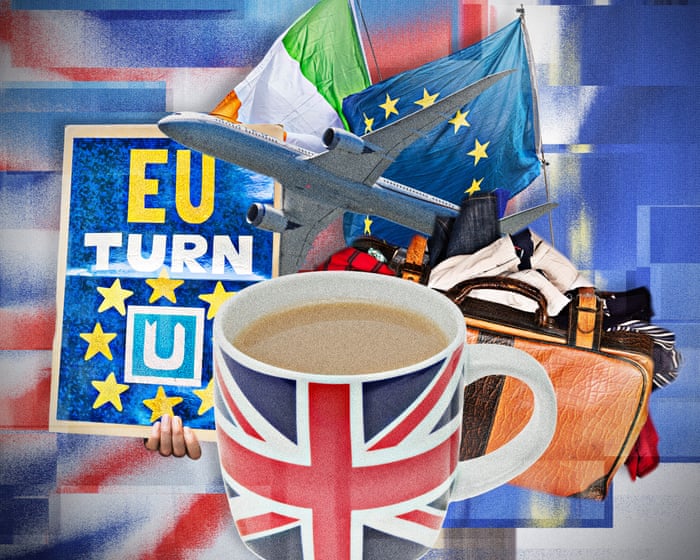
My suitcase was packed – but I stayed to find out what drove Brexit voters
Julia Ebner
Austrian researcher on counter-extremism, co-executive director of the Institute for Strategic Dialogue, and a dual British-Austrian citizen
What she wrote after the referendum: “I put all my time, money and energy into a marriage that is now doomed to fail – because no matter what the actual consequences will be for EU migrants living in the UK, the atmosphere has changed and I no longer feel welcome here.”
What she says now: I remember waking up in shock ten years ago. My suitcase was ready to be packed. Emotionally, it felt like I had just found out my partner had cheated on me.
But once the initial feelings passed, I did what most people would do in a committed marriage: instead of filing for divorce, I decided to look into what had gone wrong. I spent a lot of time listening to Leave voters and quickly realized it would be unfair to judge an entire country based on a narrow majority. Britons had been forced into a life-changing binary choice during a campaign marked by political manipulation, foreign interference, and algorithms that amplified divisive content.
Now, a decade later, I’m no longer an Austrian national living in the UK. I’m a voting British citizen, a mother of two British children, an academic at a British university, and a frequent adviser to the British government. I’ve even sworn loyalty to King Charles.
Against a backdrop of growing hostility toward immigration, foreign cultures, and languages, I’m also doing my best to keep my European side alive. I feel lucky because neither my skin color nor my religion gives away my non-British roots. Ten years on, it’s clear that the xenophobic anger didn’t end with Brexit. UKIP’s “breaking point” poster and the murder of British MP Jo Cox in 2016 were early warning signs of a bigger trend.
From the Southport riots to the Unite the Kingdom rally, from the protests in Southampton to the violent escalations in Belfast, the far right has succeeded in making its anti-immigration ideas mainstream. Yet the loudest calls for patriotism are the biggest threat to the British values I chose to embrace.
The world is different now, but Britain’s natural place is in the EU
Guy Verhofstadt
Former prime minister of Belgium and former chief Brexit coordinator for the European Parliament
What he wrote after the referendum: “Brexit will be a sad, surreal, and exhausting process. The EU must use the UK’s departure to reform and move forward. Britain can choose to be a partner in this process, or it can be an obstacle. Let’s hope for a future relationship based on trust and genuine partnership.”
What he says now: A decade on, Brexit hasn’t solved Britain’s relationship with Europe. It has only made it more complicated, more costly, and more frustrating. The promises made in 2016 haven’t matched reality. Trade barriers have increased, and Britain has found itself outside the room when decisions affecting its future are made.
The world has changed too. Faced with Russian aggression, economic competition from authoritarian powers, climate breakdown, and rapid technological change, the case for European cooperation has grown stronger. Countries acting alone can’t effectively tackle these challenges.
For me, the lesson of the past ten years is clear: Britain’s natural place is in the European Union. The EU isn’t perfect. But Britain’s interests, values, security, and prosperity are fundamentally European.
A generation of young Britons see no conflict between being proudly British and proudly European. They understand that their future security and opportunities are tied to the continent they belong to.
The responsibility now falls to them. The generation that lost its European citizenship without being asked shouldn’t accept a permanent loss. Political decisions can be reversed, and the next chapter of Britain’s story is still unwritten.Britain’s European story has yet to be written. Young Britons should have the ambition to write it.
Leaving Brexit Britain was the best decision of my life
Oliver Imhof, German writer and freelance journalist formerly based in the UK, now in Madrid
What he wrote after the referendum: “As a democrat, I have to accept a defeat. I have to accept being oppressed by a majority of an older generation that seems intent on depriving us of our future. That’s why I’m leaving this country. When? Definitely before the ink dries on the divorce papers. Where am I going? I don’t know yet, but hopefully somewhere warm where our generation has a voice.”
What he says now: In September 2018, I packed my bags and said a completely unemotional goodbye to a city I once loved. I left behind an amazing group of people, but I was so fed up with the UK that I wasn’t exactly wiping away tears when the plane took off from Gatwick. The moment the airport gate opened in Madrid, I felt nothing but relief.
Leaving has turned out to be the best decision of my life so far. While the UK was battered by Brexit and the Covid-19 pandemic, Spain came out thriving. Ironically, it did so by adopting everything British people voted against in the 2016 referendum. Sensible and relatively liberal migration policies brought a fresh spirit to the capital. A functioning welfare state provides basic services so no one gets left behind. Hard work guarantees you a decent life in sunny weather. It almost makes you feel like the Spanish economy works for the people, not the other way around.
Yet every year I return to the UK. Often I’m shocked by the levels of poverty, half-empty high streets, and the sense of insecurity, although I sometimes miss life in London, a city where no one is really a foreigner. Bureaucracy on the continent can be slow sometimes, and I do appreciate Anglo-Saxon qualities like a hunger for innovation and open-mindedness.
I hope the UK can overcome its divisions and revive the progressive mentality that once made the country great. Ideally, it will do so as part of a united Europe one day.
Brexit has brought Ireland closer to unity
Emer O’Toole, Irish writer and associate professor of Irish performance studies at Concordia University in Canada
What she wrote after the referendum: “It’s probably best, then, that we come to terms with the uncomfortable idea that Ireland will, in a sense, be partitioned a second time. And yes, this could unsettle the peace. All parties – the UK, Northern Ireland, the Republic, and the EU – need to do everything in their power to ensure that the border they create fits the contours of our past and our present.”
What she says now: I remember joking about the fact that no Brexiter could offer a coherent plan for Northern Ireland; that they’d just, to quote Paul and Linda McCartney’s hit “Give Ireland Back to the Irish.” It was surreal that Brexit could happen when there really was no plan.
The unionist community was against a customs border in the Irish Sea, while the nationalist community rejected a return to a hard border on the island. I remember going over the possibilities with friends and family: what a return to checkpoints would look like, the danger it posed to a peace agreement that was, at that point, less than two decades old. Reading my column, I’m brought back to those anxieties, and to the hope that those in power would prioritize peace. Ultimately (to cut a long story short), the customs border was placed in the Irish Sea, and the peace was preserved.
In 2016, I speculated that Brexit would bring Ireland closer to unity, and it has. The post-Brexit customs solution for Northern Ireland was supposed to offer a best-of-both-worlds scenario, where it kept access to the EU single market while remaining part of the UK. But Brexit has helped widen the gap in living standards between the North and the Republic. Standards of living in the Republic are…Now the numbers are much higher, and the gap is growing. More people are traveling from the North to the Republic for work. This new economic reality goes hand in hand with a changing identity and political landscape. The figures I gave in 2016 for “British only” (40%), “Irish only” (25%), and “Northern Irish only” (20%) identities in Northern Ireland have now shifted to about 32%, 29%, and 20% respectively. In other words, after Brexit, the number of people who call themselves unionists and nationalists is nearly equal. Meanwhile, Fine Gael, one of Ireland’s main political parties, is working on a plan for unity. If people in Northern Ireland eventually vote to join the Republic, there will be a plan ready.
‘Brexodus’ didn’t really happen – but the UK is no longer a promised land
Jakub Krupa
Former UK correspondent for Polish media, now the Guardian’s Europe live blogger
What he wrote after the referendum: “The idealistic image of the UK that many Europeans have always had – a place of cultured and informed public debate, along with its trademark openness – has changed over the last few months. Instead, an ugly face of xenophobia and anti-migrant sentiment has taken center stage. Maybe I’m naive, but I still firmly believe Britain is better than this.”
What he says now: After the Brexit referendum, I called for a country that works for everyone, including EU citizens. Facing deep uncertainty and incidents of abuse, many wondered if the UK would still be their home in the future. Ten years on, the vast majority have stayed, even though things have changed a lot. So there hasn’t been the big Brexodus some people claim – not even close – but right now, more Romanians and Poles are leaving the UK than arriving. Britain is no longer the promised land it used to be.
This new reality is often discussed with barely hidden condescension – maybe because of Britain’s lingering sense of exceptionalism. “Wait, what? Even in Poland, that country of tabloid-ridiculed swan-eating manual laborers we looked down on, things are better now?” It’s ironic that a Polish passport is now more powerful than a British one, and that more and more Brits are searching their family trees for Polish roots. They’re welcome to visit, but only for less than 90 days in any 180-day period – Schengen rules are Schengen rules.
The millions of EU citizens still in the UK now rely on the settled status and rights they were given as part of the Brexit deal. But after Nigel Farage recently told the Italian newspaper La Repubblica that he would tear up those rights if Reform gets elected in 2029, they’ll be losing sleep over their future.
Faced with this ongoing uncertainty, or maybe wanting to show their love for their new home, or both, just under half a million people have become UK citizens since 2016 (468,322, to be exact). Romanians, Poles, and Italians have led the way. It’s an expensive, ridiculously bureaucratic process that can take away some of the joy and relief, but getting citizenship should be seen as a vote of confidence in the UK. For these new Britons, the UK is no longer just a place to earn money temporarily – it’s where they’ll build a home and start families. It’s their country too.
But looking at these numbers, I can’t help thinking about everything that didn’t happen. About experiences, friendships, and loves that could have been but weren’t. About people who would have moved to the UK to study and fall for this wonderful, welcoming country – but didn’t.
That’s how my story began. If I were younger, it wouldn’t have. It couldn’t have.
I’m still relieved – Britain’s heart was never in it
Joris Luyendijk
Dutch journalist and non-fiction author
What he wrote after the referendum: “Democrats across Europe are in shock over Brexit, when they should be jubIt’s a blessing that a slim majority of British voters—mostly from England and Wales—voted against their own short- and long-term economic interests to leave the EU. For decades, British governments played a double game: they took all the benefits of EU membership while avoiding its responsibilities, and in the meantime, they undermined and even blackmailed the club from within. All of that is now over.
What he says now: When I moved to London in 2011, I was as anglophile as they come. Growing up in the 80s on a diet of The Smiths, The Young Ones, and British journalism, I thought I was moving in with my European cousins.
Five years later, I had become so disillusioned with British political and cultural attitudes toward Europe and the EU that I was actively rooting for Brexit. Ten years later, I’m still an anglophile. And I’m still relieved that Britain is out.
Europe has two kinds of countries: small ones, and small ones that don’t realize it yet. Britain is the last country in the second category. More mature political cultures elsewhere on the continent realized long ago that they need to pool resources, even if it means giving up some sovereignty.
For key parts of the British—and especially English—political and media class, that idea is heresy. At best, they support the EU on transactional grounds, arguing that the UK can get more out of membership than it puts in. But for the EU to work and become democratic at the European level, it needs to be transformational—something that has never been built before.
Britain’s heart was never in this “European project.” For decades, its politicians ridiculed, undermined, and blackmailed their way from summit to summit, treating EU membership as a favor they were granting to Europeans.
Then, Britain voted to leave. That was incredibly stupid, especially since it happened based on lies and manipulation.
But imagine a European summit with Nigel Farage at the table. The EU is too important to leave to self-delusional British saboteurs.
Lost jobs, split families: the human cost was plain to see
Anne-Laure Donskoy
Founding member of the3million, a grassroots organization for EU citizens in the UK
What she wrote after the referendum: “I will always remember the mood at the oversubscribed first meeting of the3million forum in early July in Bristol. The anxiety in the room was palpable. People who had lived in the UK for anywhere from a couple of years to 60 or more suddenly found themselves with huge question marks about their future, their lives, and their families. Something had to happen; apathy was not an option.”
What she says now: Back then, I was experiencing a heavy dose of anxiety. I had started and was co-chairing the group the3million, defending EU citizens in the UK who had no roadmap, despite promises made by out-of-touch, legally incompetent politicians who focused on slogans.
Over the next three years, along with many committed campaigners, I worked to support the rights of EU citizens—not forgetting British citizens in Europe—in a post-referendum settlement. We saw the full, devastating impact of Brexit on people who had only been exercising their free-movement rights. In 2017, I collected and presented data to the UK government showing that the permanent residency application process was a disaster, leaving entire groups in precarious situations, especially women and vulnerable people. It took the relentless and determined efforts of UK- and EU-based citizen rights groups to get both sides to understand the devastating absurdities of Brexit.
Beyond the legal and technical aspects that turned ordinary people into playthings of politicians, the human cost of Brexit was plain to see from the start: lost jobs, missed opportunities, split families, Kafkaesque bureaucracy, despair, and open, unashamed abuse and assaults.People who have lived in the UK for a long time have lost their sense of belonging and still feel let down. Sadly, things haven’t fully calmed down, and problems continue.
Ten years later, my life has been reshaped by Brexit. I’ve become a British citizen, but I haven’t completely moved on from it. I’m now doing a PhD on how women activists have worked in the wake of the Brexit vote—showing once again that the personal is always political. For everyday people, this story isn’t over yet.
Frequently Asked Questions
Here is a list of FAQs about European perspectives on Brexit based on the theme I remember the shock It can still be reversed
BeginnerLevel Questions
1 What does I remember the shock mean in this context
It refers to the surprise and disbelief many Europeans felt when the UK voted to leave the EU in 2016 Most polls and experts expected a Remain win
2 Why do some Europeans think Brexit can still be reversed
A significant number of Europeans believe the UK could rejoin the EU in the future They see current public opinion shifting in the UK and the practical difficulties of Brexit as reasons to hope for a return
3 Do most Europeans now regret Brexit happening
Yes a majority of EU citizens in countries like France Germany and Italy think Brexit was a mistake for the UK Many also feel it weakened the EU itself
4 Has Brexit changed how Europeans view the UK
Yes Many now see the UK as less reliable more inwardlooking and a competitor rather than a close partner The special relationship has cooled in practical terms
5 What is the biggest problem Europeans see with Brexit today
The biggest problem is trade friction New customs checks paperwork and border delays have made it harder and more expensive for EU businesses to export to the UK and for British tourists and students to visit
IntermediateLevel Questions
6 What specific examples show Europeans think Brexit was a bad idea
Trade German car exports to the UK fell sharply after new rules
Travel EU citizens now need visas for long stays in the UK British tourists face longer queues at EU borders
Science UK universities lost access to EU research funding and networks
Fishing French fishermen lost access to UK waters causing protests
7 How do Europeans feel about the UKs current relationship with the EU
Most want a closer more cooperative relationship but they are wary of giving the UK cherrypicking benefits They prefer a standard distant trade deal
8 What would it take for the UK to rejoin the EU according to Europeans
It would require the UK to
Rejoin the single market and customs union
Accept free movement of people