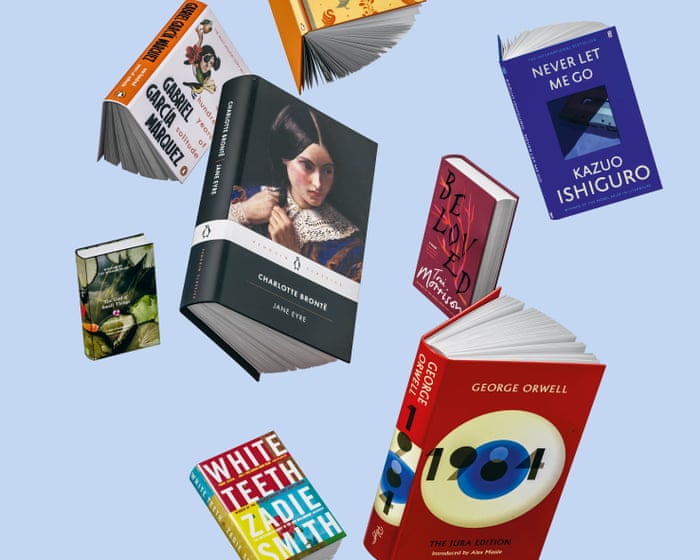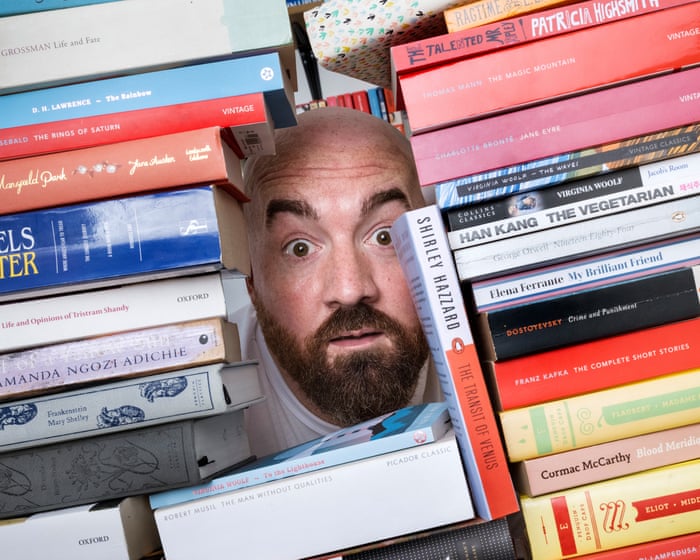
It’s a privilege to be surrounded by books. My parents come from the literary working class—a group of people who believe that great books lead to a better life. For them, reading was a kind of reverse class snobbery. My dad could read as well as anyone. He’d prove it on package holidays, sitting on the balcony the whole time, head down, cigarette in hand, flipping through Jane Austen or Herman Melville. The only difference between my father and an old Etonian was the grind of having to work. To borrow from Oscar Wilde: work is the curse of the reading class.
As for my own reading habits, my mum wore me down. Any time I said I was bored, she’d shout, “Read a book!” I gave in pretty quickly. She nudged me toward the classics—books that Italo Calvino described as ones people say they should “reread,” either because they’ve already read them or don’t want to admit they haven’t. In my late teens and twenties, I worked my way through the greats. I fell in love with a woman named George and thought Middlemarch was magical. I was a smart kid, prone to bad decisions, unsure of my place in the world. It’s probably no surprise that I identified with Dorothea.
My appetite for the classics faded along with my hairline. In my early thirties, I turned to contemporary writers—favorites like Zadie Smith, Sally Rooney, Elena Ferrante, Roddy Doyle, and Chimamanda Ngozi Adichie. Then, a few weeks ago, I came across the Guardian’s new list of the 100 best novels. I nearly burst with smugness. I’d read 68 of them and decided right then to read the remaining 32. I thought about how unbearable I’d be at dinner parties. Most of the books I hadn’t read were old, hefty Victorian novels—the kind I used to love. I felt almost excited.
Then I opened the first book. The Life and Opinions of Tristram Shandy, Gentleman isn’t really about life, and it’s not about Tristram Shandy either. The novel is mostly about opinions. Laurence Sterne threatens the reader in the opening pages, hinting at a few possible digressions, and spends the rest of the book following through on that threat. F.R. Leavis, in The Great Tradition, dismisses Sterne for “irresponsible (and nasty) trifling,” which feels like too kind a critique. I found Tristram Shandy unforgivable. The language was wordy, the plot impossible to follow, and the detours infuriating.
I turned to something more modern. Dracula was fun for the first 150 pages, and I enjoyed the vampire’s general campiness. But I struggled with the obvious absurdity of the epistolary format. Every journal entry was written in the exact style of a rambling Victorian novel. And Van Helsing drove me crazy with all his moralizing and dithering. I wasn’t exactly rooting for Count Dracula, but I wouldn’t have minded seeing a piece of sweetcorn stuck in Van Helsing’s teeth.
In my twenties, I used to take Charles Dickens on holiday. I read David Copperfield by the pool. I had a tough time with Hard Times, but Great Expectations lived up to the hype. So now I turned to Our Mutual Friend. Dickens divides writers. George Orwell criticized his politics, Ford Madox Ford hated his style, and E.M. Forster despised his characters. But I loved the pacing and the humor—both subtle and not-so-subtle. The characters sometimes veer into caricature, but I often loved that. Dickens may not have Eliot’s intelligence or complexity, but it’s hard to deny the guy was entertaining.
But again, while reading Our Mutual Friend, I found my concentration slipping. I kept checking football scores, and I don’t even really care about football. Even with Dickens—a writer I once loved—I found the story complicated and the prose as heavy as the 900-page book. I put it down after about 60 pages. Dislike one classic, and you can blame the book. Dislike three in a row, and the problem seems bigger. So what had changed? Have we all changed? Or was it just me?
The page makes few demands. It is liReading is quiet and focused, allowing us to concentrate on a single task. The page has no pop-ups, no calls to action, no ads fighting for our attention. But according to research by psychologist Gloria Mark, screens push us to switch our attention and chase after new, shiny things. We focus on interfaces, ads, and interactive elements instead of the content itself. Online, research by Chartbeat shows that one in three readers spends less than 15 seconds on any given article. Many who started reading this piece probably didn’t make it this far. Good riddance.
Screens have changed how we read. They encourage a shallower reading experience, promoting skimming and scanning. Reading on a screen has hurt reading in general, and our reliance on screens has led to a kind of text fatigue. Kate McLoughlin, a professor of English literature at the University of Oxford, says we read more than ever, just not books. “There’s a huge amount of reading going on: social media posts, blogs, comments below articles, text messages, emails, and the outputs of AI.”
Work makes the problem worse. According to the National Readership Survey, more of us now have managerial jobs instead of manual ones. We spend our days staring at screens, drowning in instant messages, emails, and work-related clutter. After all that bad reading, people don’t want to spend their free time on Victorian classics.
Read one chapter per session, and you’ll be better able to appreciate the details of these worlds—and their cliffhangers.
My parents are a good example. My dad was a middle manager, spending his days with reports and emails. He struggled to pick up a book during evenings and weekends, cramming classics into two-week summer holidays. But my mom worked as a childminder, basically a manual job, and she managed to read novels every evening.
But the biggest problem with classics is the lack of practice. Nancy Yousef, a professor of English at Yale, explains the challenge of reading 18th- and 19th-century novels. “The main challenge is the length and complexity of sentences we’re no longer used to,” Yousef says. “Following a thought or an image through multiple subordinate clauses, through thickets of syntax that might involve conditionals and conjectures, and shifts in register that take you from concrete to abstract and back again—that’s difficult.” Helen Hackett from University College London agrees. “Older books are often quite thick, and the sentences are thick too,” she says. “Even as a professor of English literature, at the end of a tiring workday, I more often turn on the TV than open a book.”
As a teenager, I had no trouble reading authors like Sterne, Bram Stoker, and Dickens, but now they felt absurdly challenging. In less than a decade, I’d lost the ability to read some of the best books ever written. I had no idea how that happened. The experts I spoke to told me, over and over, that classics require patience and practice. A good reader needs to learn or relearn how to read them. So how do I practice the classics?
View image in fullscreen: Reading is easier when you have a companion to help. Photograph: Linda Nylind/The Guardian
The most common advice: start small. Katie Garner, a senior lecturer in 19th-century literature at St Andrews, recommends the “Read like a Victorian” strategy: “Replicate the experience of reading Victorian classics in the serialized form in which they were originally published.” Dickens, Elizabeth Gaskell, and many others first appeared in that format. Self-serializing slows us down, lets us linger on the text, and creates suspense. “Read one chapter per session, and you’ll be better placed to appreciate the details of these Victorian worlds—and their cliffhangers.”
View image in fullscreen: You can break a book into chunks, or simply pick smaller books. Anton Chekhov once wrote to a friend: “I have a mania for shortness. Whenever I read—my own or other people’s works—it all…”It doesn’t seem short enough to me. I used to fetishize big books. I tweeted about them. I steered conversations toward the big books I’d read—it was reading as performance. But now, concise novels impress me more. I enjoy watching a writer do more with less. There’s a fine line between the Tolstoy of Anna Karenina and the Tolstoy of War and Peace. For readers returning to the classics, maybe start with The Prime of Miss Jean Brodie or The Metamorphosis.
“The world in classic novels can feel distant and strange compared to our own,” McLoughlin says. “In Britain, the rise of the novel has long been tied to the rise of an entrepreneurial class. What entertained white, male Victorian capitalists may not appeal to today’s audiences.”
More recent classics tend to ease readers into reading. They speak to our present, with all its complications. Start with Catch-22 or anything by James Baldwin—books that feel more current than most contemporary novels. To read our world, to understand it, few come close to Toni Morrison. Writers like Philip Roth and J.G. Ballard questioned whether fiction could change the world, carrying the burden of false humility. A few pages of Morrison lift that burden.
Or read old books that still shape our world, old books that feel deeply new. Frankenstein resonates with those of us worried about the inflated egos of any given tech bro. Critics often focus on the novel’s philosophy, its vitalism, its social contract, but Mary Shelley writes with prose sharp enough to perform surgery. Or turn to Wuthering Heights, a novel that reinvented itself several times over, speaking to today’s narratives of class and race. Or pick one of those pesky dystopian novels, always relevant to people of all political views who are convinced their opponents are tyrants. Calling anything Orwellian is now Orwellian, but Orwell is still worth reading.
“Once you’ve listened to Alan Rickman read The Return of the Native,” Garner says, “you’ll be hooked on Thomas Hardy.” I frown on people who frown on audiobooks. Despite their best efforts, they’re not better than the rest of us. Audiobooks improve accessibility, and we should welcome anything that helps people read. The only problem with classic audiobooks is that, since the texts are in the public domain, hundreds of versions have been recorded by any amateur with a microphone. So you’ll need to look for favorite actors, to find your Rickman. Or ask for recommendations. I fell in love with audiobooks after listening to Stephen Fry narrate The Hitchhiker’s Guide to the Galaxy. The next audiobook on my list is Their Eyes Were Watching God, read by actor and civil rights activist Ruby Dee, as recommended in the Guardian by Afua Hirsch.
Supplementary materials improve accessibility. The best ones are inside books. Editions like Penguin Classics and Oxford World’s Classics aim to make reading easier and more understandable, with introductions, timelines, glossaries, maybe even a map or two. The best have explanatory notes that guide readers, telling us exactly when authors are throwing shade. The classics are in constant conversation: satirizing, parodying, contradicting, seeking revenge. Explanatory notes give insight into the pettiness of authors. And they slow us down, helping us appreciate the writing.
Good reading leads to better reading. In The Novel: a Biography, Michael Schmidt writes: “Reading is a cumulative act, adding skills, increasingly creative as it goes. To become a ‘good reader’ you must give yourself over to a regime of concentrated pleasure.” The more you read, the richer the reading becomes. You’ll start to notice how novels speak to each other. Connections will often seem obvious, like how Wide Sargasso Sea responds to Jane Eyre. Some connections may feel just right.For example, Things Fall Apart challenges the Eurocentric view of Africa presented in Heart of Darkness. Sometimes, these connections just make reading more enjoyable. Take this: knowing Henry James’s work makes reading one of my favorites, The Line of Beauty, even better.
I started putting these tips into practice. I bought the Oxford World’s Classics edition of Our Mutual Friend and began again. The introduction shows how Dickens’s life shaped the story—his marriage breakup, the death of friends, and visits to a poor East End neighborhood. The explanatory notes also deepened my appreciation of the writing. Just page ten has four notes: one describing an intriguing metaphor, references to famous naturalists and chemists, and an allusion to a poem by Thomas Moore. I check any note that catches my interest, and the little curiosities are usually delightful.
I’ve adopted the “Read like a Victorian” approach: I read only a few chapters at a time and put the book down with a thud, even if I want to keep going. I’m taking Our Mutual Friend slowly, without rushing toward a self-imposed finish line. The digressions still bore me, but I’m learning to appreciate the arguments and the lively passages—at least the good ones. I’m gradually getting used to the longer sentences, the shifts in tone, and the complex syntax. My love for classics is slowly returning.
Books open our minds and keep them open. They improve how we communicate, think critically, and learn. But most importantly, novels boost our empathy. They help us navigate the world with kindness and compassion. Putting away screens and spending time with a classic, lingering a little on human nature, feels like a worthwhile pursuit—even if you need a few tricks to do it.
There’s no wrong way to read the right book. In literature, as in life, ignore the purists and find your own path to success. Start at the end if you want. Tear the book in two. Maybe read it aloud in a Glaswegian accent. Do whatever it takes to get reading.
It’s probably best to end with some wisdom from Virginia Woolf, the only writer to appear on the Guardian’s list five times: “The only advice that one person can give another about reading is to take no advice, to follow your own instincts, to use your own reason, to come to your own conclusions.”
Do you have an opinion on the issues raised in this article? If you’d like to submit a response of up to 300 words by email for possible publication in our letters section, please click here.
Frequently Asked Questions
Here is a list of FAQs based on your situation designed to help you get back into reading classic novels
BeginnerLevel Questions
1 I used to love reading but now I cant focus Is it possible to get that back
Yes absolutely Your brain has just gotten used to short bursts of information Start with just 10 minutes a day without your phone The focus is a muscleyou have to exercise it again
2 Where do I even start I feel overwhelmed by all the mustread lists
Dont start with War and Peace Pick a shorter storydriven classic like Of Mice and Men or Animal Farm They are powerful but quick to read
3 What if I dont understand the oldfashioned language
Thats normal Dont stop to look up every word Try to guess the meaning from the sentence If you are totally lost after a page try a modern translation or an annotated version
4 Do I have to read the book in one sitting
No Thats a modern pressure Classics were often published in serialized chapters Read one chapter a day Its actually closer to how the author intended them to be enjoyed
Intermediate Advanced Questions
5 How do I deal with the slow start of most classic novels
Classics often spend the first 50 pages setting the scene Push through it A good trick is to read a plot summary online first so you know where the story is going This removes the anxiety of being lost
6 I get distracted by my phone every 5 minutes Any practical tips
Yes Use the phone in another room rule Read a physical paperback If you must use a device put it on Airplane Mode Also try reading out loudit forces your brain to slow down
7 What if I start a classic and I hate it Should I force myself to finish
No Life is too short A classic is just a book that has lasted a long time If you hate