On a hot, still, silent noon at a crossroads of dirt roads in rural France, Thomas Trezise stood scanning the horizon, looking and listening for his wife. He tried to calm a deep sense of dread. Susan Brison had left for a morning walk two hours earlier. How could she be gone so long? It was 4 July 1990, the beginning of what was supposed to be a busy summer. Trezise and Brison were both assistant professors in the US—he in French at Princeton, she in philosophy at Dartmouth—and had just arrived at the remote farmhouse of Trezise’s French colleague. Life seemed full of promise. “I’d found someone with whom I really wanted to spend my life, and I just felt very, very lucky,” says Trezise. “Susan and I had fallen quickly and deeply in love—it was magical—and at that point, we were also trying to conceive a child. We loved being in France. I felt I’d found my way. It was a good place… until it happened.” By 1pm, Trezise was still trying to hold back rising panic when, out of the corner of his eye, he saw his colleague running toward him, yelling. “That’s the moment I remember,” says Trezise. “I just thought: ‘OK. I wasn’t wrong that something had happened.’ It was terrifying.” An ambulance was at the gate, but Trezise could not recognize the figure inside. She was bandaged, bruised, and bloodied, her cheeks hugely swollen, her eyes reduced to slits, and an enormous bulge on her forehead. Seeing his reaction, Brison slowly lifted her oxygen mask and said in a hoarse voice: “I’ll be OK.” “I knew I needed to be there, I needed to listen, but—this is a masculine thing—I wanted to fix it and I knew I couldn’t.” Outside on the driveway, Trezise allowed himself one scream to the skies, fists clenched. Though it would be days before he learned exactly what had happened, it was instantly clear to him that a man had done this to her. Back in the ambulance, on the way to a hospital in Grenoble, it took every ounce of Trezise’s will to contain his anger, fear, and frantic emotion, and instead project calm. It was, he remembers, like “an actor taking the stage.” He became, or tried to become, “the strong, supportive spouse.” This is the starting point of Trezise’s memoir, Beginning Again, which gives a powerful account of the days, weeks, and years that followed. It’s a voice we rarely hear, especially in such depth—a man’s experience of his wife’s rape and attempted murder. Trezise and Brison are in their seventies now, tenured professors with an adult son. Within months of the assault, Brison had begun speaking publicly about sexual violence. Before long she was writing about it too. In 1993, her account was published in the New York Times, and later her book, Aftermath, explored how to find sense and meaning when you have landed far beyond the moral universe. It was Brison who suggested that Trezise write about it too. “I knew he had it in him to write this book,” she says, “and I was always encouraging him.” For Trezise, there were many layers of difficulty in doing so. “One was this feeling of complicity,” says Trezise. “It’s impossible not to know that the vast majority of sex crimes are committed by men. A simple way of putting it is that, if I’d gone on that same walk that day, I would have been safe.” Entitlement was another barrier. “What voice do I say this in? I do not want to claim ‘victimhood’ when Susan’s victimization was so much worse. But I did want to say that this has very dire effects and it’s not just my story, it’s the story of millions of people.” When men stay silent, sexual violence gets filed under “women’s problems,” when of course, says Trezise, it’s “a problem for humanity.” During their first 11 days in the hospital, Trezise slept beside his wife, with the help of sedatives prescribed to both of them. Brison couldShe could barely speak—she had been strangled so badly that her trachea was fractured—and Trezise became her voice, her support, her advocate, and her protector, because Brison was terrified that her attacker might show up at the hospital. Trezise was also on high alert. They refused to be separated, even during treatments and examinations. His book describes helping her take her first bath—just the two of them, locked in the bathroom, him washing her, then taking a shower himself, sticking his head out every 15 seconds to check she was still safe.
The account of the attack itself comes from Brison, through the unedited deposition she wrote with a detective in the hospital, a painstaking process that took eight hours to complete. It’s a horrifying, harrowing read that tells how Brison was grabbed from behind by the throat while walking and taken to a muddy ravine. She was punched, assaulted, strangled, smashed with a rock; she drifted in and out of consciousness, and bargained and begged for her life. The ordeal only ended when she pretended to be dead.
Brison had barely looked at the deposition since giving it—and had no intention of doing so until Trezise asked permission to include it in his book. “It was important, as wrenching as it is, for readers to know exactly what she went through,” says Trezise. “If I had paraphrased it, I would have felt like I was appropriating her voice.” For Brison, reading it within her husband’s narrative gave her a different perspective. “I was very moved,” she says. “I had never stopped to think about how he felt as I was giving it. It’s important for people to know the effect on him.” At one point in the deposition, Brison describes being in so much pain that she thinks it would be better to die—but then imagines her husband finding her body in a ravine and being “alone in the world.” This gives her the strength to carry on. “It left me speechless,” says Trezise. “Just like in the ambulance, when she said: ‘I’ll be OK.’ She didn’t say that for her own sake. She said it for my sake.”
Still, through all this and back in the US, Trezise held back his emotions to be the “supportive spouse” he thought Brison needed. At Princeton, with Brison at home on disability leave, doors and windows locked, it was Trezise who stepped back out into “normal life”—going to work, buying groceries, handling all of life’s admin. “The question for me was, ‘How can I help her? What should I do?’—and those are the things I knew how to do,” he says. “The trouble is, I feel like at times, they were done to the exclusion of me being emotionally accessible, because that was more disorienting. I knew I needed to be there, that I needed to listen, but—this is a masculine thing too—I wanted to fix it and I knew I couldn’t. And that was a source of great frustration and, at times, anger and depression.”
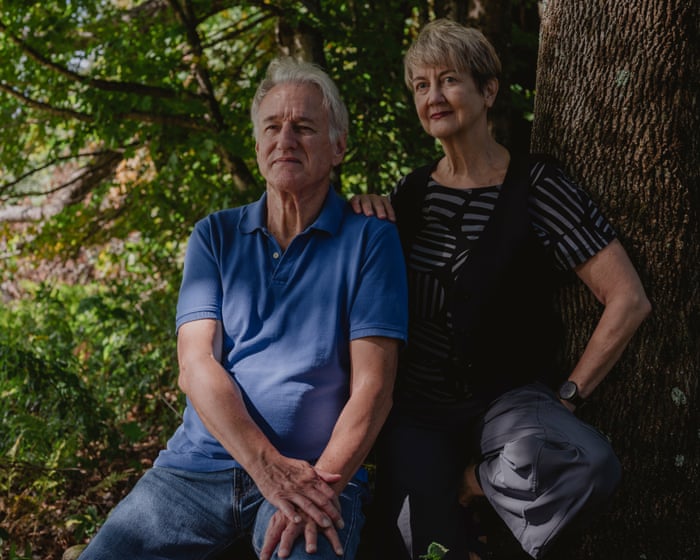
View image in fullscreen’I knew, even during the hardest of times, he would stand by me’ … Brison and Trezise. Photograph: John Tully/The Guardian
Many couples do not survive trauma like this, and Brison can see why. “My trust in the world was so shattered, I didn’t feel viscerally that I could walk out the front door and not get killed or the ground would fall beneath me,” she says. “Tom was so strong, he was a rock. I know that’s what he thought I needed, but I needed to be accompanied. He hadn’t cried. He hadn’t shown that he was hurt. For a while, our ability to understand each other was shot.” Brison resented his ability to pick up his former life, and imagined him out there, doing fine. In truth, Trezise was barely coping. “It was hard to get through the day,” he says. “Before I taught my class, I lay on the floor of my study and just dreamed about being somewhere else. The most banal, everyday exchange like, ‘How was your summer?’ o”How are you doing?” was so hard to answer that 99% of the time I said nothing, which made me feel like a ghost.” Although he had received a fellowship to write a book on Samuel Beckett, he had lost all interest. (He never wrote it.) Having built a career around his love of France – the country and the language – Trezise had no wish to ever return and could hardly bear to hear French. Every aspect of their life and marriage had been profoundly changed. “It’s partly because the attack was of a sexual nature,” says Trezise. “We’d been trying to conceive a child before the attack, but physical intimacy – any intimacy, emotional or psychological – becomes really fraught. In one sense, you’re asking: ‘Am I entitled to feel attracted to Susan?’ ‘Am I entitled to cry?’ I didn’t feel entitled to my own feelings a lot of the time. It was as though I couldn’t be myself. I had to walk on eggshells. Susan was angry – and I didn’t blame her in the least. But it can be hard to be around someone who’s angry, even if that person isn’t angry at you.” What helped? For Brison, finding her own community, especially a survivors’ self-help group, was hugely important. Though there were no support groups for partners at that time, Trezise also began therapy. “It was absolutely essential,” he says. “It was a revelation to have one hour a week with someone who knew a great deal about trauma and whose job it was to listen, so I didn’t feel like I was imposing.” He advises anyone in a similar position to seek support. “Just because you’re a carer doesn’t mean you don’t need care,” he says. “You need to find it, whether that’s family, friends, a group, or a therapist. If you don’t have support yourself, you won’t be a good caregiver.” My trust in the world was so shattered that I didn’t feel in my gut that I could walk out the front door and not get killed. Though there is no linear path to recovery, Trezise found comfort in the passing of time. “Even when things seemed absolutely impossible, somehow we kept going the next minute or the next hour,” he says. “And I think the other side of it was that we were not going to let this rapist destroy our lives. As Susan put it in her book, we were not going to finish his job for him.” (The assailant, a local man, was quickly identified and later sentenced to 10 years for rape and attempted murder.) Perhaps most healing of all was the arrival of their son, Gabriel, four years after the assault, almost to the day. “Having a child was terrifically important,” says Trezise. “It’s magical. Here comes this creature who’s absolutely unprecedented, he’s new, and guess what? It’s not a bad thing to be a boy. He knows nothing about this, and that was gratifying to me. Also, this is the start of a new story. It’s a story that’s going to be his, but we can help him, and he’s helping create a new story for us by showing us, ‘Look, this chapter you’ve been going through, it’s not the only one you’re going to have in your book.’ It was a way for us to love each other too, through him.” The cover of Beginning Again depicts the Japanese art of kintsugi, where pottery is repaired with the breaks left visible, lined and lacquered in gold and silver. For Trezise, it seems apt. “Things got radically changed, but they can be put back together in a very beautiful way,” he says. Decades on, there is still PTSD remaining for both of them. Brison will always turn around if she hears someone walking behind her, and, though they now live in a beautiful part of Vermont, she would never take a country walk alone. In Trezise’s case, he struggles to contain deep panic if he has arranged to meet his wife and she isn’t there. (She has learned to let him know when she’s(He’s running late.) They both have a strong startle response. “He’s worse than I am!” says Brison. “When we’re in the house together and one of us is about to walk into the room, we whistle or say, ‘I’m coming!’”
But clichéd as it may sound, they are closer for having survived this. “I said it in the dedication in my book and it still brings tears to my eyes,” says Brison. “‘For Gabriel, who arrived, and Tom, who stayed.’ He stayed. It wasn’t easy, and lots of men don’t stay. I knew, even when we were having the hardest of times, that he would stand by me.
“I always knew that he was a good human being,” she continues. “He has always been incredibly kind and generous and thoughtful. What has changed enormously is that he has become so much more aware of his feelings and able to articulate them. He has overcome decades of being socialised as a boy and man so that I don’t have to read his mind any more.”
Trezise has learned more about Brison too. “The depth of her strength is just incredible,” he says. “She’s so incredibly brave. Her resilience is amazing. I already knew she was a wonderful person – she’s loving, she’s a terrific friend to her friends – but if one thing comes out of this, it’s that this is a person I can trust with everything. And I’m just so lucky.”
Beginning Again by Thomas Trezise (University of California Press, £23) is published on 27 October. To support the Guardian, order your copy at guardianbookshop.com. Delivery charges may apply.
Information and support for anyone affected by rape or sexual abuse issues is available from the following organisations. In the UK, Rape Crisis offers support on 0808 500 2222 in England and Wales, 0808 801 0302 in Scotland, or 0800 0246 991 in Northern Ireland. In the US, Rainn offers support on 800-656-4673. In Australia, support is available at 1800Respect (1800 737 732). Other international helplines can be found at ibiblio.org/rcip/internl.html
Frequently Asked Questions
Here is a list of FAQs based on the theme of a couple coping with a devastating attack focusing on resilience trauma recovery and practical coping strategies
Beginner Questions
1 What does the phrase We werent going to let this rapist ruin our lives mean
It means the couple refused to let the trauma of the attack define their future They decided that while they couldnt undo the attack they would not give the attacker the power to destroy their happiness or relationship permanently
2 What is trauma bonding in this context
It is not the negative kind of bonding Here it means the couple grew closer because they faced the crisis as a team They leaned on each other for support instead of letting the stress tear them apart
3 Is it normal for a couple to struggle after a sexual assault
Yes it is very common Sexual assault can cause flashbacks fear of intimacy and anger It is normal for both partners to feel overwhelmed confused and distant at first
4 What is the first step for a couple coping with this
The first step is safety and validation The nonvictimized partner must believe and support the survivor They should seek immediate medical care and report the crime if the survivor chooses to do so
5 Can a relationship survive such a traumatic event
Yes Many relationships survive and even become stronger However it requires professional help patience and a shared commitment to healing
Intermediate Questions
6 What are common problems couples face after an attack
Common problems include
Intimacy issues The survivor may fear sex or physical touch
Communication breakdown One partner may want to talk while the other shuts down
Guilt and blame The nonvictimized partner may feel guilty for not protecting them
PTSD symptoms Flashbacks and nightmares disrupting daily life
7 How can a partner help without being overbearing
Ask what they need instead of assuming Give them space if they ask for it but reassure them you are there Let the survivor make their own decisions about reporting or seeking therapy
8 What is the second assault in this context
This refers to the insensitive treatment a survivor might face from police doctors or friends For example being asked What