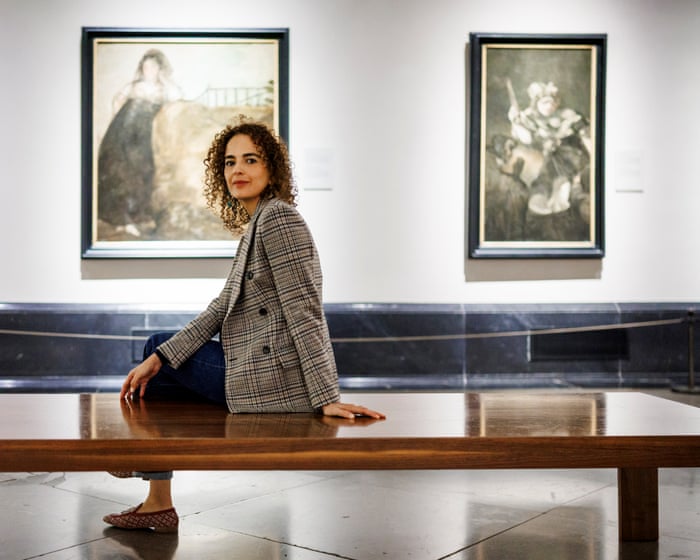
It’s a bright, chilly spring morning in Madrid, and the Museo del Prado won’t open to the public for another hour. Without the crowds, the museum feels empty and eerily quiet. Pale light gathers in the corners and casts long shadows around the paintings, as if the figures inside them have quietly stepped into the room. That’s where I meet Leïla Slimani, the French-Moroccan writer, who has spent the last two weeks using the space as inspiration for her work.
With quick steps, Slimani leads us to a basement gallery that holds some of her favorite pieces: Francisco Goya’s dark and haunting Black Paintings, created later in his life when the Spanish artist had a particularly bleak view of humanity. Among them are Saturn Devouring His Son, a violent scene of the god biting into his own child; The Fates, with three ominous figures spinning the thread of life; and Witches’ Sabbath (The Great He-Goat), where the devil appears as a goat leading a group of witches.
“Sometimes when I write, I put paintings near my desk. Every book has a color,” she says. “Being in a room alone with a Goya is really special,” Slimani tells me later, over cappuccinos at a nearby café. “He didn’t paint the present or the past – he painted the future, our own situation. He saw things others don’t.” She pauses. “There’s something about disappointment – 25 years after the French Revolution – in how he looks at society. I feel very connected to that.”
Slimani is in Madrid as part of Writing the Prado, a residency that invites international authors to create new work inspired by the museum. For her, the link between literature and painting feels natural. “Sometimes when I write, I put paintings near my desk,” she says. “In a painting, there’s the exact atmosphere you’re trying to capture. Every book has a color.”
View image in fullscreen
‘Are you blind? Are you spoiled?’ … Slimani. Photograph: Pablo Garcia/The Guardian
Goya’s vision matches her own concerns as a writer. “I always ask myself, ‘Are you aware of what’s happening around you? Or are you blind? Are you spoiled?’” Sitting on the edge of her chair, in blue jeans and a checked blazer, Slimani seems anything but. She’s smiley and down-to-earth, but there’s a strong determination behind her big brown eyes. She speaks freely, rarely second-guessing herself.
A focus on what lies beneath the surface – on contradiction, power, and human weakness – runs through Slimani’s life and work. Born in Rabat in 1981, the daughter of a doctor and a government minister who later became a banker, she left for Paris at 17, studied at Sciences Po, and then started her career as a journalist. Her first fiction manuscript was widely rejected before she wrote her debut novel, Adèle, about a bourgeois Parisian wife and mother leading a sexually promiscuous double life.
While Adèle showed her taste for breaking boundaries, it was her second novel, Lullaby, that turned her into a literary star. Inspired by real-life childcare tragedies, it opens with an act of unthinkable violence and works backward, exploring class, race, and maternal anxiety. In 2016, it made Slimani the first Moroccan woman to win the Prix Goncourt, and her public life changed overnight. She was later appointed by French President Emmanuel Macron as his personal representative for promoting the French language and Francophone culture.
“I was very excited,” she says now. “Did I deserve it? I don’t know. But it was happening, and I wanted to enjoy it. Some people were like, ‘Aren’t you afraid they gave you this prize because you’re a woman and you’re an Arab?’ I was like, ‘So what?’ I’m not going to try and find a reason not to be happy.”
Her refusal to downplay her success is sharpened by a formative family trauma. When Slimani was 20, her father was arrested and imprisoned on charges…Charges related to a financial scandal. He died before the case went to trial but was cleared after his death. Slimani has often said that her early urge to write came from anger and a desire for revenge. That drive, she says, is still there. “Literature is probably the best way to give justice back to people who aren’t understood or listened to. A writer can go very deep into someone’s mind and try to shed light on contradictions. And as a reader, you feel empathy and tenderness for a person you probably wouldn’t in real life.”
In recent years, Slimani has focused on her own family history in The Country of Others trilogy, which ends with I’ll Take the Fire, published in English this year. The book follows two sisters as they deal with identity, belonging, and escape. “I was very anxious about writing this book, because it’s about my father,” she says. “I wasn’t sure I was strong enough.”
[Image: ‘Did I deserve the job? I don’t know’ … the author with Emmanuel Macron in 2017. Photograph: Reuters]
The novel’s title comes from a line that tells the main character to leave Morocco “and take the fire with you. Don’t look back, don’t dwell on your childhood or your country.” But is that ever possible? “It’s possible,” says Slimani, “and I think it’s very important when you emigrate not to spend all your time looking back. Nostalgia can be a poison. One of the secrets of happiness is to be able to look straight ahead.” She smiles. “But my memory is like a fish – I forget a lot, so it’s easier!”
That forward momentum she talks about comes with tension. When she arrived in Paris as a teenager, Slimani embraced reinventing herself, telling herself she would succeed as a writer if she could sit at Café de Flore with a glass of wine and a cigarette. But she has described integration as a kind of fragmentation, a “violent” demand to shed one identity in order to be understood in another.
“I knew freedom would come with solitude, but I was, and still am, convinced that it’s worth it.” As a young woman, she admits she often acted like different versions of herself to fit in, even laughing along with racist jokes. “When you’re young, you just want to belong. But at what cost?”
This question extends into her broader thinking about freedom. “Freedom is always partial. I’ve never met someone who is totally free. If they are, it means they have nothing to lose.” She rejects the label of the “free” or “brave” woman, calling it “ridiculous.” She says: “I don’t want to play that role. Sometimes I’m very alienated. Sometimes I’m a coward.”
“People are obsessed with losing their culture, their tradition, their privilege. You see it in the UK with Reform and their flags.”
The waiter comes to clear our cups, and Slimani playfully takes a hit of her vape. Her urge to speak and act on her own terms has been around for a long time. When she was four, she told her parents: “It’s my mouth and I’ll say what I want,” which earned her the family nickname Cémabouche (“C’est ma bouche” – “It’s my mouth”).
Her work keeps coming back to the limits placed on women, especially in Morocco. In her nonfiction book Sex and Lies, she collected stories from women about their hidden sex lives, and she has been outspoken on abortion and sexual freedom. What does it mean for a woman to be brave today? “To be selfish, and accept not always being likeable.”
As a journalist, she covered the Arab Spring; since then, she has written strongly about extremism, identity, and racism in France. Does she think Europe makes it easier or harder to hold multiple identities? “There’s a new kind of racism that’s about contamination,” she says. A fear that being close to the “other” will erase identity.”People are obsessed with losing their culture, their traditions, their privilege. You see it in the UK with Reform and their flags. It’s the same in France.” Everyone feels lost, she adds, “and the far right and populists are winning everywhere. They now control the narrative.”
But it’s not just the West she challenges. Slimani has also spoken about feeling let down by people from her own background who embrace Islamism while rejecting the cultures they live in. “You can’t win,” she says. “I criticize Islamists in Morocco, and in France people are happy to hear it—but for the wrong reasons. You feel like you’re being used by people you’re not even friends with.”
View image in fullscreen
Slimani walking through the museum. Photograph: Pablo Garcia/The Guardian
What she argues for instead is complexity. “The world isn’t black and white. We deserve nuance. There are many ways to define yourself as a Moroccan.” She resists being seen as an exception. “They want to turn you into an icon—’Look, she’s Muslim, she drinks, she speaks loudly, how brave.’ No, I’m just me!” She recalls a recent conference where the person introducing her listed her views on abortion, homosexuality, and Islam, then concluded: “We are so lucky to be French.” She shakes her head and says, “I felt so embarrassed for him.”
For Slimani, literature remains the best way to preserve nuance, and she calls it “an important weapon against dogmatism, fanaticism, and stupidity.” She’s less interested in the performance of being a writer, preferring a certain secrecy. “You need to do it in the dark. It’s exactly like love—you do it and you don’t talk about it. Literature is very erotic.”
At the Prado, she has tried to hold onto a private space, structuring her days around looking and thinking as much as producing. At first, she found the pressure paralyzing. “I couldn’t write for the first few days. Then I told myself, ‘Stop. Just enjoy being here and see what comes.'”
For the past few years, she has been living in Lisbon with her husband and their two children. Letting go of pressure is something she’s still working on. “Now I have children, travel, promotions—it’s hard to steal time just to think. So the Prado has been a dream come true.”
Writing the Prado is a joint initiative between the Prado Museum and the Loewe Foundation, in collaboration with Granta en Español.
Frequently Asked Questions
Here is a list of FAQs based on Leila Slimanis quote Writing is just like love you have to do it in the dark
BeginnerLevel Questions
Q What does Leila Slimani mean when she says you have to write in the dark
A She means you have to write without knowing if it will be good without an audience watching and without any guarantee of success Its about trusting the process even when you feel unsure or scared
Q How is writing like love
A Both require vulnerability You dont wait until youre perfect to start a relationship and you shouldnt wait until youre confident to start writing You just have to begin even if it feels messy or risky
Q Im a beginner writer Should I be afraid to write badly
A No According to Slimani writing in the dark means you give yourself permission to write badly The fear of being bad stops most people from starting Just write the first draft without judgment
Q Do I need a special place or mood to write in the dark
A No The dark isnt about literal darkness Its a mental state where you ignore distractions selfdoubt and the need for external approval You can write anywhere if you can tune out the noise
IntermediateLevel Questions
Q How do I overcome the fear of showing my writing to others
A Remember that you first have to do it in the dark for yourself Dont show anyone your raw early drafts Wait until youve shaped it a bit The fear lessens when you separate the private act of writing from the public act of sharing
Q What if I feel like my writing is just bad and not worth continuing
A Thats the hardest part of the dark Slimanis advice is to keep going anyway Love isnt always easy and writing isnt either Bad first drafts are normal The magic comes from revising later in the light
Q How does this quote apply to starting a new chapter in life