Humankind has feared and sometimes welcomed the end of the world since its beginning. The Bible’s Book of Revelation describes “end times”—a period of suffering, war, famine, plague, floods, and environmental disaster—that may seem more plausible today than it once did. Islam also speaks of a fateful day of judgment or reckoning. Christian evangelicals believe that in the final rapture, a chosen few—the righteous or the “elect”—will be saved while sinners burn. This is a minority view. Matthew’s gospel predicts that most people will defy, ignore, or mock warnings of imminent Armageddon. Peter, another disciple of Jesus, agreed: “In the last days, scoffers will come, scoffing and following their own evil desires.” Yet this worldly skepticism does not make a universal catastrophe less likely. It may make it more likely.
Donald Trump’s blanket denials of the dangers supposedly posed by artificial intelligence—whose uncontrolled development some see as the latest sign of apocalypse—could be seen as fulfilling Peter’s prophecy. This US president, the closest thing the world has to a one-man doomsday machine, is fond of scoffing and evil desires. In Robert Harris’s 2019 novel, The Second Sleep, a worried scientist lists half a dozen ways the world might end. They include devastating climate change, pandemic disease, a giant asteroid collision with Earth, or some other overwhelming calamity. Few heed the fictional scientist’s fears. In the end, what destroys him and almost everyone else is a disturbingly plausible cyber crash—a global digital and internet meltdown.
While arguments rage over whether large language models will acquire consciousness and moral agency—and the power to delete humanity—existential AI threats remain, for now, open to mitigation. In sharp contrast, extraordinary complacency surrounds the most pressing, avoidable, and proven human-made threat to life on Earth. It is as if the world has been seized by collective deafness and a blind refusal to see what is staring it in the face. This is no laughing matter. The accelerating, global proliferation of advanced nuclear weapons is bringing real-time “end times” closer to home by the day. The question increasingly is not “if” but “when” limited or full-scale nuclear warfare will erupt. Eighty-one years after Hiroshima, how much longer can our luck hold?
Alarm bells are ringing, if only people would listen. Desperate Vladimir Putin recently threatened to deploy Russia’s entire nuclear arsenal, comprising about 4,400 warheads, against Nato countries if they activated a supposed plan to invade the Baltic exclave of Kaliningrad. He offered no evidence for his claim, and it’s true that the frequent Kremlin nuclear sabre-rattling since its full-scale invasion of Ukraine went badly has diminished Moscow’s credibility. Yet that in itself is destabilising. To work, nuclear deterrence relies on an adversary believing the threat is real. Disbelief invites miscalculation. At the same time, Putin’s inability to halt Ukraine’s conventional drone and missile attacks deep inside Russia may be edging him closer to pressing the nuclear button, possibly in the form of low-yield tactical or “battlefield” nukes.
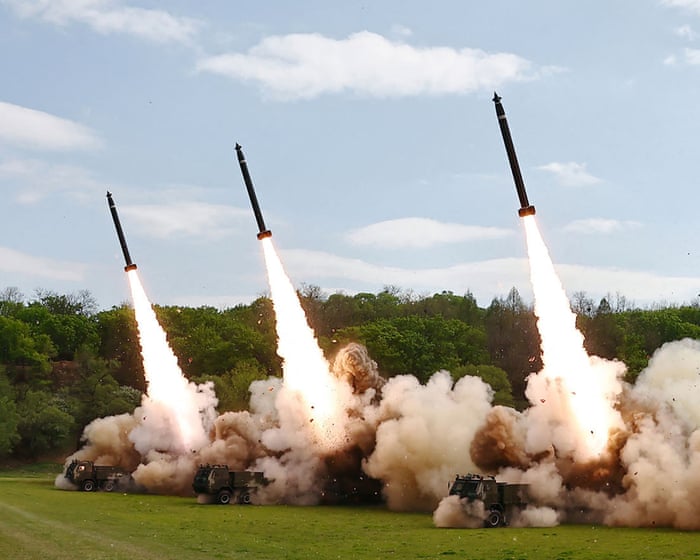
Trump’s bottom-line justification for the illegal US-Israel war on Iran is his wilfully mendacious claim that Tehran was weeks away from obtaining the bomb. He claims to be protecting the world from nuclear war. Yet his reckless threat, issued at the UN, to “annihilate the Islamic Republic” implies a possible US nuclear attack. Trump’s hypocrisy is stunning. The US is upgrading its nuclear arsenal of 3,700 warheads and may resume nuclear tests. It unreservedly supports Israel’s hidden nuclear weapons programme. And Trump is pursuing a lucrative deal with Saudi Arabia, another bitter foe of Iran, to provide civilian nuclear technology that he knows could be repurposed to make weapons. That has prompted regional cCountries like Turkey and Egypt are now considering going nuclear. Similar dangerous trends are appearing across Asia. North Korea’s leader, Kim Jong-un, has effectively won international acceptance of his country as a nuclear weapons state. In August, South Korea said Pyongyang now has up to 120 warheads, which Kim uses to intimidate its neighbours. The two principles that once guided the West’s postwar Korea policy—reunification and denuclearisation—have been almost completely abandoned. Ignoring the humiliations of his first term, Trump is again seeking a summit with Kim, whom he strangely calls a friend. “As long as I’m around, he [Kim] is going to be fine,” he boasted. Japan and South Korea do not share his confidence. Both are debating whether to acquire nuclear weapons for self-defence. Meanwhile, China’s president, Xi Jinping, having once again outmanoeuvred a flattering Trump at their Washington summit, is reportedly building nuclear weapons at a furious pace—one that, at this rate, may soon lead to disaster. Addressing the UN General Assembly, Secretary-General António Guterres warned that the world has reached “the most dangerous nuclear moment” since 1989. Global military spending reached nearly $3 trillion last year, while AI is increasing uncertainty over nuclear command-and-control, the UN was told. Annual spending on nuclear weapons is up by 20%. In a new paper published by the non-partisan Arms Control Association (ACA), Daryl Kimball, the head of the ACA in Washington, lamented the absence of high-level disarmament talks between the main nuclear powers and the lapse of strategic arms limitation treaties. “The nuclear sword of Damocles still hangs over all of us. The threat has become more complex, and in the absence of new arms-control breakthroughs, we are headed for an unprecedented three-way buildup of Chinese, Russian, and US nuclear forces,” Kimball warned. The fragmentation of the rules-based international order makes things worse. Trump-era abuses—the idea that might makes right, that international law and the non-proliferation treaty’s binding obligation to disarm can be ignored, and that the UN charter and human rights norms do not apply to authoritarian “strongman” leaders—all make the slide into nuclear anarchy easier. Unresolved forever wars in Palestine, Iran, Ukraine, Myanmar, Yemen and Sudan are basic ingredients of a third world war. Also potentially catastrophic is the rapidly developing contest for control of space, especially the race to build nuclear-powered lunar bases. The 1967 Outer Space Treaty, under which more than 130 countries agreed the moon is no one’s property, is now routinely ignored by both governments and billionaires such as Elon Musk and Jeff Bezos. The weaponisation of space by the US and others is advancing quickly. Russia, for example, is reportedly developing an orbiting nuclear-armed anti-satellite weapon. If the human race really is determined to bring the heavens crashing down in a mad rush toward apocalyptic self-destruction, this is the surest, quickest way to do it. More surprising than the irresponsible behaviour of politicians is the deafening public silence, the absence of large-scale protest in much of the world, and the complacency, bordering on indifference, that accompanies this global march to oblivion. If and when a final reckoning comes, individuals who stayed silent will be complicit in their own undoing. Hiroshima is not a shrine. It’s the future. Simon Tisdall is a Guardian foreign affairs commentator.
Frequently Asked Questions
Here is a list of FAQs based on Simon Tisdalls article about the world overlooking the threat of nuclear destruction while focusing on AI
Beginner Questions
Q What is the main point of Simon Tisdalls article
A The article argues that the world is so obsessed with the risks and potential of artificial intelligence that it is ignoring the much more immediate and catastrophic threat of nuclear war
Q Why does the author think nuclear destruction is a bigger threat than AI
A Because nuclear weapons already exist and can be launched in minutes causing immediate mass destruction AI risks are mostly futurebased and uncertain while nuclear war is a present and proven danger
Q What does nuclear destruction mean in simple terms
A It means the massive death environmental damage and collapse of society that would result from a nuclear war
Q Is the author saying we should stop worrying about AI
A No He is saying we should not let AI distract us from the more urgent and deadly risk of nuclear weapons
Q What are some examples of nuclear threats today
A Russias war in Ukraine tensions between India and Pakistan North Koreas missile tests and the breakdown of arms control treaties between the US and Russia
Q Why do people focus more on AI than nuclear weapons
A AI is new exciting and heavily covered in the media Nuclear weapons feel like an old problem so people pay less attention to them
Q What is a nuclear weapon
A A bomb that uses nuclear reactions to create a huge explosion far more powerful than regular bombs
Q How many countries have nuclear weapons
A Nine countries the US Russia China France UK India Pakistan Israel and North Korea
Intermediate Questions
Q What does the article mean by the obvious threat right in front of it
A It means nuclear weapons are a clear and present danger that everyone knows about but chooses to ignore
Q Has the risk of nuclear war increased recently
A Yes Key arms control treaties have collapsed and conflicts involving nucleararmed states have intensified
Q What is a tactical nuclear weapon
A A smaller nuclear weapon designed for battlefield use but still far more destructive than conventional bombs