Germany’s foreign minister has stated that France must increase its defence spending to help achieve European self-sufficiency. As European nations grow more aware that they might have to rely on themselves for defence amid strains in the transatlantic relationship, Johann Wadephul emphasized that Paris needs to back its words with action.
In an interview with German broadcaster Deutschlandfunk, Wadephul commented on French President Emmanuel Macron, saying, “He repeatedly and correctly refers to our pursuit of European sovereignty. Anyone who talks about it needs to act accordingly in their own country.”
European countries are under pressure to strengthen their defence capabilities as concerns rise over whether Washington would assist its NATO allies if attacked. NATO members agreed last June to raise defence spending to 5% of GDP by 2035, but Wadephul noted that progress toward this goal has been lacking.
“Unfortunately, efforts in the French republic have also been insufficient to achieve this so far,” he said. “France, too, needs to do what we are doing here amid tough discussions.”
Germany has exempted most defence spending from its constitutional “debt brake” and allocated over €500 billion for defence between 2025 and 2029. Meanwhile, France, grappling with public spending debates, has the EU’s third-highest debt-to-GDP ratio, after Greece and Italy.
Wadephul’s remarks highlight tensions in the Franco-German alliance, traditionally the engine of EU cooperation. Germany has repeatedly rejected Macron’s calls for joint debt to fund investment, and the two countries disagree on developing a next-generation European fighter jet and an EU trade deal with South American nations.
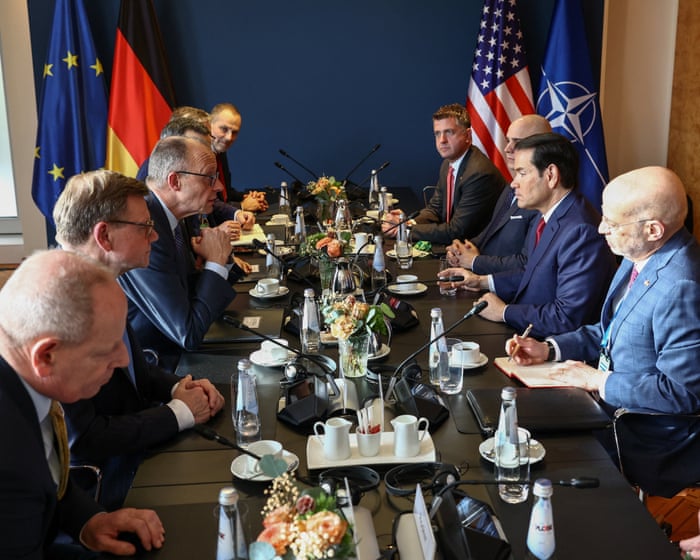
At the Munich Security Conference last week, German Chancellor Friedrich Merz warned of the threat Russia poses to Europe and sought to reaffirm U.S. security commitments, while acknowledging the need to repair ties. “In the era of great power rivalry, even the United States will not be powerful enough to go it alone,” he said. “Being a part of NATO is not only Europe’s competitive advantage. It is also the United States’ competitive advantage. So let’s repair and revive transatlantic trust together.”
Merz also revealed preliminary talks with Macron about Germany possibly joining France’s nuclear umbrella. However, the idea of Europe seeking its own nuclear defence beyond U.S. protection exposed divisions within Germany’s ruling coalition.
Wadephul, a member of Merz’s Christian Democratic Union, expressed caution about Europe developing a stronger nuclear defence, stating, “There are enough atomic weapons in the world.” He added that no one in Washington doubts the U.S. would use its nuclear arsenal to defend Europe if needed, warning against creating such an impression through debate.
Germany’s Vice-Chancellor Lars Klingbeil affirmed Berlin’s reliance on NATO’s nuclear deterrence and said there are no plans to acquire atomic weapons, which Germany has renounced under existing treaties. He welcomed discussions with France on joining its nuclear umbrella, saying, “We’ll see what the outcome is.”
However, senior Christian Democrat Armin Laschet warned that the proposal might signal to Washington that Germany is voluntarily giving up the U.S. protective shield, noting that France would insist on maintaining control over its nuclear weapons.France has stated it will maintain full control over the use of its nuclear arsenal. “He [Macron] will not give the German chancellor a say in this nuclear armament issue,” said Armin Laschet on public television.
Thomas Röwekamp, the CDU chair of the Bundestag defence committee, argued that while Germany must assume greater responsibility for European security, it should not recklessly seek to replace U.S. nuclear guarantees. In the Augsburger Allgemeine newspaper, he called for a “European complement within NATO” to the U.S. atomic arsenal.
Röwekamp noted that France has been making a key contribution to European deterrence for years, and that the current dialogue demonstrates “how closely we are continuing to develop this contribution together.”
In a weekend article published in the Guardian and the German newspaper Die Welt, the highest-ranking military leaders of Britain and Germany jointly and unprecedentedly appealed to the public to accept the “moral” case for rearmament and to prepare for the threat of war with Russia.
Frequently Asked Questions
Of course Here is a list of FAQs about Germany urging France to boost its military budget designed to be clear and conversational
BeginnerLevel Questions
1 Whats the basic news here
Germany has publicly suggested that France should increase its spending on its military to better meet NATO and European defense commitments
2 Why would Germany tell France what to do with its money
As the two largest military powers in the European Union they are core partners Germany believes that for Europe to be strong and secure independently both nations need to invest heavily in their armed forces
3 What is the NATO spending target theyre talking about
NATO allies have agreed to aim to spend at least 2 of their Gross Domestic Product on defense each year Its a benchmark for sharing the burden of collective security
4 Is France not meeting the 2 target
Recently France has been spending slightly below the 2 target while Germany after years of being below has now reached and plans to exceed it following Russias invasion of Ukraine
5 Isnt this a bit awkward between allies
It can be Public criticism between close partners is unusual and highlights the serious pressure and debates happening within Europe about how to pay for its own security
Advanced Strategic Questions
6 Why is Germany pushing this now
The main catalyst is Russias war in Ukraine which has fundamentally changed Europes security landscape Germany sees this as a longterm threat requiring sustained high investment from all major European powers
7 Whats the deeper goal beyond just hitting 2
Germany wants a more capable and integrated European defense industry They argue that if both countries invest significantly they can jointly develop nextgeneration weapons instead of competing or buying from outside Europe
8 How does Frances nuclear deterrent play into this
France argues that its independent nuclear arsenal provides a massive security umbrella for all of Europe a value not captured in the simple 2 GDP spending figure They feel this strategic contribution should be considered
9 What are the common objections or problems with this push
Sovereignty France resists external dictates on its budget priorities