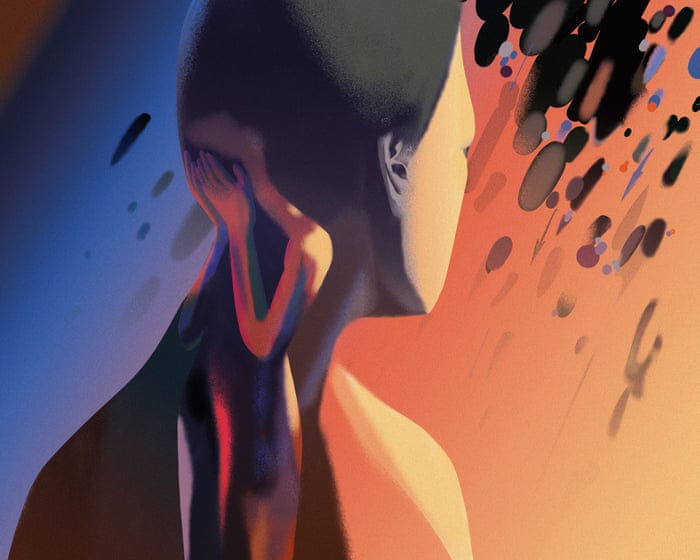
Jenna Turnbull’s chest tightens. The 36-year-old civil servant from Cardiff can vividly picture herself as she speaks: an 11-year-old in her PE kit, waiting with the other children for her lesson to begin. “We were outside by the courts, waiting to play netball,” she says. “One of the boys commented that I had hairy arms.” Her voice trembles. The incident was clearly childish; rationally, she knows that. Yet 25 years later, the embarrassment remains visceral, with the power to cause instant physical discomfort.
She searches for another example of her acute reaction to teasing and recalls a trip to the pub with friends six years ago. Amid the loud conversation and laughter, someone made a quip about her being untidy at home—or at least, that’s how she perceived it. “About me not keeping on top of the house,” she recalls. The person “was having a laugh. It was just something said off the cuff.” Yet while the memory and details are hazy, the shame she feels is not. “That comment still haunts me,” she says. After that pub outing, she began cleaning her house obsessively—to such an extreme that it became one of the symptoms leading to her diagnosis of obsessive-compulsive disorder (OCD). “I’ve been known to spend four or five hours cleaning my bathroom,” she says.
She describes another incident, when she sent a work email to senior colleagues that contained an error. It was pointed out in a reply, which copied in other colleagues. Her chest tightened again; she struggled to breathe. “I thought I was dying,” she says. “The shame of receiving that email actually made me call my GP and say, ‘I need to come in… I’m having an asthma attack.'” She managed to get to the surgery, breathless. “They took my oxygen reading and it was fine,” she says. “It was a panic attack. It left me completely debilitated.” At other times in her past, she has self-harmed when overwhelmed by shame.
These reactions came to a head late one night in 2022, during divorce proceedings, when she called a mental health crisis line. “The shame of carrying the fact that I was going to be a separated, single mum was honestly the most horrendous feeling I’ve ever had in my life. I didn’t think I wanted to make it through,” she says. The nurse who spoke to her “saved my life that night.” She suggested that Turnbull, who had received an autism diagnosis in childhood, might also have attention deficit hyperactivity disorder (ADHD) and another condition Turnbull had never heard of: rejection sensitive dysphoria (RSD—sometimes called rejection sensitivity dysphoria).
Although RSD is not a formal diagnosis, those living with it often also have an ADHD diagnosis. The emotional dysregulation symptoms of ADHD have only recently gained prominence in research and diagnosis—and many sufferers of RSD have only discovered they have it through clinical treatment for their ADHD, though it is still not mentioned in official diagnostic tests. Experts stress that not everyone with ADHD will experience RSD, and it can also occur in those with autism and generalized anxiety disorder, or as a separate condition. However, too little is understood about it yet to explain why.
The term RSD was first used in the 1960s but has become more common in recent years. There are support groups on social media—one Facebook group has 67,000 members—and thousands of TikTok posts about it. It has also begun to filter into employment law. Last month, a headline in The Times read: “Worker with ‘rejection sensitivity’ awarded £12,000 over remark by boss.” An employment tribunal agreed the employee had been diagnosed with dyslexia and rejection sensitive dysphoria. She won the payout after the tribunal found her employer had acted unlawfully when her boss told her: “no thinking outside the box.”When she asked for a quiet space at a work party to help manage feelings of overwhelm, she was told to “think outside the box.” The employee later explained, “She is basically saying, mask, act neurotypical and don’t rock the boat.”
However, comments on the news story offered a different perspective. One person wrote, “Rejection Sensitivity Disorder (sic) or ‘touchy’…” Another replied, “Surely it’s just human nature to not like criticism and we have to learn to cope with it!” Turnbull is accustomed to such remarks and admits that even close friends and family can be dismissive of RSD. Responses have varied from “you’re not alone in feeling this way” and “that is not abnormal” to “I don’t believe it, it’s a modern-day excuse.” She often internalizes her hurt when she hears them. “There is a view that invisible ailments can’t be real,” she says.
Psychiatrist Dr. William Dodson, a leading expert in the field based in Denver, Colorado, is familiar with people dismissing RSD. After working with ADHD patients since the mid-90s, he noticed that many exhibited similar intense, often immediate reactions to perceived rejection, teasing, criticism, or self-criticism. While rejection sensitivity is a common human experience, he explains that the dysphoria—which means “unbearable” in Greek—is what makes rejection feel different for those with RSD. He identified the characteristics as understood today, stating, “This is something that is just several orders of magnitude stronger” than everyday rejection, and that unbearable pain is often disproportionate to the event.
Turnbull acknowledges that anyone would struggle with a divorce and that “a lot of people experience embarrassment and shame.” However, it is the intensity of her reactions that marks her as someone with RSD. “I will get chest pains and severe stomach pains… The number of times I’ve felt rejection and my chest feels like it’s collapsing…” For most of her life, Turnbull says she was labeled as someone who “took things to heart too much. I could never take a joke.” When a nurse told her over the phone one night, “You’re carrying something heavy, but your brain is adding 10 times the weight,” it changed everything. “Just putting a name to it was the big thing,” she says. She has since been diagnosed with ADHD.
In a paper detailing the experiences of four patients with ADHD and RSD, Dodson and his co-author describe episodes that “begin with the experience of perceived rejection, demonstrating rejection sensitivity, that progresses into a nearly instantaneous dysphoric mood, which causes significant distress and impairment.” He believes this is distinct from other disorders, such as chronic depression—initially thought in the 1960s—as those may have a more gradual onset without a specific trigger and last significantly longer.
Dodson says that when he mentions RSD to his ADHD patients, “about 95% will go: ‘Oh my God, that’s me.’ People would burst into tears right there.” He notes that “no patient volunteers this. They are very sensitive about the rejection,” and for about 25% of them, RSD is “the most impairing part of their lives.”
Lauren O’Carroll would agree. The 41-year-old, who lives in Cambridge and runs a coaching business called Positively Parenting, supporting parents with ADHD, was diagnosed with ADHD at 21. It wasn’t until she was 37 and sought help from a private psychiatrist that RSD was suggested to her. In childhood, she was called “oversensitive,” “the emotional one,” a “drama queen.” From as early as she can remember, any request she made…Any request she received – whether to close a door or do her homework – would trigger shame. “I would immediately explode… I’d take it as a criticism,” she explains. At home, the rage would be physical. “I would feel super angry, super hard done by, like the world was against me… It would feel like a punch in the guts.”
She still experiences these gut punches in adulthood, too. She admits she will lie to cover up mistakes, which feels “deeply uncomfortable.” For example, if she books the wrong train ticket for work, she would rather pay out of her own pocket than tell anyone. When she was 18, she crashed her car but told her parents another vehicle had pulled out in front of her. “I was so ashamed, I kept that lie going my whole life.”
Dr. Shyamal Mashru, a consultant psychiatrist and adult ADHD specialist in north London, says he sees many patients with Rejection Sensitive Dysphoria (RSD). Some have been so affected by a trigger that they become breathless or experience palpitations. “I’ve even had some patients go to A&E,” he says. Little is known about the causes of RSD, he explains, but “there are different theories… One of them involves what’s called an underregulated amygdala and prefrontal cortex in the brain, which causes strong emotional responses to situations.”
He also believes nurture plays a role, stressing the trauma people with ADHD often experience from childhood due to criticism of their behavior. “They’re going through lots of mini traumas that just keep hammering away at their self-esteem… We may never really find out the true answer neurologically… but in this particular condition, your life plays a big role.”
What is indisputable is that RSD affects lives. “People want to protect themselves from these emotional reactions so much they change their entire approach to life,” says Dodson. The most common response is people-pleasing. “So people like to have them around, would not reject them, not criticize them at work,” he explains. Then there is perfectionism: “They’re going to be above reproach.” And finally, some simply “give up” because they fear rejection. “Very bright, educated people who still live in their parents’ basement, unemployed. They’ve never asked a person out on a date. They’ve never applied for a job. They’re just crippled by it.”
For Dhiren Doshi-Smith, 42, from Loughton, Essex, avoiding socializing has been a hallmark of his RSD. Diagnosed with ADHD four years ago, he learned about RSD at the same time. He spent years “avoiding that sense of actually letting people in because the rejection would feel quite intense, and therefore… it’s better to isolate yourself.” Even emails and texts are triggers. “Positive messages can be read as neutral, neutral ones can be negative, and negative ones can be super negative,” he explains. He interprets silence as catastrophe, even if a friend delays a reply by a few minutes. While dating his now-husband, he would find himself unable to go about his day if a message wasn’t answered swiftly. It’s a “bodily” reaction, a “churning in the stomach,” he says. Therapy has helped him catch his negative thoughts, and he has found ADHD medication helpful.
Dodson has found that alongside therapy, a group of medications called Alpha-2 Agonists can be effective for RSD. Usually prescribed for high blood pressure, these differ from more common ADHD medications and are not typically prescribed by the NHS in the UK. Mashru says he tends toward “non-medical approaches” to treat RSD, including patients working with coaches to relearn emotional responses. Turnbull says that taking an antidepressant, combined with therapy for her low self-esteem, is helping “massively.”
The difference in Turnbull’s life has been huge. After…After 18 months in therapy, she has become better at recognizing when and why her chest tightens, and she can calm herself by taking a step back. “It has helped me keep things from getting quite as bad…” Opening up about her difficulties has also made a difference. She mentions an old friend who used to joke about her being a few years older than him—she finally asked him to stop. “I know it’s a joke, but it makes my chest feel tight and unwell. It brings up a lot of shame.” He understood.
Until recently, she had worked in the same office for 18 years and on the same team for a decade, constantly pushing herself out of fear of making mistakes. She was too afraid to apply for promotions or other jobs, worried she’d have to work with strangers who might judge her.
But six months ago, she applied for a promotion. “Eighteen months ago, I couldn’t have even considered it—the thought of being rejected after an interview was something I didn’t want to face,” she says. Simply by daring to risk rejection and go for it, she got the job.
She hasn’t overcome her rejection sensitive dysphoria. “I’m still on that journey,” she says, and may always be. But “understanding it has helped me accept myself.”
Frequently Asked Questions
Frequently Asked Questions About Rejection Sensitive Dysphoria
Basics Definition
What is Rejection Sensitive Dysphoria
RSD is an intense emotional response to the perception of rejection criticism or failure Its not just feeling hurt its an overwhelming often physical feeling of pain that feels disproportionate to the situation
Is RSD a formal diagnosis
No RSD is not a standalone diagnosis in manuals like the DSM5 It is most commonly understood as a symptom or a key feature of ADHD though people with other conditions may experience it too
What does dysphoria mean in this context
Dysphoria means a state of unease or profound dissatisfaction In RSD it specifically refers to the intense emotional pain caused by perceived rejection
Why is there more awareness of RSD now
Increased discussion on social media personal storytelling by ADHD advocates and more research into the emotional components of neurodivergence have all helped bring RSD into the public conversation
Symptoms Experience
What does RSD actually feel like
People often describe it as a sudden crushing sense of shame humiliation or failure Physically it can feel like a punch to the gut your chest caving in or a wave of heat and panic The emotional pain is very real and acute
How is RSD different from just being sensitive
While sensitivity involves deeper feelings RSD is characterized by its extreme intensity and speed The reaction is often instantaneous and overwhelming and it can be triggered by very subtle cues that others might not notice
What are common triggers for RSD
Common triggers include perceived criticism being left out a friend not responding to a message not meeting your own high standards feeling like youve disappointed someone or even the anticipation of rejection
Can RSD cause physical symptoms
Yes Along with the emotional pain people may experience a rapid heart rate sweating flushing stomach aches or a feeling of physical heaviness or collapse
Causes Connections
Is RSD only linked to ADHD
It is most strongly associated with ADHD and many experts