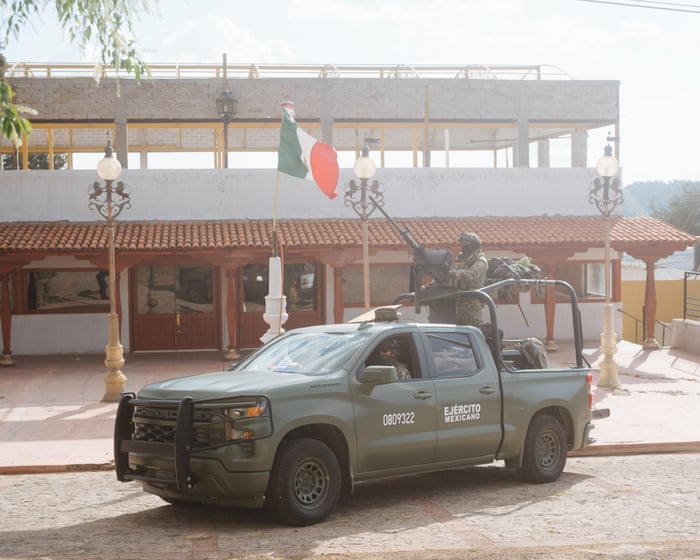
Two days before one of the world’s most powerful drug lords was killed while trying to flee a chalet in the hills outside Mexico’s second-largest city, the Tapalpa Country Club posted an ad on Instagram inviting lovers to visit a place where they could “inhale peace [and] exhale stress.”
“Date idea: Escape to Tapalpa,” read the message, promoting romantic private cabins, picnics with spectacular lake views, and a golf course “to have fun together.”
The Mexican cartel boss known as “El Mencho”—who locals say was a regular visitor to this picturesque tourist hub of pine forests and cobbled streets in Jalisco state—seems to have liked the idea.
It was here that the drug lord’s reign came to a dramatic end on Sunday morning. Mexican special forces—reportedly with the help of CIA intelligence and a U.S. Predator drone—tracked him to a lodge in the gated community where he had been hiding with a girlfriend.
A nearby restaurateur recalled seeing four truckloads of cartel fighters racing to the scene around 8 a.m. on Sunday, about an hour after helicopter-borne army troops launched their surprise attack.
“They were going into battle,” the food seller said, describing a fierce five-hour shootout.
Videos posted on social media captured the intensity of the conflict. “You could hear these booms. There was an explosion—I don’t know whether it was a car exploding or a bomb,” the restaurateur added.
As El Mencho, whose real name was Nemesio Rubén Oseguera Cervantes, and two bodyguards fled into the woodland around his rural hideout, cartel members took to the streets to wreak havoc.
Two convenience stores at Tapalpa’s entrance were set on fire. El Mencho’s followers used excavators to dig meter-wide trenches in the winding roads leading to their boss’s safe house. Fallen trees, cars, and trucks were doused in gasoline and set ablaze.
“It was insane,” said one black-clad special forces police officer in Tapalpa, one of thousands deployed to the region to control the chaos that quickly spread across Mexico.
Cartel attacks were reported in at least 20 of the country’s 32 states. Jalisco’s capital, Guadalajara, and its top beach destination, Puerto Vallarta, were brought to a standstill, stranding tourists and leaving locals hiding at home. More than 60 people were killed.
But if the mayhem was meant to distract security forces and help El Mencho escape, the plan failed. On Sunday afternoon, as the gunfire subsided, Mexico’s defense ministry announced that the 59-year-old leader of the Jalisco New Generation cartel (CJNG) had died in a helicopter on the way to the hospital after being wounded in the shootout.
“We’ve… taken down one of the most sinister cartel kingpins of all,” Donald Trump boasted on Tuesday, claiming credit for the bold Mexican military operation to capture their country’s most wanted man.
Four days after El Mencho’s killing, the Guardian’s reporters traveled by road to the shell-shocked narco-tourist town where Mexico’s most feared drug boss made his last stand.
Postcards in now-empty tourist shops celebrate the rural charms of a region that has also become a playground for drug lords, whose drug labs and training camps are located in the surrounding mountains.
“Tapalpa is tranquility,” reads one. But driving south from Guadalajara, through cartel-owned fAmid fields of agave, blueberries, and avocados, the mood was tense. The landscape told a story of a day of terror and a brutal, years-long conflict, fueled by the United States’ insatiable demand for drugs made in Mexico, like methamphetamine and fentanyl.
In Techaluta de Montenegro, a quiet dragon fruit farming village at the base of the mountain where El Mencho was killed, the supermarket had been firebombed. Its charred facade stood out against the bright blue sky. Farther along, a young man in a cap and blue jeans lingered at a deserted intersection, watching the few drivers brave enough to head up toward the scene of the drug lord’s death.
The 30-mile road up to Tapalpa was littered with reminders of Sunday’s violence: a bullet-riddled police station, the burned-out shells of cars and trucks, and the still-smoldering remains of a supermarket surrounded by red police tape marked “Danger.”
A few miles past that warning, more cartel lookouts appeared. First, a white pickup truck followed the unwanted visitors toward the town center. Then, a three-vehicle convoy led by a masked motorcyclist in a dark grey tactical vest. Outside the deserted 17th-century St. Anthony of Padua church in Tapalpa’s historic center, another narco scout emerged, discreetly photographing the outsiders. Not a single police officer or soldier was in sight.
With cartel lookouts everywhere, locals spoke in hushed tones about what they called “el evento”—the event—and the downfall of a man respectfully known as El Señor Mencho (“Mr. Mencho”).
One church official said two local Catholics were injured after being caught in crossfire while training for an annual pilgrimage. A woman who introduced herself as a manager at the Tapalpa Country Club recalled receiving orders to abandon the upscale property around 7 a.m. on Sunday as the operation began. She didn’t say who gave the orders. Staff were only allowed to return on Tuesday morning.
In the meantime, a group of Mexican journalists sneaked into the unguarded compound and claimed to have found one of El Mencho’s hideouts. Inside, they discovered medicine for the kidney disease he was long rumored to have, along with a handwritten summary of Psalm 91—a text popular among Latin American drug traffickers whose lives are constantly at risk. It read: “A thousand may fall dead beside you, ten thousand all around you, but you will not be harmed.”
At La Loma, a nearby cluster of chalets, police found another of El Mencho’s sanctuaries, where his heavily armed security team reportedly stayed when he was in town. In one room, the stuffed heads of three animals—a zebra, a gazelle, and a deer—were said to be mounted on a wall. The road leading there was scattered with bullet casings and partially blocked by two burned-out cars, possibly the ones a restaurateur had seen speeding toward the area as traffickers tried to rescue their boss. The only person at the entrance was a gardener watering his employer’s sun-scorched plants.
Remarkably, neither location—two of the most important crime scenes in recent Mexican history—was guarded by security forces.
On Wednesday afternoon, government troops seemed to have other priorities, providing security to construction workers tasked with clearing and repairing the road.Road crews were rebuilding the roads connecting Tapalpa to the outside world. On a back road, police special forces and army soldiers armed with assault rifles and machine guns stood guard around a trench dug by El Mencho’s underlings to block reinforcements during Sunday’s attack.
As workers filled the gap with hot asphalt, the security forces gripped their weapons, knowing that despite El Mencho’s death, his Jalisco cartel still held power here and across large parts of Mexico.
“If anyone thinks Mexican drug traffickers will stop operating because of what happened… I think they are delusional,” said John Feeley, a former senior U.S. diplomat in Mexico City who first heard El Mencho’s name about 15 years ago, at the start of his brutally violent rise.
While Trump has taken credit for the criminal’s killing, Feeley was sure he would deny responsibility if—as some fear—the drug lord’s death triggers a deadly war between or within cartels in Mexico. “The deaths will be in Michoacán, they’ll be in Jalisco, they will be in Guerrero,” he said, naming three of Mexico’s most violent states. “And [Trump] will just say something like, ‘See, I told you that place is run by the drug traffickers.’”
As troops prepared to withdraw from Tapalpa before dark, a forest fire—which locals said was ignited by Sunday’s shootout—continued to burn through the woods where El Mencho’s life ended.
A local restaurateur expressed hope that the town’s new notoriety as the place where Mexico’s most feared man died would not scare away tourists.
“We invite them to come, taking precautions of course,” he said, before adding, “Here in the town center, nothing happened at all.”
Frequently Asked Questions
Of course Here is a list of FAQs about the topic Shellshocked and on edge inside the Mexican resort town where El Mencho made his final stand written in a natural conversational tone
General Beginner Questions
1 What is this article about
Its a news feature that explores the impact of a major cartel leaders last stand on a Mexican resort town detailing how the violence shattered the communitys sense of safety and normal life
2 Who is El Mencho
El Mencho is the leader of the Jalisco New Generation Cartel one of the most powerful and violent drug cartels in Mexico
3 Which Mexican resort town is it talking about
While the articles specific location might vary it is almost certainly referring to Puerto Vallarta Jalisco or a nearby coastal town in the state This is the heart of CJNGs territory and a major tourist destination
4 What does made his final stand mean
It refers to a reported intense military and police operation aimed at capturing or killing El Mencho The phrase suggests a last desperate battle where he was cornered though he ultimately evaded capture
5 Why would a cartel boss be in a resort town
Resort towns offer a blend of anonymity luxury hideouts established logistical networks for moving money and people and proximity to ports for drug trafficking
Impact Community Questions
6 What does shellshocked and on edge mean for the residents
It means the community is deeply traumatized by the sudden extreme violencelike soldiers with shellshock On edge means they live in a state of constant anxiety fear and hypervigilance never knowing when violence might erupt again
7 How does this violence affect regular people and tourists
Residents face daily fear economic hardship extortion and the trauma of living in a war zone Tourists might be largely unaware but their safety can be at risk from crossfire kidnappings or being in the wrong place at the wrong time
8 Is it safe to travel to this town now
Travel advisories