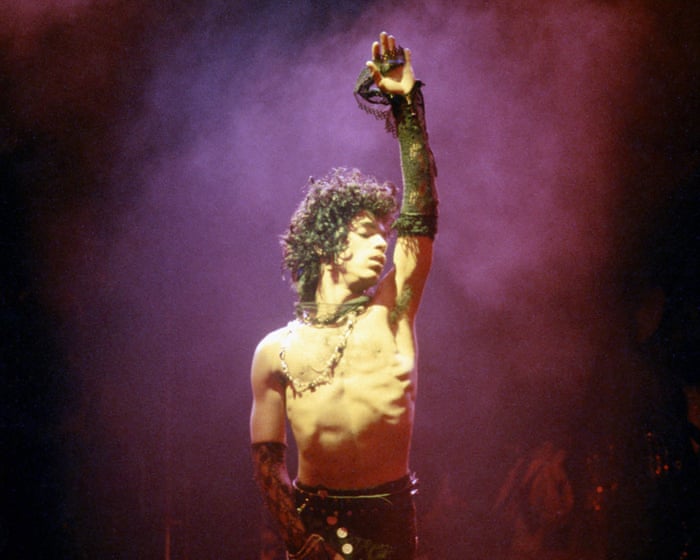
It’s hard to believe Prince has been gone for ten years. When he died, I was so stunned I couldn’t even speak, but I can talk about him now. I first met him in 1977 when he came to my show. He was 19 and had this incredible confidence—he looked like he belonged in Funkadelic. To me, he was like a new version of Sly Stone. He was an amazing guitarist, could write on keyboards, and played bass and drums incredibly well. His father was a pianist and arranger, so Prince knew how to arrange music, and he could dance like James Brown. He was the perfect rock star, but he was more than that. He was truly special.
I introduced his music to a pirate radio DJ in Detroit who helped break all our records, and years later, Prince returned the favor by signing me to Paisley Park Records and inducting me into the Rock and Roll Hall of Fame. After we made music together, we started spending time together. Prince would call me at all hours—he never seemed to sleep. I’d joke, “I’m the one on drugs, not you!” But he’d ask me to come over in the middle of the night, and we’d just talk. He loved hearing my stories about the old days, like meeting Mavis Staples, Sam Cooke, or Jimi Hendrix. He’d say, “I never met anybody.” But once you were close with him, you stayed close for years.
He always asked me how I managed to leave a venue after a concert, because he could never get out. The last time I saw him perform was in London with 3rd Eye Girl, two years before he passed. At the end of the show, he yelled, “My friend George Clinton, on the balcony!” The spotlight hit me, and while everyone was looking up, he slipped out, leaving me with all his fans.
The past ten years have been incredibly difficult. Prince and I weren’t just collaborators; we were like family. We never dated, but we shared love and respect for 33 years. He gave me a platform in the music industry with Apollonia 6 and even brought me to walk the red carpet at the Oscars. Prince could be demanding, but he brought out the best in you.
While filming Purple Rain, we worked six or seven days a week. I had to jump into a freezing lake and ended up with hypothermia. Everything started fading to black, and Prince was horrified, crying, “Please don’t die, Apple. I love you.” He helped bring me back. Later, when I got sick, I slept in the same bed with him. I thought he might have other intentions, but he just wanted to take care of me. He was a complete gentleman. I’d wake up hearing him in the studio and sneak in wearing my pajamas. Once, he hummed the first melody for “When Doves Cry” into my answering machine, saying, “Don’t erase this!” so he wouldn’t forget it.
He was like a sponge for literature and politics, always learning. He’d show up at my house at 3 a.m. asking, “What are you doing?” I’d think, “It’s 3 a.m.! What do you think I’m doing?” But I’d grab a coat, and we’d drive all over Hollywood, listening to what he’d just recorded or looking at the stars on the Walk of Fame, dreaming about having our handprints there together.
As we got to know each other, I saw his vulnerable side and the fears he carried. In later years, he became more reclusive and had trouble trusting people. He’d say, “I don’t have a cell phone because I’m allergic to lithium,” and he became harder to reach.Then, in 2014, he called to say he’d gotten the rights to his music back and was so happy. He started correcting his mistakes in life and doing right by people—helping financially, paying hospital bills. He was very upset when Vanity [Vanity 6 singer Denise Matthews] died. He adored her; she was his mirror image. At her memorial, I noticed a change in his physique that made me nervous. I asked how he was feeling, and eventually he said, “Well, some people say I look too thin.” It seemed like his zest for life was fading. This was six weeks before he passed away. We hugged. I said, “I love you.” He said, “I love you too”—and those were our last words to each other.
‘He couldn’t wait to show me his room full of fan mail’
Charles ‘Chazz’ Smith, cousin and original drummer in Grand Central
It feels like just yesterday we were kids, going to see Sly and the Family Stone play at the Parade stadium in Minneapolis. We didn’t have tickets, but people tore the fence down, so we ran in and ended up on the front row, with Sly looking right at us. After that, Prince said, “We’re gonna form a band, and you’re gonna be the drummer.” He had an upright piano in his basement and a TV built into the wall, and we’d play TV themes like The Man from UNCLE. Two weeks later, his dad got him a guitar, and the next day he came back playing Santana’s “Black Magic Woman” note for note. He was obsessed with being great at guitar, writing songs, and playing rock, funk, ballads—everything.
We’d practice for hours and then critique each other on how ragged or tight we sounded. Afterward, we’d go play basketball. Prince could probably have played professionally if he’d wanted to, but music always came first. He studied all the incredible players and at local jam sessions, he blew everyone away. We’d ride our bikes, gaze at the stars, and he’d say, “I’m gonna be up there one day.” Girls all thought Prince was cute, but he was shy and sensitive—romantic, the type who gave flowers and Valentine’s cards. When he got famous, he was amazed that girls would drive all the way from places like Detroit just to park outside his house. He couldn’t wait to show me his room full of fan mail.
I’m really happy with what he accomplished, but I’m also sad because if he’d had a regular life, he might still be here today. What if he didn’t have to take on the whole world from day one, or fight the record industry for the freedom to be himself? From 18-hour recording sessions to the dancing, he pushed himself to the absolute limit. And I don’t think you ever get over losing a child [Amiir Nelson, with first wife Mayte Garcia, who died from Pfeiffer syndrome type 2 at six days old]. He carried a lot on his shoulders for a very long time. People will talk about the great things he did for years to come, but there was also a lot of heartbreak.
‘He understood what it felt like to be a misfit’
André Cymone, childhood best friend and bandmate
It really doesn’t feel like ten years. Sometimes it hits me harder than others. My wife and I were in Tucson recently, and suddenly in an alley, there was a big mural of him. It’s just so weird because I think: this is my childhood friend. We grew up eating bowls of cereal together.
We met in junior high, talked about music, and ended up jamming. Then Prince showed up on my mother’s doorstep and lived with us for seven years. His parents had split up, and so had mine. He didn’t talk much—you could put Prince in a headlock and maybe squeeze three words out of him—but nobody understood me as an individual like he did. We realized that our fathers had played in the same band and wanted to blow them out of the water. We were brothers in the truest sense; it was a beautiful friendship.We pushed each other, and everything was a competition: music, dancing, basketball, girls. We started the band Grand Central in the cellar. Since we were in Minneapolis, we’d listen to music from the west coast and the east coast—funk, rock, pop, jazz, avant-garde—and sort of filtered it into a unique blend. I played with him until after the Dirty Mind tour, by which point he’d found his own lane, which he did exquisitely.
He understood what it felt like to be a misfit and wanted to speak to misfits around the world: straight, gay, Black, white, Puerto Rican, whatever. He had more than his share of female relationships but was bold enough to think outside the box in ways most artists wouldn’t touch because they felt it would challenge their masculinity. So he’d write songs like “If I Was Your Girlfriend.” He’d say to me, “I don’t want to specify whether I’m talking to a girl or a man. I want people to wonder. To create a mystery.” He wanted people to join his philosophical army and feel like they had an artist who spoke to them.
After he became famous, it was like being in a Pink Panther movie. I’d be driving, a limo would pull up, and a guy inside would say, “Prince wants to see you,” and give me cryptic instructions like, “Go down a tunnel, knock on the door, and you’ll be escorted inside by two blondes.” I’d think, why can’t he just call me?! But when he invited me to hear the Sign o’ the Times album, it blew me away. I knew what “The Ballad of Dorothy Parker” was about: after our first gig in New York, when Mick Jagger and Andy Warhol came to see us, we’d had a rendezvous with a couple of very famous female singers but wound up getting kicked out of the apartment.
He gave so much for so many years. Diving off huge stage platforms in platform shoes took a toll on his body. On the last tour—when it was just him, a piano, and a microphone—I think he was channeling his father, still giving all he could but on his own terms. His death doesn’t make sense to me, but I’m so proud of what he achieved. He deserves to be remembered like Picasso or Van Gogh; he left a lot of treasures.
‘He never made a move on me. But goddammit, I would have!’
Mica Paris, singer and collaborator
When I was 14, I used to hide my Prince albums under the bed from my grandparents because on the cover of Dirty Mind he was wearing stockings. My sister would say, “Why do you like this guy? He’s a freak.” But there was something about him.
Then, when I was making my first album, I got the golden ticket to see him at Camden Palace in London. Mickey Rourke, Ronnie Wood, and Bono were all there, but I was in the second row. Prince was mesmerizing. Then he suddenly stopped, looked at me, and said, “Don’t you sing?” I’ve no idea how he knew that, but he handed me the microphone. Before I knew it, he wanted to write a song for me and sent four over. When we recorded “If I Love U 2 Nite” in Paisley Park, this beautiful complex, he came in at 4 a.m. with coffee and cream. The next thing I knew, he was playing me all these amazing tracks from the vault and asking my opinion—me, from south London. It wasn’t insecurity; he just needed validation because he was constantly trying to better himself.
After that, he’d call me whenever he was in London. I couldn’t believe I got to spend so much time with him. We used to hang at his shop in Camden or go to Stringfellows or Cafe de Paris, but be the only people there. I didn’t understand the relationship and would take my sister, but I think he just liked being around strong women, and I loved being with him. Recently, my mate reminded me…He told me that when he first came over, I said, “Who’s going to wash your clothes while you’re here?” Can you imagine! I said that to Prince! But maybe he liked that. He never made a move on me. I’m not promiscuous at all, but goddammit, I would have! He was incredibly sexy and had this aura.
He was such an observer. He never said much, which people misunderstood for arrogance. He was just very thoughtful and wanted to make sure every word was correct. We got on like a house on fire despite his very few words, and just being with him in near silence was wonderful. In 2014, I hadn’t seen him for a few years, and then I got a call asking me to see him at Koko – the old Camden Palace – when he did some club shows. I’d never seen him look so frail, because he was always very muscular. A couple of nights before he died, I had a dream where he was pulling a curtain back and smiling. I think he was saying goodbye.
‘He was more comfortable with 10,000 people than five’
Owen Husney, Prince’s first manager
I was 10 years older than Prince, so I was supposed to go first – but in my quietest moments, I didn’t picture him being an 80-year-old limping up to get the lifetime achievement award. Once you’ve been the youngest, cutest, brightest, most talented meteor in the sky, that would be very hard to take. In 1976, when I heard his four-song demo tape, it captured me right away because it was different. Then I found out he was 18 years old, writing everything, singing and playing all the instruments. A kid who in the beginning couldn’t even afford the right clothes, but made them look great nonetheless.
Somebody once asked me at dinner: “Do you think Prince was supernatural?” Everybody laughed, but supernatural can also mean someone who is so gifted he can do things 99% of people cannot do; so yes, he was. He only had a high-school education but could grasp concepts, then demand his own way. He was able to say to Warner Brothers: “I will produce my own album.” He had that incredible self-confidence, but his falsetto had a vulnerability that just melted into you.
He was a shy guy, more comfortable with 10,000 people in a room than five. My job was implementing his genius. I remember a serious conversation about the word “controversy.” Some of Prince’s lyrics and early outfits were outrageous, but you need talent to back that up. He sang about sexuality, gender; identified people’s issues and made them feel OK. People have told me he saved them from being suicidal. His sexuality seemed heterosexual but he was certainly in touch with his female side. In private, he was such a prankster. Once, in LA, he bought a fake hand, wedged it in a bus door as it was driving off and went: “My hand! My hand!” People never saw that stuff because, even before he was famous, he didn’t want his fans to see him doing “normal” things. He could see so far ahead and knew where he was going.
‘Sometimes I’d go over and bake him cookies’
Susan Rogers, audio engineer
I never experienced anything close to what Prince was doing in the 80s. I witnessed the birth of all the classic albums, including his masterpieces Purple Rain and Sign o’ the Times. When I joined, he was on his way to becoming a superstar and I was an up-and-coming audio technician around the same age. I was a rare female in the studio world and he had a soft spot for outliers.
Prince was hypercreative. Most of us have inhibitory brakes in our nervous systems, which we can turn off to be creative – with Prince, those brakes were always off. I’d get calls in the middle of the night, or at 6am when we’d been up all night working he’d say, “Fresh tape!”, and go again. The other staff…The engineer at Sunset Sound would get so furious she’d be throwing pencils, but I’d be doubled over laughing because it was just so ridiculous and wonderful.
He was incredibly spontaneous, and the smallest thing could set him off. Once, I got a call to come to the studio immediately. On the way, I picked up some wintergreen Tic Tacs. After I got him set up to record his vocals, I found him going through my bag. I didn’t mind—it was just Tic Tacs and a toothbrush—but then the very next lyric he sang was: “Cherry blue wintergreen / Fireworks in every scene.”
He once told me, “Susan. You have no friends.” How could I have friends when I worked for him? There was an employer-employee boundary, but we worked in very close quarters for a long time. I saw a good part of the person he was, and I liked him. He was uncomfortable in celebrity settings because he didn’t do small talk. I understood the loneliness that comes with that kind of artistic vision. Sometimes I’d go over and bake him cookies.
Prince would give me indirect compliments. Once, I’d been awake for four days wiring something, and he came in at 4 a.m. with Sheila E. He told her, “Susan is the only one who knows what I’m about.” Gosh. I haven’t thought about that in a long time, but it was his way of letting me know he recognized my effort.
We once made a home movie called Mommy Dearest; Prince played mommy.
Susan Moonsie, friend and Vanity 6/Apollonia 6 vocalist
My sisters met Prince first. He was interested that they could cook Trinidadian food, so he invited them over to cook for him and his managers, and I was included. He didn’t say much, but he had big, beautiful green eyes and stared at me from across the room all night, which made me very uncomfortable. He was quiet, polite, intellectual, a real gentleman, and he loved the food. A year or so later, I ran into him again, and the rest is history.
It was incredible being around a genius who saw music as a calling. Creating was like breathing for him. It was amazing to watch him in the studio, playing all the different instruments with such passion and soul, or just at home on the piano playing a lullaby. Sundays were his fun day. There’s a picture of us roller-skating in the park (which he sang about in the song “Strollin'”), which was probably one of the last times he could go out without being harassed.
He always talked about putting a girl group together, but I never expected to be part of it. I’d never sung professionally and had just started my degree at the University of Minnesota, but when Prince asked me to be part of Vanity 6 (later Apollonia 6), it really boosted my confidence. We were three women in lingerie saying what most women wanted to say but couldn’t, which we knew would outrage the moral majority. We were having fun.
When he put “My love to Vashti” (my middle name) on the sleeve of the 1999 album, I felt truly loved. I’ve been told that he wrote “When Doves Cry” about our relationship. He asked for my opinion on the finished song, which he often did. The doves represent peace and harmony, which I guess he got from our relationship, but by then it was on and off because we wanted different things. I left the music business because I wanted a normal life. My fondest memories are from the times before he got too famous.
Bobby Z, drummer in Prince and the Revolution
Even after 10 years, I still catch myself seeing a movie and thinking, “Prince would like this.” Or I hear a joke we’d have laughed at together, because after 40 years of friendship, he’s still a part of my psyche. I was Owen Husney’s drummer…I remember when he had an ad agency, and Prince would come into the office and disrupt business just by sitting there. He was so strikingly unusual that Owen would tell me to take him out, so for seven months he rode along with me in the station wagon while I ran errands. We became friends, and then I became his drummer, but the friendship always came first. To be part of that tight-knit group in Minneapolis that grew into something as legendary as the pyramids is still astounding, but for André Cymone and Prince, music was life and death.
Playing with Prince was the first time I’d experienced musicianship so intense. Amazing riffs and melodies would flow effortlessly, but he was always competing with his own songs. He wrote “Electric Intercourse,” which he liked, but then wrote “The Beautiful Ones,” which replaced it on the Purple Rain album. Purple Rain started with just the title and took time to develop—I think that creative pressure is what forged it into a diamond. From 1976 onward, there was a new song, a video shoot, or something happening every single day. He’d lay down entire tracks in three hours. You couldn’t believe what you were seeing. In “1999,” he sings, “I was dreaming when I wrote this”—and songs really did come to him in dreams. He was mining for them constantly, even in his sleep.
He found meeting other celebrities very uncomfortable unless he was a fan. He could get shy or embarrassed, or sometimes huge stars would be around and he just wouldn’t give them the time of day. So, aside from shaking Elizabeth Taylor’s hand, I’m not sure he’d have been interested in chatting. There was one hilarious moment when Bruce Springsteen and Madonna came backstage, but Prince’s dressing room was off-limits to them, so they had to use the band’s restroom. When he met David Bowie at Paisley Park, it was a warm moment because he felt they were equals.
Playing with Prince was like being in the purple marines: he might toughen you up or break you down, but he’d push you to a place you didn’t think you had in you. For a moment, you might even feel superhuman, just like him.
—
‘Minneapolis was very segregated. He wanted to make music for everybody’
—Matthew ‘Dr’ Fink, keyboards for Prince and the Revolution, and the New Power Generation
When we opened for the Rolling Stones early on, about 40% of the audience threw food, glass, and whiskey bottles at us. I saw a bottle of whiskey fly right by Prince’s head, and he walked off. Mick Jagger persuaded him to do the next show, but the same thing happened. I have no doubt there was a racist element. Prince said, “That’s it. I’m done”—but he never said he was too scared to go on. Instead, he said, “They’re not our fans. We have our own fanbase, and we will draw people in. People are going to find us, and it’ll be great.” He had that kind of confidence, and that’s exactly what happened. Minneapolis was still very segregated at the time, but he wanted to make music for everyone.
When I first heard his music, I asked, “Who’s the band?” On his first two albums, he’s the only musician, but gradually he let us in. He was completely against drug use or drinking—and later went vegan—and expected us to be just as disciplined. I learned early on not to come to rehearsal unprepared or to not learn the new song he’d recorded the day before, which we had to pick up by ear. We’d rehearse for hours at a time, for months on end, but I wish I had videos of all the things we did during breaks, like making funny videos or improvising skits as if we were a comedy troupe. He could shift between personalities—sometimes self-deprecating, sometimes ebullient, and sometimes he’d be quiet and introspective, and you never knew what was going on inside.
After I left the band, around 1997, right after he’d…After losing his child, he told Oprah Winfrey about being in psychoanalysis and being diagnosed with multiple-personality disorder. That shocked me because he was such a private person and usually avoided interviews. From the stories Prince shared with me about his stepfather and everything he went through after his parents’ divorce, it was clear he was traumatized—which I believe contributed to how he poured himself into music. He was relentless. After the Purple Rain tour, he told us he was taking two years off. Six months later, he called to say, “I’ve made the next album. We’re going again.”
‘His talent in music and basketball kept him from being beaten up’
Candy Dulfer, saxophonist and collaborator
When I was 18, my band Funky Stuff was asked to open for Prince, which was a dream come true because he was my idol. Then, during our soundcheck, someone came to tell us we’d been canceled. I should have been sad, but I got angry instead. I wrote a card saying, “Dear Prince, you missed the chance to see a girl blow her ass off on stage.” Sheila E came out in her beautiful clothes, and I gave her the card. On the third night, my boyfriend had tickets, and an announcement came over the speakers: “Can Candy Dulfer come backstage?” I still don’t know how they knew I was there, but I met Prince and ended up on stage. He was impressed that I had chutzpah, and that was the beginning of a beautiful time with him that, with some gaps, lasted almost two decades.
He’d call at 4 a.m., so I’d think my grandmother had died or something. I was young, cute, and probably very gullible, but looking back, he was such a gentleman. He was androgynous, soft-spoken, and had a feminine style—he wore high heels and perfume. But you knew right away he wasn’t gay. He just loved female energy. We went to a club called Bunkers, and one of his old school friends said, “We used to call him ‘horse head’ because he had such a big head on small shoulders.” He must have been teased, so only his skill in music and basketball kept him from being beaten up. Basketball was his way of saying to men, “I may wear high heels, but don’t mess with me.”
Later on, I really got to know him. He had lost his child, gone through a divorce, and faced lawsuits with the industry, so the band wanted to make him happy. From 2001 to 2003 was the happiest he’d been in a long time. After he suddenly became a strict Jehovah’s Witness, he told me, “I had to go really heavy into this religion because otherwise I would have bought a gun and killed myself and the people around me.” It was so intense, and I said, “I get that you need something.”
The Musicology tour was beautiful, but then we did a gig at a casino in Atlanta, and he slipped and broke his hip. He should have had a hip operation, but as a Witness, he wasn’t allowed to, so that’s probably when the painkillers started. I think being in constant pain does something to your mind. He became moody and sometimes not so nice. When drummer John Blackwell’s two-year-old daughter drowned in the pool at home, instead of us all crying and canceling everything, he canceled just one or two shows. At the time, I thought that was incredibly mean, but I now understand it was tough love, to help us all get back on our feet again.
When Prince passed, I hadn’t seen him in person for 11 years—but my drummer friend Kirk [Johnson] was caring for him at the end and found him [dead] in the elevator. It’s so painful that we only ever cry together. Despite Prince’s darker moments, which we all have, I still love him. The big shows don’t mean nearly as much to me as the human moments. He loved my mother and would pay th…My mom spent thousands of dollars flying business class to be on tour with us. When I got tired of watching the show videos back every night, my mom would say, “I’ll watch it with him,” and they’d sit and talk for hours. He loved family and I think he was missing a real one. This is going to make me cry, but once when I was being modest or critical about my playing, he said, “Stop doing that, because you’re not just putting yourself down, you’re putting your family down.”
Sananda Maitreya (formerly Terence Trent D’Arby), singer and friend
Prince emerged when I was starting high school, and I immediately felt an incredible connection beyond the music. He represented diversity and understood that you didn’t have to choose between James Brown or the Rolling Stones, Funkadelic or the Beatles. I was leaving Jacksonville to be shipped off to the military when I saw him on the cover of Rolling Stone. It felt like a victory: you can be who you really are and bring that to the music.
When I was making my first album, he became aware that this new artist was being compared to him and got in touch asking to hear my demos, but I was never going to out-Prince Prince. When we first met after he came to one of my concerts, it was like looking into a mirror and seeing myself from a different angle. I remember kissing him on the forehead. I had such immense respect for him. He was funny, insightful, a joy to be around, very much an alpha male. I was in awe of him and found myself deferring too much, but I saw him as my big twin brother and I was all ears. He was like a missionary, a wizard, a mesmerizing figure. He was surprisingly deep in his philosophical and spiritual outlook and didn’t suffer fools. He could see beyond normal dimensions.
I didn’t have the compulsion to be in the studio all the time like he was, but I think he understood the urgency of his timeline: to get as much work done as possible. After he died, the piano instrumental I titled “Prince” just came to me. I pictured him in the Weimar Republic in the 1920s, in a big coat covered with stickers like luggage—London, Paris, Berlin, Monte Carlo—because, to me, as an artist he was a traveler who brought all these experiences and left a portion of himself behind. “When Doves Cry” sounds as revolutionary today as it did when he released it.
LeRoy Bennett, lighting director and friend
I don’t think Prince realized how extraordinary he was and how other mortals weren’t able to keep up. He’d do a two-hour soundcheck, play a show, take us all back to the hotel to watch the video of the show all over again, then he’d play another show after the show. One time, before the LoveSexy tour, I was up for three days. In my first five days of rehearsals with him, he was horrible to me, trying to find my breaking point. I’d go back to the hotel and cry. Bobby Z gave me a big hug and said, “Don’t worry. We all go through this.” Obviously, I made it through the test, and from that point we were inseparable.
We were similar in the way we thought visually and wanted to push the boundaries of what a show was. When I started on the Dirty Mind tour, 100 people were turning up to 1,000-capacity theaters. Then Rolling Stone did an article on him and ignited a fire: thousands of people were trying to get in. It was chaos, but in an amazing way. On stage, he’d appear in silhouette and people would go crazy. Then he’d do the big reveal and people would go crazier. As he got bigger, things got more extravagant. He’d have a fire pole or a bed on stage, which Madonna did after us. He worried about people stealing his ideas or his crew. I was told I co…He wouldn’t tour with Queen. Things got a bit tense, and then he came into the management office, pointedly asked, “What’s their song? ‘Prince of the Universe’?!” and laughed in my face.
He saw me as an extension of himself. I would go over and cook for him, and he loved driving me around in his car when he wanted me to hear a new song. After he changed his name to the symbol, the first time I called him “Prince,” he just went, “Oh…”—but then laughed when I said, “Well, what else am I supposed to call you?”
I eventually quit, but I’m very grateful that when he was inducted into the Rock and Roll Hall of Fame, we had an hour and a half to sit down and talk about everything we’d done, and how we loved and missed each other. When he was about 26, he told me he didn’t want to live past 35. We’re all lucky that we had a couple more decades with him.
Frequently Asked Questions
Of course Here is a list of FAQs about the quote and the remembrance of Prince ten years after his passing
General Beginner Questions
1 What is this quote from Who said it
This is a quote from Princes childhood friend and cousin Charles Chazz Smith He shared it in interviews reflecting on Princes early ambition and confidence even as a young boy
2 What does the quote mean
It means that from a very young age Prince had an unwavering belief that he was destined for extraordinary fame and success Looking at the stars was a metaphor for aiming for the highest level of stardom imaginable
3 Why is this quote being talked about now
Its being highlighted around the 10th anniversary of his death as a powerful example of how his legendary drive and selfbelief were evident to those who knew him from the very beginning
4 Who are those who knew him best being quoted
This typically refers to his close childhood friends family members former bandmates and trusted collaborators in the studio
Deeper Advanced Questions
5 How did this childhood belief manifest in his career
It manifested as relentless perfectionism prolific output and complete artistic control He believed in his vision so fiercely that he battled record labels and revolutionized the music industry
6 Was he really that confident or is this hindsight
Accounts from those who knew him consistently describe a shy but supremely confident person regarding his talent He taught himself multiple instruments wrote songs for other bands as a teen and famously told his first manager he would be a superstar
7 What are some common themes in these 10 years later remembrances
Common themes include his incredible work ethic his generosity and mentorship in private the depth of his musical genius the shock of his sudden passing and the ongoing mystery and value of his vast archive of unreleased work
8 Whats the biggest misconception about Prince that friends try to correct
That he was merely a flamboyant party performer Those close to him emphasize he was a deeply spiritual intensely private and serious musical scholar who was constantly studying practicing and