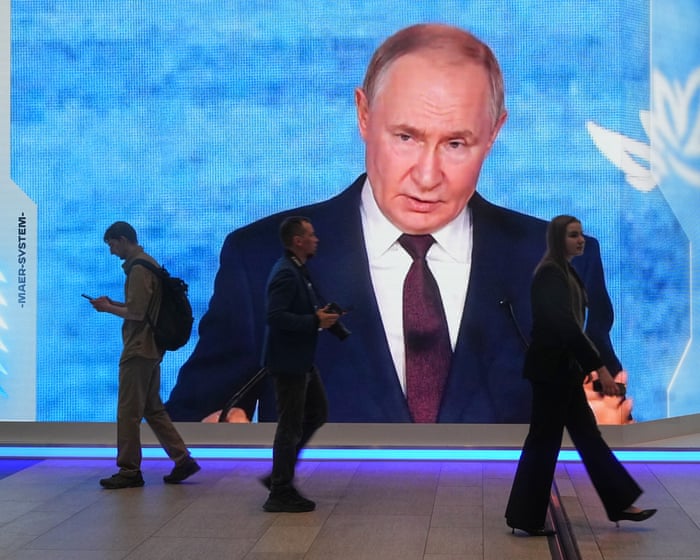
Almost everyone thinks Vladimir Putin is in serious trouble in Ukraine. By “everyone,” I mean Volodymyr Zelenskyy, his European supporters, and Western military analysts and commentators—they all seem to believe Russia’s dictator is heading for humiliation. Of course, they could be wrong. But what if they’re right? How might a desperate, cornered Putin, worried about his policies and his own safety, react to the prospect of defeat? Based on past behavior, he will escalate, not give in. His options range from trolling YouTube to starting a nuclear war.
For Ukraine, the latest news is mostly good. Using advanced Ukrainian-made drones and missiles, it has pushed the invaders onto the defensive. Russia’s dead and wounded are reportedly running at 30,000 each month. Its advance has stalled—and in some places, it’s been reversed. Ukrainian airstrikes deep inside Russian territory are bringing the war home to a misled and disillusioned public. St. Petersburg is burning. Fuel shortages are causing panic buying. Prices and taxes are rising. Putin’s 2022 “special military operation,” which was supposed to bring a quick victory, has now lasted longer than World War I.
Ukrainians still suffer daily, increasingly indiscriminate air attacks. But speaking to the Guardian last week, Zelenskyy sounded optimistic that the nightmare might be nearing an end. His view is backed, to some extent, by Western experts. Jack Watling, a land warfare specialist at the Royal United Services Institute, wrote this month that Russia’s battlefield combat power is faltering and a ceasefire may be within reach. “Putin’s savagery is exceeded only by its futility. Slowly but surely, he is losing his war,” wrote US commentator Seth Stodder.
All well and good. But three awkward questions come up. First, does Putin actually realize he’s losing? Russia’s leader is a conservative, old-school thug. He thinks Russia is still a superpower, not what he’s turned it into: a despised rogue state and a client of China. Out-of-touch Putin doesn’t use a smartphone or the internet. He’s said to rely on inner-circle apparatchiks, loyalist generals, spies, and state media, who tell him what he wants to hear. If that’s true, he’ll just keep going no matter what.
Yet this assessment raises a second, alarming question: what will Putin do if and when his Kremlin bubble bursts and it suddenly hits him that a devastating strategic and personal defeat is looming? Don’t expect him to sue for peace. Just last week, he contemptuously dismissed Zelenskyy’s offer of ceasefire talks, stubbornly repeating his wish list of war aims.
Putin’s more likely reaction would be to double down by expanding the active war zone beyond Ukraine, potentially dragging European NATO member states into the open-ended, direct confrontation they’ve avoided until now. In many ways, this is already happening. That’s why there’s a chorus of urgent warnings from European security, intelligence, and military chiefs about how Russian sabotage, subversion, and coercion are speeding up the more Russia struggles in Ukraine.
“The frontline is everywhere,” warned the head of MI6, Blaise Metreweli. “The export of chaos is a feature, not a bug, in the Russian approach to international engagement.” She said it was the product of Putin’s “aggressive, expansionist and revisionist mindset.” Keir Starmer says Western intelligence believes Russia could attack a NATO country within the next four years—which makes the furious debate over future UK defense spending all the more relevant.
Anne Keast-Butler, head of Britain’s GCHQ spy agency, claimed last month that Moscow’s forces were “going backwards on the battlefield.” Putin’s response involved intensifying pressure on Ukraine’s allies and neighbors, especially through cyber-attacks and covert disinformation campaigns. Moscow was “relentlessly targeting critical infrastructure, democratic processes, supply chains and public trust,” she said.
Russia’s offensive isRussia is becoming more physically aggressive. Incursions by armed drones and combat jets into NATO airspace are increasing. Thousands of GPS interference incidents, which disrupt civilian aviation and maritime navigation, are blamed on Russia. Poland’s rail network, which supplies Ukraine, has been sabotaged. Germany and the UK have suffered similar attacks. Undersea pipelines and internet cables in the Baltic have been cut. In this undeclared war, Norway’s land border with Russia, the North Sea, and the North Atlantic approaches are emerging as new fronts.
The expanding battlefield has a strong geopolitical side. The EU, after imposing more sanctions on Russia last week, is finally starting formal membership talks with Ukraine. Next month’s NATO summit will bring renewed promises of solidarity, despite the US stepping back. On Europe’s eastern border, most recently in Moldova and Armenia, Russian influence campaigns have been pushed back. Viktor Orbán’s defeat in Hungary was a big setback for Putin and pro-Moscow far-right populist-nationalist forces. The western Balkans are another testing ground.
Russia is expected to step up hybrid warfare operations across Europe, according to the Centre for Democracy & Resilience think tank. A key goal is to undermine coordinated Western action by spreading fear and confusion. It suggests that soon, European states will have to stop reacting one by one, recognize they are collectively under attack, and hit back by imposing greater “direct, asymmetric costs” on Russia. With the biggest planned rearmament in Europe since the 1930s, it’s only a short step to a direct east-west military conflict.
The stronger the pushback, the more extreme Putin’s reaction might be. His original decision to risk a full-scale invasion of Ukraine was not rational. Since then, he has resorted to grotesque “human wave” infantry attacks, mass child abductions, countless war crimes against civilians, reckless strikes on nuclear power plants, and “deranged” hypersonic ballistic missile attacks. These are not the actions of a normal, level-headed person. So when former president Dmitry Medvedev, Putin’s mouthpiece, threatens Europe with nuclear weapons—as he often does—that ultimate madness cannot be completely ruled out.
How does this end? Maybe it doesn’t. A third awkward question from Putin’s failing Ukraine campaign is about the shape of any future “peace” agreement. Ukraine and Europe are desperate for it to stop. Knowing this, Putin might try to freeze the conflict while reorganizing and rearming, or he could accept Zelenskyy’s ceasefire offer without truly committing to a lasting settlement. This poses a great danger for Kyiv. Public pressure to bring troops home and hold new elections could break Ukraine’s fragile unity. If the Russian threat seemed to fade, European governments might cut military support. A ceasefire without ironclad, pre-agreed security guarantees could make Ukraine more, not less, vulnerable to renewed aggression.
Current Western optimism may be misplaced. Yet it helps to remember that one man alone is the main cause of all this pain and suffering—not history, geography, identity, or ideology. The Russian people have a responsibility, to Ukraine, the world, and themselves, to remove him from power, as argued here before. Without Putin, everything is possible. With him, it’s war without end.
Simon Tisdall is a Guardian foreign affairs commentator.
Frequently Asked Questions
Here is a list of FAQs addressing the situation where Russia is losing the war in Ukraine and the potential dangers of a desperate Vladimir Putin
BeginnerLevel Questions
Q Is Russia actually losing the war in Ukraine
A Yes by most military and strategic measures Russia is losing It has failed to achieve its original goals suffered massive troop and equipment losses and lost significant territory it once held Ukraine has successfully launched counteroffensives
Q Why is Putin considered more dangerous when hes desperate
A When a leader feels cornered and faces losing power or a major defeat they may take extreme unpredictable risks Desperation can lead to irrational decisions like escalating the war using banned weapons or attacking other countries
Q What does desperate mean in this context
A It means Putin is under immense pressure Hes facing military failures economic sanctions that are hurting Russia and potential unrest at home He is running out of good options to win the war or save face
Q Could Putin use nuclear weapons
A This is the biggest fear While unlikely a desperate leader might consider using a tactical nuclear weapon to try to change the battlefield or force Ukraine to surrender It would be a catastrophic escalation
Q Is Putin just bluffing about using nuclear weapons
A Probably but its a dangerous bluff He uses nuclear threats to scare the West into reducing support for Ukraine However the risk is that if he feels he has nothing left to lose the bluff could become real
Advanced Strategic Questions
Q What specific signs show that Putin is becoming more desperate
A Key signs include mobilizing hundreds of thousands of inexperienced troops launching massive but ineffective missile strikes on civilian infrastructure seeking weapons from countries like Iran and North Korea and making increasingly erratic and threatening public statements
Q How could Putins desperation lead to a wider war
A He could deliberately attack a NATO country to test the alliances response or he could sabotage critical infrastructure in Europe A false flag attack could also be used to justify a wider conflict
Q What is tactical nuclear weapons and why are they a specific risk now