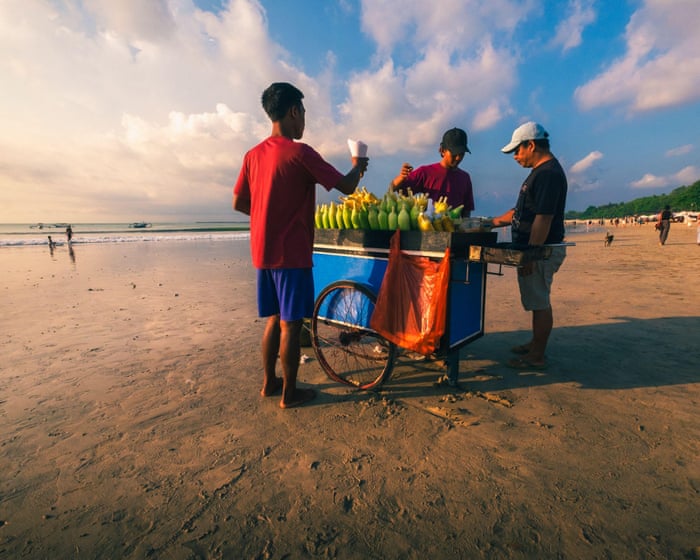
Picture a scorching summer day on a remote beach: the soft sound of waves lapping, the faint scent of sunscreen drifting by, and the distant call of a food vendor walking across the hot sand. What would you expect—or want—them to be selling? While cold drinks, fresh fruit, and miraculously unmelted ice cream seem universal, the street snacks and beachside dishes we crave vary wildly across countries and cultures.
The Guardian’s journalism is independent. We may earn a commission if you buy something through an affiliate link. Learn more.
So what goes best with open water and a coastal breeze around the world? What should you look out for on your summer holiday? And what should you avoid? Here, from custard doughnuts in Portugal and chili-spiked coconut pulp in Mexico to flash-fried red mullet in Cyprus, five chefs celebrate the culturally unique, freshly made beach dishes they crave all year.
INDIA
Barbecued Sweetcorn (pictured top)
Karan Gokani, chef, cookbook author, and founder of Hoppers
“Mumbai is a coastal city that was originally seven islands joined together. So there are beaches—usually crowded and not really for sunbathing—but the sea plays a huge role. In a strange way, it resets me. Whether I’m in Sri Lanka, the Maldives, Thailand, or India, I go back once or twice a year to find that clarity.
For me, when I think of food by the water, I always think of sweetcorn during monsoon season. Near Marine Drive, a curved coastal road that’s one of Mumbai’s most iconic spots, there’s a small beach with these weird, giant tripod rocks scattered along the shoreline. People walk there in the evening, sit by the water, and during the monsoons, you’d see women sitting by small charcoal stoves, almost squatting with umbrellas over them. They’d have a big pile of corn, peel it, and roast it to order. Now it’s often imported corn, but back then it was local and seasonal. To finish, they’d take a piece of lime dipped in a salt and chili mix and scrub it across the hot corn.
Things have become a bit westernized now, and some vendors offer versions with butter and cheese. But the old-school way is just freshly grilled corn on the cob with lime and chili. It’s the simplest food, but it instantly takes me back.”
BRAZIL
Crab and Banana Pastels
View image in fullscreen Photograph: Sonny Vermeer/Alamy
Ixta Belfrage, chef and recipe developer
“Brazil is huge, and beach eating traditions vary across the country. In Rio, you get platters of grilled prawns and oysters, milho (steamed corn in a cup), and guys with mini grills making skewers of queijo coalho, a curd cheese similar to halloumi. Personally, I don’t see the appeal of eating a hot stick of cheese on a boiling day, and I wouldn’t want seafood or oysters that had been sitting in the sun. So I tend to look to Salvador, in the northeast, where there’s a bigger African influence and completely different traditions. One is called pamonha, which is a bit like a tamale: cornmeal filled with meat or cheese, wrapped in corn husks or banana leaves, and steamed. It has that sticky, chewy, gently steamed texture and the fragrance of the husk or leaf. If someone’s selling pamonha on the beach with some hot sauce, I’m going straight for that.
But one thing I really love is pastel, which are almost like fried pasties filled with meat or cheese. One of the most delicious things I remember eating last year, at a beach bar in Brazil, was a crab and banana pastel. Banana is commonly eaten with savory food in Brazil, and that combo was sensational. That, plus some hot sauce and a Guarana (the cherry-flavored national soft drink of Brazil), is unbeatable.”
PORTUGAL
Custard Doughnuts
View image in fullscreen Photograph: Biz Jones/Getty Images/Image Source
Marcelo Rodrigues, head chef at PrimEUR, LONDON
“The whole idea of eating egg custard doughnuts—what we call bolas de berlim—on the beach just feels wrong. Like, who wants a big doughnut on a hot day? But the first time you’re at the beach, you go for a swim, and you see these Portuguese guys with huge bags, shouting, ‘Bolas de berlim! Bolas de berlim!’ and you try one, you’ll be hooked. They’re so fluffy, eggy, and sugary, and I think maybe the saltiness on your lips from the sea makes it taste even better.
The story behind them is that a lot of German Jews came to Portugal during World War II, and one of those families started making the pastries they used to make back home. It’s really a German-style doughnut, which is where the name comes from: bola de berlim, or ‘Berlin doughnut.’ Now you’ll find them all over Portugal, but especially along the coast near Lisbon.
I come from a very humble background, so if we ever had one, it would be just one to share between the four of us. These days they’re filled with chocolate and stuff like that, but traditionally it’s creamed eggs with sugar and milk—a kind of egg sauce. What makes me nostalgic about the beaches back home in Portugal are egg cream bolas de berlim, or maybe slurping up snails with lots of garlic and oregano.
I often wonder what the people who sell bolas de berlim do for the rest of the year. From May to September, they’re hustling on sunny beaches, walking on sand with heavy loads, carrying very fresh doughnuts. Where do they come from? How do they do it? Even for me, it’s a mystery, but that only adds to the excitement.”
MEXICO
Fresh coconut pulp
Adriana Cavita, chef and founder of Cavita, London
“There are so many different things we eat at the beach, wherever you go in Mexico—whether it’s prawn skewers, fruits, or empanadas. And you’ll often find ceviche with tostada at little stalls and restaurants, in different styles, whether you’re on the west coast or the east. Sometimes you can find oysters, just with drops of lime and a Valentina-style hot sauce, but I think my favorite thing to have on the beach in Mexico is fresh coconut pulp.
It’s something you’ll get at most beaches, but especially on the Pacific coast, in places like Jalisco. When you’re on the beach and it’s really hot, you’ll see these women, sometimes walking barefoot and carrying their kids, selling the coconuts. First, they make a hole in the top, you drink the water with a straw, and then when you’re done, they cut the coconut in half, scoop out the pulp, ask if you want lime or salt, and check how spicy you want it. Sometimes it’s a chili powder or a homemade hot sauce, and you either scoop it up with your fingers or use a toothpick.
And that’s it: you look out at the sea and eat this sweet, spicy, acidic pulp. It’s the kind of thing I really crave when I’m in the UK because you can’t find it anywhere. It’s super simple but super fresh—exactly what you want when it’s warm.”
ANTIGUA
Seasoned rice
Kareem Roberts, chef and cookbook author
“If you’re talking about the classic beachside dish in Antigua, it’s often fried fresh, served in foil, and simply dressed. But I have a more personal connection to beachside cooking. I grew up next to a fishing village, and a lot of the best things you can experience in the Caribbean aren’t things we’d necessarily market to tourists. They’re for locals. So as much as I could tell you to go get fresh coconut water or something, the real Antiguan experience is a dish we call seasoned rice.
It’s a one-pot seafood rice dish, but for it to truly be seasoned rice, the one ingredient that has to be in there is salted pork. Some people add salt fish, some add beans, and I’ve had it before with octopus, cockles, and pigeon peas. But without the pork, it’s not seasoned rice—it becomes something else.”There’s a dish called cook-up rice. If you’re visiting Antigua, I’d really encourage you to seek it out—it’s not hard to find if you know where to look.
I still remember one particular cook-up rice: the chewy octopus, the fluffy rice, the wilted local spinach, and the distinct flavor of the seasoning peppers. You’ll usually find it at a beachside vendor or restaurant, served in a styrofoam container with a plastic fork that feels like it might melt in the heat. If it’s on a plate, it’s not the real deal! Trust me, you’ll need a nap right after, but that’s how we truly eat in Antigua. It’s something genuine, not something staged.
CYPRUS
Fried red mullet
View image in fullscreen
Photograph: KrimKate/Getty Images
Hasan Semay, chef, presenter and cookbook author
“When I think of eating by the water in Turkey and Cyprus, one of the first things that comes to mind is the mackerel sandwiches by the Bosphorus in Istanbul. What makes them so special is how your other senses heighten your taste—the sea breeze, the piles of fresh mackerel, watching the men cook on rocking, moored boats, and that distinct, oily fish smell as the mackerel sizzles on the griddle. A warm piece of crusty bread, the oil from the mackerel soaking into sliced lettuce and onions; being encouraged to drink pickle juice and add your own garnishes. I remember the first time I ate one—there was this moment of calm, like all the noise and street vendors faded away, and I just enjoyed the food.
When it comes to Cyprus, it’s tricky because I grew up with dual nationality [Semay has both British and Turkish-Cypriot heritage]. My dad believed everything revolved around Cyprus—the best olive oil, the best tomatoes, everything. But what really brings me back is remembering going there as a kid, covered in salt water with fresh, peeling sunburn on my shoulders, and heading to a simple restaurant for fresh red mullet. The fish came from a man selling them out of a bucket—they were lightly coated in semolina or cornmeal, and you could have them grilled or deep-fried.
In a Michelin-starred restaurant, red mullet can be expensive, but in these places, where the fish swims right next to you in the sea, it’s quite cheap. And I think it’s one of the only fish that, when fried or grilled, gives you that smell and taste of prawn shells smoking over a barbecue. I picture those pieces of red mullet, stacked on top of each other, almost hissing from the grill, eaten with a quarter of an onion, some rocket, salt, and lemon juice. And I think of my dad, with his deep summer tan, fish grease and lemon juice on his hands and face, just groaning with pleasure as he attacks that plate of fried fish.”
Frequently Asked Questions
Here is a list of FAQs about Sun Salt and Sand The Best Beach Food from Around the World written in a natural tone with clear answers
BeginnerLevel Questions
1 What exactly qualifies as beach food
Beach food is any meal or snack that is easy to eat with your hands portable holds up well in the heat and doesnt require a lot of utensils Its food that tastes great with sand between your toes and a salty breeze
2 Why is fruit like watermelon or pineapple so popular at the beach
They are natures hydrators Fruits with high water content help you stay cool and hydrated under the sun They are also naturally sweet refreshing and messfree if precut
3 Whats a classic simple beach snack from the US
The classic is a PBJ sandwich It doesnt spoil quickly its filling and you can eat it without plates or forks Also potato chips and a cold soda are iconic
4 Do I need to worry about food safety in the sun
Yes The danger zone for bacteria growth is between 40F and 140F Anything with mayo dairy or raw seafood should be kept in a good cooler with ice packs If its been sitting in direct sun for over two hours throw it away
5 Whats a good beach food for someone who doesnt like seafood
Grilled corn on the cob fruit skewers hummus and veggie sticks cold fried chicken or empanadas are all excellent nonseafood options that travel well
Intermediate Questions
6 What are some famous beach foods from Asia
Thailand Som tam and grilled satay sticks
Japan Onigiri and chilled soba noodles
Philippines Pritong isda with vinegar dip and mango slices