Last autumn, I was sitting with a well-known architect in New York when their phone kept buzzing. They finally checked the messages and laughed. “Oh, the Albanian Architecture Army chat is blowing up again,” they said. “Looks like Edi has some new projects for us.”
Edi was Edi Rama, Albania’s prime minister since 2013, who has been overseeing the rapid transformation of the former communist country through a series of flashy building projects. There are twisting towers in Tirana, award-winning public spaces, striking coastal resorts, and many more bold visions on the way—all now collected in a hefty new book, The Albanian Files.
Critics see the 800-page book as a 2.2kg dossier of evidence.
The country’s makeover, it turns out, is partly coordinated through a WhatsApp group (short for “Albanian ArchArmy”) that includes some of the world’s most famous architects. It’s a place where achievements are shared, new projects celebrated, and the great prime minister-patron showered with praise for his courage and boldness. The New York architect describes it like a superhero movie: Rama sends out the signal and the world’s starchitects rush in to save the day with their daring designs. Look closely enough and you might even see the Albanian double-headed eagle projected into the night sky.
View image in fullscreenHub … Saranda port development plan by XDGA, shown in The Albanian Files. Photograph: Oliver Wainwright/Lars Müller Publishers
The WhatsApp chat might be private, but The Albanian Files is the next best thing. It’s a remarkable document, both intentionally and not. In his foreword, Rama calls the book “a precious behind-the-scenes record” of a process that is “lifting Albania in a way that nobody saw coming.” It’s an eye-opening catalog of dreams, in which 60 international firms (and not a single Albanian one) lay out their plans for over 500 projects across the country.
To Rama’s critics, however, the book is an 800-page, 2.2kg dossier of evidence. They point to the lack of transparency in decision-making, the destruction of heritage, forced evictions, the trampling of protected landscapes, and the role of Albania’s construction industry in laundering money for organized crime. The publication is full of firsthand accounts from architects documenting their experiences, and one opposition MP has called it the “smoking gun”—though there’s no suggestion that the architects have been involved in any wrongdoing. Rama is right that nobody saw it coming: most of the projects in the book are news to the local population, which has reacted with fury.
“Starchitects go home!” read one sign at a loud protest in June outside a venue in Tirana, where many of the architects in the book had gathered for an exclusive event to celebrate their work and launch the publication. “Where is the public?” read another. Tickets for the architecture festival, titled Landscapes of Abundance, cost up to €200, in a country where the median monthly wage is €700. It came at a tense moment, just weeks after huge national protests were sparked by multibillion-dollar plans to turn the Zvërnec nature reserve and the nearby island of Sazan into a luxury resort backed by the Trump family.
Dubbed the flamingo revolution, in reference to the fragile habitats critics say will be trampled by the project, the protests have now continued for over 120 days, with ever-louder calls for Rama’s resignation. Architecture has unexpectedly found itself in the firing line.
View image in fullscreenAnger … Albanians protest at development of coastal nature reserve in June this year. Photograph: Armando Babani/Getty Images
“It feels like living in an autocratic kingdom,” says Lorin Kadiu, director of Citizens.al, an investigative news platform that has been tracking construction projecSince 2018, Albania has seen growing discontent. “It’s not just the lack of transparency, but the fact that we all have to live with one person’s aesthetic tastes. The whole country has to be painted the way he wants,” one protester said.
Rama, who trained as a painter, first became well known as mayor of Tirana in the 2000s, when he gained international attention for painting grim Soviet-era apartment blocks in bright, cheerful colours. The cheap and lively makeover was a success, and Rama was praised for his unconventional artistic approach.
But now, many of his former supporters believe his architectural ambitions have gone too far. An open letter distributed at the protests condemned the “art-washing of bulldozer politics” and asked the architects present whether they enjoyed “the freedom to do here what would be forbidden, challenged, or otherwise made impossible in your own countries?” Of the architects the Guardian contacted, only one replied, saying they do not do anything in Albania that they would not be allowed to do elsewhere. They added that “the freedom in Albania is certainly alluring, and as such the personal responsibility is greater.”
As Rama pointedly writes in his foreword to The Albanian Files, architects are drawn to work in Albania by the “freedom from ‘no’ in all its forms.” The book is filled with visions for untouched coastlines, green forests, and pristine dunes and lagoons. In Gjipe, a bay many consider the last virgin beach in southern Albania, the Dutch firm MVRDV has proposed a mirrored glass hotel spanning the gorge, “like a jewel on the coastline.”
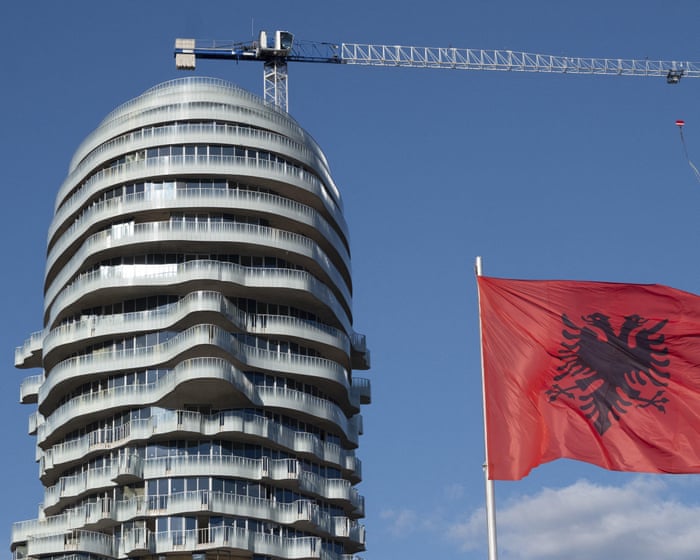
This follows closely on the heels of their apartment tower in Tirana shaped like the head of Skanderbeg, Albania’s national hero (which also looks strikingly like Rama). In the protected dune area of Rana e Hedhun, the renowned Portuguese architect Álvaro Siza has masterplanned a hillside development with a cable car and a tower block on the beach.
A few pages later, Swiss master Valerio Olgiati proposes a cluster of concrete towers rising from the sand, dotted with defensive windows. It looks as if he might be preparing to fend off an invasion from the sea.
The coastal transformation continues with Florentine luxury yacht designer Luca Dini (studio mission: “to astonish even the most discerning”). He presents an illustrated journey through his 17 projects, including the Life Marina Complex, spanning seven kilometres of virgin coastline near Saranda, and the Atara resort, with a golden “crown” hovering above the cliffs like another military lookout post. It almost becomes parody when his comic-style illustrations end with an image of a super-yacht soaring above a skyline, with the designer himself declaring from the deck: “[we] create spaces that harmonise with the environment.”
The book’s editor, Anneke Abhelakh, asked the architects to submit their own texts, and they are striking in their honesty. At times it reads like a hot-mic transcript. “Because there are not many rules and my clients care very little for the context,” writes Berlin-based architect Sam Chermayeff, “we are forced to think through our own values.” He recounts the “truly wild” experience of working in Albania, including how he was called out of the blue by one of Rama’s associates and soon asked to design two towers in Tirana totalling 45,000 square metres – quite something for a designer better known for experimental kitchens.
“Of course I agreed,” he adds, “not really understanding what was happening.” Contacted for comment, Chermayeff responded: “I do ask Albanian clients the same questions that I ask of clients in any country and am equally assured,” adding that “as in Germany or the US, I really do not know more than what I am told,” aHe added that he does not work in or near protected areas. “I do not do anything,” he said, “that I would not do elsewhere.”
Austrian architect Chris Precht describes how Rama himself approached him on Instagram, “asking if I would be interested in working in Albania.” He now has 29 projects to his name, including a €4m “Garden of Eden,” built in the courtyard of the prime minister’s own office.
“It is an unimaginable reality,” says a campaign group of Albanian architects and urban planners, Arkitektët Shqiparë, which has created an online database of all the projects—published in Albanian, unlike the book. “A narrow group of foreign architects is contacted directly by the prime minister’s office and receives projects without a competitive procedure.”
Beside the seaside … Olgiati’s proposal for concrete towers on the beach in Lezha. Photograph: Oliver Wainwright/Lars Müller Publishers
The foreign architects describe it differently. “Rama never appoints the architects himself,” one member of the ArchArmy group tells me. “But he makes introductions to developers. And it is understood that, if they choose one of his architects, they [the developers] will get permission to build what they want.”
Rama has consistently denied the allegations. In a furious interview with CNN in June, he denounced the claims of corruption as “fake news.” He has long maintained that the wider protests have been stoked by the US president’s enemies, including Iran. “If it were not Jared Kushner,” he said, “nobody would give a shit about flamingos, about Albania, about nothing. It’s the whole hate against Trump that creates all this scrutiny.”
Contacted by the Guardian, the prime minister’s office did not respond to requests for comment in detail but called the allegations “hearsay” and “bitter assessments.” During a speech this week to launch the competition for a new tower, Rama insisted the competition juries are “mostly architects, urbanists and academics who are entirely free,” that “the Albanian side is in the minority” and that there is “never any orientation or influence” on the jury. He added that today Albania “is the largest open ‘university’ in architecture,” as young Albanian architects have the opportunity “to meet, to follow, to work concretely with masters.”
The book’s subtitle is Freedom and Architecture, and there is an air of carte blanche to many of the designs. “Working as an architect in Albania is liberating,” writes the Belgian Xaveer De Geyter, alongside his proposal for a colossal trio of M-shaped towers for the port of Saranda, “provoking a degree of freedom that sometimes leaves us in a cold sweat.” Spanish studio Arquitectura-G praises Albania’s permitting process as “significantly faster and less restrictive” than elsewhere, driven by “a clear vision coming from the prime minister.” Portugal’s Manuel Aires Mateus concurs: “There are times when things have to be top-down.”
The palpable thrill of building on virgin terrain is also evident. Japanese doyen Kengo Kuma describes the exhilaration of flying over Albania in a helicopter. “I found it very exciting,” he writes, “as most of the nature is untouched.” In Asia, he adds, “it is very difficult to find a project in such ‘virgin land’.” The Berlin-based Indian architect, Anupama Kundoo, talks of the opportunity to create, “free from the baggage” of Europe and other “developed countries.”
Kundoo is working on a masterplan for a “laboratory settlement” of 50,000 people in the protected Divjakë-Karavasta national park. Such a project has only been made possible by a controversial 2024 law, which allows the construction of five-star resorts in protected areas, from which the TThe rump-backed plan in Zvërnec also benefits. There is no suggestion that any of the architects named in this article are breaking any laws. “The developers are in a hurry,” says Kadiu. “There is a sprint to build as much as possible before these laws are repealed.” Pressure is growing. Albania has entered the final phase of its EU accession negotiations, but these lax regulations remain an obstacle. Both the 2024 law and the 2015 legislation that gives preferential treatment to “strategic investors” were criticised in an EU report last year as conflicting with its standards. A European Parliament resolution in June this year “expressed serious concerns” and called for an “immediate moratorium on new permitting procedures, construction works and development interventions” within protected areas. Rama continues to defend both laws as pragmatic, modernising policies that balance environmental conservation with high-value economic development. Beyond fears for the environment, and the opaque permitting and procurement processes, another burning question remains: how can one of the poorest countries in Europe afford to build these extravagant schemes? Property prices have risen astronomically, but wages and bank mortgages have not increased at anything like the same rate, leading critics to suspect that dark money is involved. The Global Initiative against Transnational Organized Crime identifies Albania’s real estate and tourism sectors as major sites of money-laundering, noting that the construction sector is “heavily infiltrated by illicit funds”. Its 2020 report estimated that €1.6bn of “dirty money” had been laundered through Albanian real estate in the previous three years. As I reported in 2022, leaked wiretaps revealed Italian mafia figures discussing how Tirana’s high-rise boom was a prime opportunity for laundering their cash, with construction prices of roughly €500 per sq m paling in comparison to listing prices of up to €4,000 per sq m. Albania’s own Special Prosecution Office against Corruption and Organized Crime, SPAK, is making progress. In June, it seized €150m of assets, including apartments, villas and commercial properties, tied to an alleged cocaine trafficking network. The same month, Pëllumb Gjoka, once named a “strategic investor” by the Albanian government with approval to build a €52m resort on the coast, was sent to prison for ordering mob hits. View image in fullscreen ‘It’s a classic example of what happens when you think you’re the benevolent leader’ … Albanian Prime Minister Edi Rama. Photograph: Stefano Costantino/SOPA Images/LightRocket/Getty Images Research by Citizens.al shows that several projects in The Albanian Files are linked to ongoing SPAK investigations (none of the architects named in this article are implicated), alleging criminal capital has been funnelled through shell companies, construction contracts and property transactions. Over 40% of the projects in the book don’t even mention who the client is, leading many to ask: why the opacity? One former member of the ArchArmy is rueful about the way things have turned out. “Like the others, I joined with a real conviction that this could be a positive change for the country,” they tell me. “Rama knew Albania was going to develop very quickly, and he didn’t want to fuck it up. It’s better to have some good architects involved to make sure it turns out halfway decent, rather than people building generic apartments along the coast without any control.” The architect says they backed out after being part of a competition jury that “didn’t feel democratic” and the fact that issues around land ownership “always felt very vague”. They add: “Rama still very much believes that he’s doing the right thing for the country. It’s a classic example of what happens when you think you’re the benevolent leader, but you stStaying in power too long.” This sentiment is echoed in one of the book’s most revealing contributions. Reinier de Graaf of the Dutch firm OMA writes an open letter to Rama—meant as a parody, but the humor falls flat. “Given Albania’s enduring status as an enlightened architectural patron,” he writes, “our profession would benefit greatly if the country never had another election again, and if you… would just continue as president for life—maybe even king.” He adds: “In a world of autocracies, may we have one benevolent autocrat with taste?”
Frequently Asked Questions
Here is a list of FAQs about the architectural boom in Albania and the Starchitects go home phenomenon
What does Starchitects go home mean
It is a slogan or sentiment criticizing the trend of famous international architects designing big projects in Albania often while local architects feel ignored or undervalued
What is a Starchitect
A Starchitect is a celebrity architect with international fame like Norman Foster or Zaha Hadid who is hired to design iconic often expensive buildings
Why is Albania hiring so many famous foreign architects
The government and developers want to put Albania on the map They believe iconic buildings by famous names will attract tourism foreign investment and signal that the country is modern and open for business
What is driving Albanias building boom
The main drivers are a push for rapid modernization a booming tourism industry and a government strategy to rebrand the countrys image from its communist past to a dynamic European destination
What are some examples of these big projects
Major projects include the new Albanian Parliament building by Zaha Hadid Architects the Tirana Riverside project by Bjarke Ingels Group and a master plan for the city of Durrs by Stefano Boeri
Why are local architects upset
Local architects argue that they understand the local culture climate and regulations better They feel that big international firms are taking opportunities and public money that should support the local profession
Is the building boom good for Albanias economy
It can be Construction creates jobs and new buildings can attract tourists and business However critics worry the money could be spent on more essential services like healthcare or education
What are the main criticisms of this boom
Critics say the projects are often too expensive ignore local needs and focus on luxury tourism rather than improving life for average citizens There are also concerns about corruption and lack of transparency in how deals are made
Do these foreign architects actually build the projects
The Starchitect firm usually creates the design and vision The actual construction and daytoday work is almost always done by local Albanian firms and workers
What is architectural washing
This is a term critics use when a government uses flashy architecture to distract from problems like corruption or poor public services The shiny new building makes the government look good