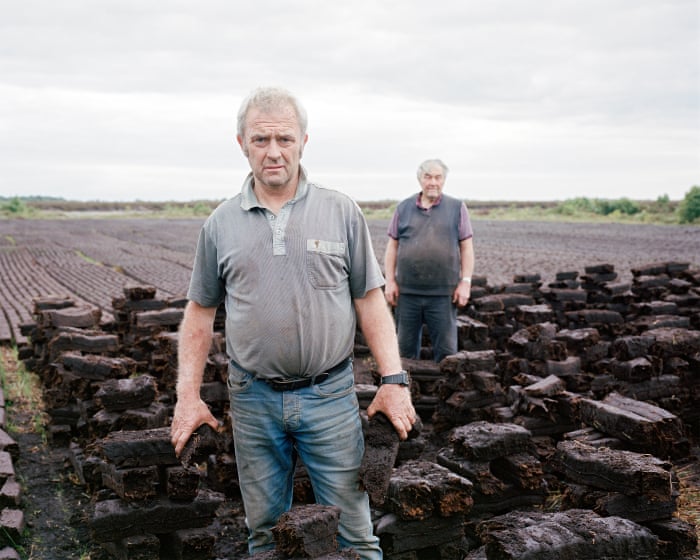
“You can read Ireland’s history in the bogs. They hold thousands of years in their layers,” says photographer Shane Hynan about his project, Beofhód (which means “Beneath” in English).
The bogs, called portachs in Irish, cover about 1.2 to 1.5 million hectares—roughly 14% to 17% of the country’s total land area. The raised bogs in the Irish Midlands are made of peat that forms at just 1mm per year in low-lying, poorly drained basins or old lakes. As historical geographer Kevin Whelan notes in the Atlas of the Irish Rural Landscape, “the bog has been etched as deeply into the human record as into the physical record in Ireland—more so than anywhere else.”
Hynan first became fascinated by them after living abroad for a long time. “I went from being an insider to an outsider. When I came home, I noticed how much the bogs had changed. In a good way, I saw fewer men cutting turf. In a bad way, I saw there was no money in the work anymore.”
For generations, turf from the bogs was dried and cut into blocks, providing the main fuel for rural homes. Households that use turf might spend up to €800 a year on heating—less than a quarter of the average Irish household’s annual energy bill. “It’s very, very cheap fuel. They can control the quality and quantity of it; you can’t really do that with anything else,” Hynan says.
But the bogs were also under threat from other directions. Ireland holds 8% of the world’s blanket bogs—made from the remains of grasses and sedges, found along the west coast’s mountainous areas—yet data from Ireland’s Central Statistics Office shows that more than 80% of the original peatland has been lost to extraction, forestry, horticulture, or farming.
“I reckon in 20 years… a lot will be gone,” says Hynan. “It’s a finite resource.”
The problem, beyond the impact on the landscape, is that peat bogs are one of the most important carbon sinks on the planet. A study by the FarmPEAT project found that a healthy Irish raised bog can store up to 13 times more carbon per hectare than the Amazon rainforest, because the carbon is stored underground rather than in short-lived plants.
So what should be done? “These bogs are unresolved, just like my work,” Hynan says. “I’m not trying to resolve anything… It’s a feeling that connects me to them. When people’s voices started getting louder in my head, I began to see a lot of gaps between ideas of what we should do, what’s really happening, and how people are being demonised. It’s a very complex situation here in Ireland.”
He rejects the idea that his photography tells people what to do or judges them: “I’m not being preachy and telling you to stop. I’m here to question your relationship with the environment.”
“There’s real uncertainty about the future of the bogs—how we interact with them, how we see them, and how we use them.”
Shane Hynan’s Beneath | Beofhód is on display at the Photo Museum Ireland until 5 July 2026.
Frequently Asked Questions
Here is a list of FAQs about documenting Irelands disappearing boglands written in a natural tone with clear concise answers
BeginnerLevel Questions
1 What exactly is a bogland
A bogland is a type of wetland that builds up over thousands of years from dead plants mainly moss Because the ground is waterlogged and lacks oxygen the plants dont fully decay This creates a thick spongy layer of peat
2 Why are Irelands bogs disappearing
The main reason is that people have been cutting the peat for centuries to use as fuel for heating homes In recent decades largescale mechanical harvesting for gardening compost and electricity generation has also drained and destroyed huge areas
3 What does thousands of years in their layers mean
Each layer of peat is like a page in a history book By studying the pollen seeds and even ancient insects trapped in each layer scientists can figure out what the climate was like what plants grew and even how early humans lived going back over 10000 years
4 Why should I care about bogs Theyre just wet empty land
They might look empty but theyre incredibly important They store huge amounts of carbon are home to rare plants and animals preserve ancient artifacts perfectly and hold a unique record of our past
5 What does documenting the bogs actually involve
Scientists and photographers are working fast to record whats left This includes taking core samples of the peat photographing the landscape and its unique plants and carefully collecting and preserving any ancient objects or human remains found before they are destroyed by peat cutting
Advanced Deeper Questions
6 How exactly do bogs act as a carbon sink
The bog moss absorbs carbon dioxide from the air as it grows Because the dead moss doesnt rot in the bog that carbon stays locked in the peat An intact bog stores more carbon than a rainforest When you drain or cut a bog that carbon is released back into the atmosphere as CO2
7 What kind of ancient artifacts have been found in Irish bogs
The most famous are bog bodieshuman remains preserved so well that skin hair and even stomach contents survive Archaeologists have also found butter