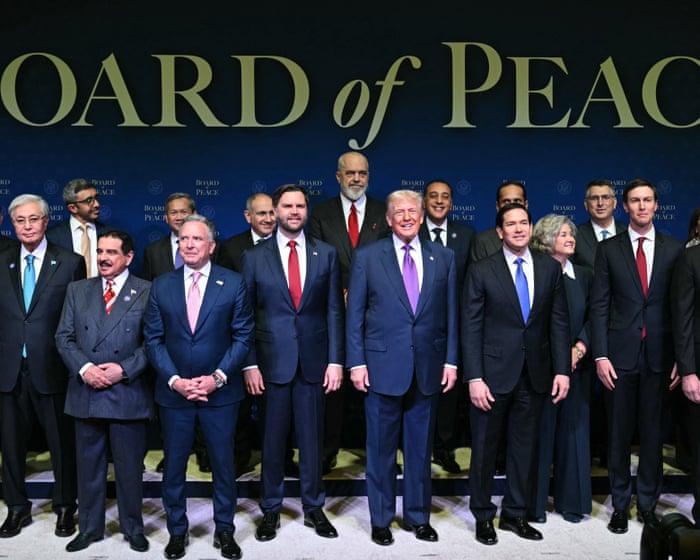
The UN-sanctioned Board of Peace, announced by Donald Trump earlier this year to govern Gaza, is planning to grant itself broad legal immunity, according to a draft resolution obtained by the Guardian. The draft also allows the organization to acquire public property in Gaza “free of charge.”
The four-page resolution, labeled “sensitive but unclassified,” extends wide protections to every member of the Board of Peace and its administrative arm, the Office of the High Representative (OHR), as well as to Palestinian technocrats, international military forces, and non-resident contractors set to work in Gaza. It defines the legal processes from which they would be immune as “any arrest, detention or legal proceedings in the courts or other entities in Gaza.”
It is unclear whether the document aims to shield the Board of Peace and its affiliates from prosecution in international courts, in addition to potential claims in Gaza.
The Board of Peace’s chair, Donald Trump, would have the authority to waive someone’s legal immunity, provided he has majority support from the peace board, according to the June 2026 draft resolution.
The seven-member “executive board” leading the Board of Peace includes Trump’s son-in-law Jared Kushner; special envoy Steve Witkoff; the president’s chief of staff, Susie Wiles; and his national security adviser, Marco Rubio. Although countries have pledged billions, most have not yet transferred funds to support its work in Gaza, and no major contracts have been issued.
What is Trump’s Board of Peace and who is involved?
Read more
The White House referred questions to the Board of Peace.
The Board of Peace did not answer specific questions about the draft resolution, but an official said in a statement: “There is no operative resolution or immunity framework of the kind described in your questions … Any suggestion that this process is designed to create lawlessness or impunity is wrong, misleading, and gets the issue entirely backwards.”
The official added that “the suggestion that the President will have a role in establishing or waiving immunity in Gaza [is] categorically false,” and that “the Board will ensure all personnel, contractors, and participating entities follow applicable law and operate under clear rules, oversight, and accountability mechanisms.” The official did not explain what the oversight and accountability would involve.
Nickolay Mladenov, a Bulgarian diplomat serving as the Board of Peace’s high representative for Gaza, has been meeting in Cairo this week with Palestinian administrators chosen by the Board of Peace to govern Gaza. According to a person familiar with the agenda, the discussions have focused on refining the framework for the group’s work in the territory. The prospective immunity resolution, titled “RESOLUTION NO 2026/3,” has not been shared with the Palestinian group, the person said.
‘No external oversight’
Six lawyers specializing in US contracting law and international armed conflict reviewed the draft resolution for the Guardian.
If the resolution takes effect, they said, it is unclear how Board of Peace officials, soldiers, and contractors would be held accountable if there are shootings or accidents affecting Gaza residents, or even how the group might resolve routine disputes over business or land use there.
US-led reconstruction efforts in Iraq and Afghanistan were often plagued by controversies over corruption or cases of civilian deaths or abuse by American contractors, including those working for Blackwater and KBR, who have since faced lawsuits in US courts. Any reconstruction effort in Gaza could face similar challenges.
“It looks like an attempt to exempt the board, and all of its personnel, from accountability for potential legal violations,” said Emily Schaeffer Omer-Man, an expert in litigating international humanitarian law in Israeli, American, and foreign courts.
Several lawyers, iIncluding Omer-Man, several people pointed to the specific risks in section 7 of the draft resolution, titled “Third Party Liability/Claims.” This section sets up a system for the Board of Peace to review and decide on any claims for “property loss or damage and for personal injury, illness or death” resulting from its work in Gaza.
“They’re basically saying there’s no outside oversight, including the international laws that apply to occupation,” said Noura Erakat, an international law professor at Rutgers University. “They’re creating their own legal system.”
Contractors have also asked for clarity on the legal protections they would have for potential work in Gaza. The Trump-backed peace board has asked for bids on rubble removal, security work, and a large reconstruction effort there. Trump’s son-in-law, Jared Kushner, has described turning the coastal area into a place with luxury resorts, high-tech cities, and regional business centers.
Laws for international contractors and military forces are usually laid out in “status of forces agreements” between countries, but there is no such agreement for Gaza. American contractors can still be subject to US law for certain crimes even when working overseas.
“I think any company would want a very clear legal framework,” said Doug Brooks, president emeritus of the International Stability Operations Association. “There are liability issues that any serious American company would want to be clear about.”
Israeli officials don’t want to negotiate a status of forces agreement for Gaza because Israel doesn’t want to recognize Gaza as a state, one American security contractor said.
“It’s pretty important for political and legal cover and insurance,” the contractor said. “It gives the people of Gaza clarity and comfort about how they’ll be treated and dealt with by contractors they might work with.”
Free facilities for the Board of Peace
The final section of the Board of Peace’s draft resolution, titled “Premises of the Board of Peace, OHR, and ISF,” says the group “shall be provided, free of charge, public premises and facilities needed for the accomplishment of the missions in Gaza.”
Legal experts said this single phrase could allow for the illegal seizure of Palestinian property. It’s not clear which group—Israel, Hamas, or the Palestinian Authority—would be responsible for “providing” the Board of Peace with facilities, or under what terms.
The Board of Peace plans to build a base for an international military force, as well as logistics hubs to support its operations there, according to contractors involved in the process. The international force is meant to help disarm Hamas, which is a key step in Trump’s peace plan. Israel has refused to move forward with steps outlined in a November 2025 ceasefire agreement if Hamas remains armed.
“The Board of Peace is taking a page out of Israel’s repressive playbook”
“By unilaterally claiming the power to seize Palestinian land, property, and buildings for their own use without consent, compensation, or redress, the Board of Peace is taking a page out of Israel’s repressive playbook,” said Omar Shakir, executive director at Dawn, a non-profit that investigates the impacts of US foreign policy in the Middle East. “Far from signaling an end to genocide, apartheid, and occupation, this document suggests deepening some of its ugliest features. This risks not just complicity, but directly committing serious abuses.”
Several lawyers raised questions about the Board of Peace’s legal authority to take control of public facilities and premises.
“If they don’t have a status of forces agreement with Israel, then it’s not clear what the board’s legal authority would be,” said Brad Parker, associate director ofPolicy at the Center for Constitutional Rights. CCR lawyers have represented victims in U.S. lawsuits against Blackwater and other American security contractors for alleged abuses in Iraq.
The UN Security Council authorized the Board of Peace to oversee the administration of Gaza until December 31, 2027. The UN Charter gives its diplomats and organizations specific legal protections for work done on behalf of UN missions abroad. Language in the Board of Peace’s draft resolution seems to draw on those existing frameworks, which include protections against the arrest or detention of UN diplomats during official work, as well as the seizure of UN property. It’s unclear whether the Board of Peace could use UN immunities for its own protection.
The draft says the resolution will take effect once Mladenov signs it. The Board of Peace did not respond to questions about which other parties, if any, would also sign its sweeping resolution.
“How valuable is this document if they’re the only ones signing it?” Shakir said.
Get in touch
Contact us about this story
The best public interest journalism relies on firsthand accounts from people in the know. If you have something to share on this subject, you can contact us confidentially using the following methods:
Secure Messaging in the Guardian app
The Guardian app has a tool for sending tips about stories. Messages are end-to-end encrypted and hidden within the routine activity that every Guardian mobile app performs. This prevents an observer from knowing that you’re communicating with us at all, let alone what’s being said.
If you don’t already have the Guardian app, download it (iOS/Android) and go to the menu. Select ‘Secure Messaging’.
SecureDrop
If you can safely use the Tor network without being observed or monitored, you can send messages and documents to the Guardian via our SecureDrop platform.
Our guide at theguardian.com/tips lists several ways to contact us securely and discusses the pros and cons of each.
Frequently Asked Questions
Here is a list of FAQs based on the topic of Documents show that Trumps Board of Peace plans to give itself broad immunity
BeginnerLevel Questions
Q What is the Board of Peace
A Its a proposed government board that President Trump reportedly planned to create Its stated goal was to promote peace and resolve disputes but documents show it was designed to have very broad powers
Q What does broad immunity mean in this context
A It means that the members of the Board of Peace would be protected from being sued or prosecuted for most of their official actions Basically they couldnt be held legally responsible for what they did while serving on the board
Q Why would a peace board need immunity
A Normally immunity is given to protect officials from frivolous lawsuits that could stop them from doing their jobs However critics say the level of immunity in these documents is unusual and could allow the board to act without any legal consequences
Q Is this board actually created yet
A No It was a proposal found in documents and planning memos It has not been officially created or approved by Congress
IntermediateLevel Questions
Q What specific powers does the proposed immunity cover
A According to the documents the immunity would cover actions taken in the course of official duties but the definition of official duties is written very broadly This could potentially protect the board from laws against bribery fraud or even violating peoples constitutional rights as long as they claim it was part of their job
Q How is this different from the immunity that other government officials have
A Most officials have qualified immunity or absolute immunity for specific narrow functions This plan appears to give the entire board a blanket allencompassing immunity that goes far beyond what is typical for an executive branch advisory body
Q Could the Board of Peace overrule other government agencies or courts
A The documents suggest the board could investigate and potentially resolve disputes involving other federal agencies This has raised concerns that it could be used to pressure or override decisions by the Justice Department the FBI or even the courts without being held accountable
Q What is the main criticism of this plan