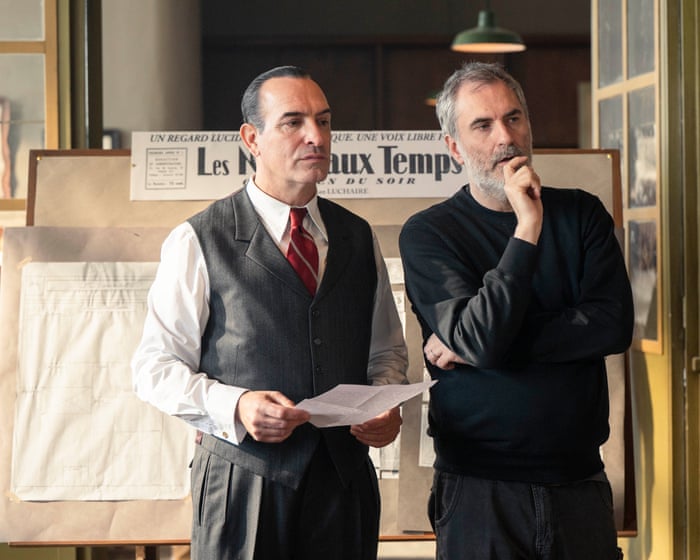
The director and Oscar-winning star of a box office hit film about Nazi collaboration have dismissed criticism that they whitewashed wartime atrocities as dishonest and “a scandal.”
Xavier Giannoli and actor Jean Dujardin responded to a heated debate among French historians over their film Les Rayons et les Ombres (Rays and Shadows), which tells the story of wartime press baron Jean Luchaire.
Luchaire, initially a pacifist, became a Nazi collaborator during the Occupation of France, serving as commissioner for information and propaganda for the puppet Vichy regime. He was executed for treason in 1946.
Giannoli rejected accusations that he created what one critic called “a masterclass in historical gaslighting,” insisting he collaborated closely with historians on the screenplay. He described the critics’ attacks as “factually false.”
“My aim was to tell the story of a collaborator in his world—the disgusting obscenity of people who were partying under chandeliers, eating caviar and petit fours during the Occupation,” he told the current affairs and culture program Quotidien.
When accused of negatively portraying the French Resistance, the filmmaker responded angrily: “It’s a scandal! It’s disgusting! It’s profoundly dishonest! The film has opened a historical debate, but I didn’t expect it to take on such political dimensions. The debate is now polarizing along today’s political lines.”
Luchaire was a French journalist and press baron appointed minister of information in the Vichy government led by Philippe Pétain. In 1944, his newspaper Les Nouveaux Temps disseminated Nazi propaganda calling for the “extermination” of the French Resistance and published articles attacking Allied forces after D-Day. During the Occupation, he lived in luxury, dining at fine restaurants and attending glittering parties.
The film is narrated from the perspective of Luchaire’s daughter, Corinne, an actress once hailed as the “new Garbo,” played by Nastya Golubeva. Corinne also collaborated and partied during the Occupation and was later imprisoned for “national indignity” after the war. She died of tuberculosis in 1950.
Since its release in mid-March, Les Rayons et les Ombres has attracted over 800,000 viewers in France. Its success is surprising, partly due to its length—over three hours—which limits daily screenings.
However, critics, including historians, have attacked the film for downplaying the role of the Resistance and the fate of Parisian Jews who were rounded up and sent to Nazi death camps. They argue the film encourages viewers to empathize with Luchaire and his daughter.
Luc Chessel, a film critic for the left-wing newspaper Libération, wrote: “We apologize for the slightly Radio London-style Anglicisms, but we are witnessing a masterclass in historical gaslighting.” He added, “The film’s overarching problem lies in its moral approach to the whole matter.”
In Le Monde, historian Bénédicte Vergez-Chaignon, a specialist in World War II, criticized the film’s “distortion of time and events.” She stated, “The list of ‘liberties’ taken with historical truth—some of which are quite egregious—is endless… The banality of saying that a character is never entirely good or entirely bad does not justify forcing compassion upon the audience.”Critics have also taken issue with the director’s choice of title, which comes from Victor Hugo’s 1840 poetry collection “Les Rayons et les Ombres,” where Hugo argued that everyone contains both good and evil.
Giannoli dismissed much of the criticism as “factually false.” He suggested that the attacks, largely from left-wing publications and reviewers, were politically motivated. “The rise of the National Rally party may have hysterically influenced these commentators’ reactions to the film,” he said. “I did extensive work with historians who specialize in this period, and from that research, I wrote a screenplay. A screenplay is not a historical thesis. It’s not a documentary. To claim we are making Jean and Corinne Luchaire sympathetic is profoundly dishonest.”
The director added that even today, discussing wartime collaboration in France remains difficult. “Vichy was a moral chaos. The extreme right was at its core, but some left-wing people collaborated, and so did some pacifists. These critics want to claim the left didn’t collaborate… but history is complex, as the film shows. There is no attempt to absolve these people.”
Dujardin, who won France’s first Oscar for Best Actor for his role in the 2011 film “The Artist,” said he understood Giannoli’s frustration. “Dictators are not always monsters or fire-breathers. Great dictators were human and even sympathetic in the beginning,” he remarked, describing Luchaire as “a paradox.” “He was a left-wing humanist in the 1930s, but his pacifism became extreme; for him, it was anything to avoid war.”
Frequently Asked Questions
FAQs French Director Defends Film on Nazi Collaborator
BeginnerLevel Questions
1 What is this controversy about
A French director made a film about a French Nazi collaborator during World War II Many historians and critics accuse the film of distorting historical facts and presenting a misleading overly sympathetic portrait of the collaborator The director is defending his artistic choices
2 Who is the director and what is the film called
The director is Cédric Jimenez The film is titled LEmpereur de Paris
3 Who was the Nazi collaborator in the film
The film focuses on Maurice Papon a highranking French civil servant During WWII he helped organize the deportation of over 1600 Jews from Bordeaux After the war he held prominent government positions before being convicted of crimes against humanity in 1998
4 What are the main accusations against the film
Critics say the film minimizes Papons direct role in the Holocaust suggests he was a reluctant or unaware participant and focuses more on his postwar bureaucratic career thereby whitewashing or distorting the gravity of his wartime actions
5 Why does the director say he made the film this way
The director typically argues that he is exploring the gray zones of history the complexity of individual choices under a dictatorship or the banality of evil within bureaucratic systems He may state his intent was to provoke thought not to deliver a straightforward historical documentary
Advanced Practical Questions
6 Whats the difference between historical drama and historical distortion
A historical drama uses real events as a framework for artistic storytelling sometimes filling gaps with plausible fiction Historical distortion knowingly alters or omits key facts in a way that misrepresents the core truth of events especially when it excuses or minimizes atrocities Critics place this film in the latter category
7 Why is this so sensitive in France specifically
France has a complex relationship