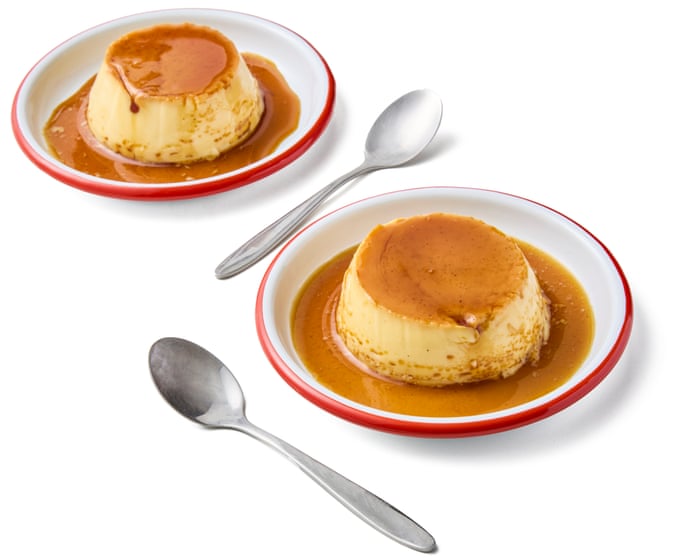
I don’t know why this classic French dessert isn’t more popular online. It’s a pleasure to watch a softly set custard jiggle seductively on screen, or to admire the way the light bounces off its glossy caramel top. Worse still, it’s also becoming harder to find on menus. Well, you know what they say: if you want something done well, do it yourself.
Prep: 15 min
Cook: 50 min
Cool: 4 hr+
Makes: 6
For the custard
Soft butter or neutral oil (e.g., sunflower, vegetable, or groundnut), for greasing
500ml whole milk (see step 2)
1 vanilla pod, or 1 tsp vanilla extract
2 whole eggs
100g caster sugar
4 egg yolks
For the caramel
60g caster sugar
40g soft dark brown sugar (see step 3)
1 pinch salt
1. Get your equipment ready
Lightly grease six dariole moulds, small pudding bowls, or smooth-sided ramekins. Arrange them on a baking tray or shallow tin—preferably one just large enough to hold them snugly—and place it near the stove. Cut six pieces of tinfoil large enough to cover each pot later.
2. Infuse the milk
Pour the milk into a small pan. You could use semi-skimmed, but I recommend whole milk, especially if you’re buying it just for this. Slit the vanilla pod lengthwise and scrape the seeds into the milk (or stir in the extract). Add the empty pod, bring to a simmer, cover, remove from the heat, and let it infuse while you make the caramel.
3. Start the caramel
Mix the sugars and salt for the caramel in a small, deep saucepan. A light-colored pan is helpful so you can see the sugar caramelize more easily. (Note: You can use 100g caster sugar instead for easier judgment, but I love the rich, treacly flavor of dark brown sugar.)
4. Reduce to a syrup
Keep a small heatproof plate nearby. Place the sugar pan over fairly low heat until the sugars melt into a rich, glossy brown syrup. If it blackens or smells acrid, it’s gone too far and you’ll need to start over, so watch it carefully.
5. Pour the caramel into moulds
Once you think the syrup is ready, remove it from the heat and place a small blob on the plate—it should set almost immediately (if not, return the pan to the heat). Working quickly before the syrup hardens, divide it among the six ramekins, swirling to coat the bases completely.
6. Mix the whole eggs, egg yolks, and sugar
Crack the whole eggs into a heatproof bowl, then add the sugar and yolks. (Freeze the whites for later use in meringues, mousses, marshmallows, cocktails, or an omelette, or give them to the dog.) Beat until combined with no streaks of yolk or white, but avoid incorporating too much air.
7. Finish the custard
Remove the vanilla pod from the milk (don’t throw it away—wash and dry it well, then place it in a jar of sugar to perfume it). Slowly pour the infused milk into the egg mixture, stirring constantly. Let it settle for at least 15 minutes; the caramel in the moulds should set during this time. Meanwhile, preheat the oven to 150°C (130°C fan)/300°F/gas 2 and boil the kettle.
8. Fill the moulds
Skim any foam off the custard, then divide it evenly among the ramekins, ideally pouring through a sieve to catch any bits of shell or stringy egg white. Cover each mould tightly with foil, then pour enough hot water from the kettle into the tray to come two-thirds up the sides of the ramekins.
9. Bake, cool, and serve
Carefully transfer the tray to the oven. Bake for 15 minutes, then remove the foil and bake for another 30–40 minutes, until just set but still slightly wobbly in the center. Lift the ramekins out of the tray, let them cool, then refrigerate for 4 to 24 hours. To unmould, run a butterRun a knife around the edges, flip onto plates, and give the tops a firm tap.
Frequently Asked Questions
FAQs Making Crme Caramel with Felicity Cloakes Guide
Q What exactly is crme caramel
A Its a classic baked custard dessert with a layer of soft liquid caramel on top When inverted onto a plate the caramel becomes a sauce
Q Whats the biggest difference between crme caramel and flan or crme brlée
A Crme caramel has a soft liquid caramel sauce Flan is often the same thing just a different name Crme brlée is a richer creambased custard with a hard torched sugar crust on top not a soft caramel bottom
Q Im a beginner Is this recipe difficult
A Not at all Its very approachable The key is gentle cooking and patience The most technical part is making the caramel which just requires careful watching
Q Whats the most important tip for a smooth custard
A Avoid bubbles Strain your custard mixture through a fine sieve into the caramellined dish This removes any eggy bits and ensures a silky texture
Q How do I know when the caramel is ready
A Felicitys guide suggests cooking it until its a deep amber colourlike a rusty penny It will smell rich and nutty not burnt Swirl the pan dont stir to help it colour evenly
Q Why did my caramel crystallize or become grainy
A This happens if sugar crystals form on the side of the pan To prevent it you can brush the sides of the pan with a wet pastry brush as the sugar dissolves at the beginning or simply put a lid on the pan for a minute to let steam melt any crystals
Q My custard is watery or didnt set What went wrong
A This usually means it was underbaked or the oven was too hot Bake it in a water bath until its set with a slight wobble in the centre like set jelly It will firm up as it chills
Q What is a water bath or bainmarie and why do I need it