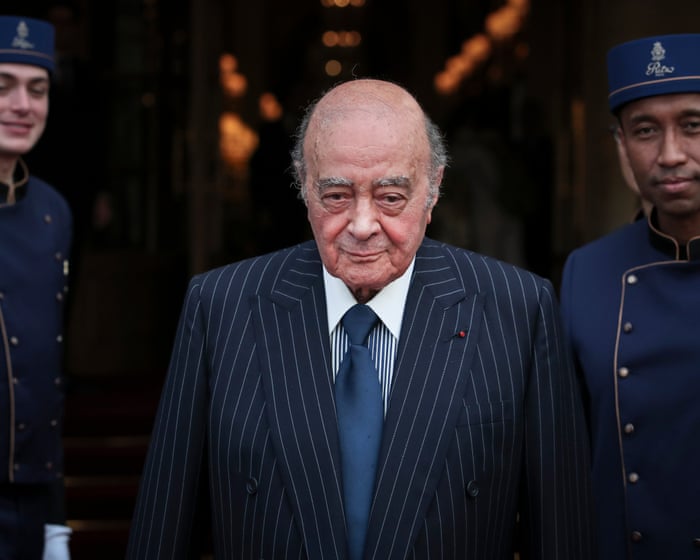
It’s reassuring to learn that police investigating sexual assault claims against Mohamed Al Fayed have passed a file to the Crown Prosecution Service—just three years after the former Harrods owner died at 94, and only decades after the first survivors reported their abuse. The CPS says it won’t give a timeline for any decision, to which we might say: no kidding. In this case, the one thing you could never accuse the authorities of is being tied to anything like a schedule.
The story, though, certainly has scale. So far, more than 400 allegations—including rape, sexual assault, sexual exploitation, and human trafficking—have been made against Al Fayed by at least 156 women. He got away with it all, dying without ever facing charges. The claims span from 1977 to 2014. At least 21 women came forward while he was alive, and there have been detailed reports in news articles and documentaries about the alleged enablers of his vile behavior, from lawyers to spokespeople to security thugs to the doctors who performed “purity checks” on his young female assistants.
So, not to be a downer—because any progress here is better than none—but that sense of scale isn’t really visible in the file sent to the CPS. It relates to a male suspect in his 80s and two indecent assaults on two women in London. The investigation is still ongoing, the Met confirms.
Of course, other under-prosecuted criminal networks exist. During the heavy coverage of the Jeffrey Epstein case, many wondered how so many people could turn a blind eye to such blatant abuse by someone known to have served time for soliciting prostitution from a minor. People were amazed at the vast collective silence—yet anyone who couldn’t believe it should have been reassured that other vast silences were very much alive. Peter Mandelson’s now infamous message of sympathy to his friend Jeffrey just before his 2008 imprisonment—”it just could not happen in Britain”—always strikes me as ironically fitting. Maybe his lordship was right, though not in the way he meant.
As the Epstein uproar raged earlier this year, several Al Fayed survivors wrote to me asking why that case dominated everything while another, still unresolved one—and much closer to home—seemed to lack the surge of outrage that pushes something from the shadows of society into the spotlight of our (always late) reckonings. The usual answer is that many people and institutions have a deep vested interest in not getting to the bottom of it.
It would be unwise to conclude anything else here. There’s been no comparable political pressure to shine a light on Al Fayed’s activities. No one has gotten wall-to-wall news coverage for asking how he could run an alleged criminal empire in the heart of Knightsbridge, when allegations were made repeatedly and rumors in elite circles were more than loud. It seems it was just the way things were.
And as noted, for things to stay that way for so long, there had to be whole armies of enablers and hangers-on who facilitated the abuse, looked away, or shut down, mocked, or trashed those who stepped out of line and spoke up.Including the alleged victims. Only one of Epstein’s helpers, Ghislaine Maxwell, has ever faced justice. Typically, no one except the ringleader in what I call the sex-case industrial complex even gets charged – they just fade back into society, into other jobs, into the ongoing silence.
Today, the Al Fayed survivors’ group No One Above put out a statement saying: “Survivors have spent decades either not being believed or being told that Fayed and those around him were too powerful and nothing could be done – but today is an important reminder that time passing doesn’t, on its own, put accountability out of reach.” Yet, with the best intentions, time passing doesn’t exactly help, does it? Al Fayed himself died without facing any consequences, and we all know that once something conveniently becomes “historical,” it’s much harder to prove.
But there are things the public can support right now. What Al Fayed’s survivors want is the trafficking investigation they’ve been asking for for almost two years. As they point out, this wasn’t just one bad man or some kind of corporate abuse. They claim it was a trafficking network with multiple perpetrators and enablers, backed by illegal money moving globally. At least five survivors have already been officially recognized by the Home Office as victims of modern slavery. Yet the Met has been accused of failing in its legal duty to refer victims to the national referral mechanism (which identifies modern slavery victims) – it seems the police didn’t think they had to. Once again, a survivors’ group is doing all the work. No One Above wants confirmation that human trafficking and modern slavery are the main focus of the Al Fayed investigation, and to know that financial investigators are being used to figure out how the network was funded and hidden.
It’s still unclear if any delayed justice will happen in this case. Even if it does, we can expect all those institutions that turned a blind eye to immediately fall back on their usual empty promises like “never again.” In fact, it would be more honest to say the opposite. Always again. Always again, until society has the courage to realize that it often takes a community to do bad things, just as it does to do good ones.
Marina Hyde is a Guardian columnist.
Do you have an opinion on the issues raised in this article? If you’d like to submit a response of up to 300 words by email for possible publication in our letters section, please click here.
Frequently Asked Questions
Here is a list of FAQs based on the articles title and premise written in a natural inquisitive tone
General Background Questions
Q What is the Met finally doing about Mohamed Al Fayed
A Three years after his death the Metropolitan Police have launched a formal investigation into multiple historical allegations of rape and sexual assault against him They are looking into claims from over 40 women
Q Why did it take so long for the Met to act
A The victims say the police ignored them for years while Al Fayed was alive Now that hes dead he cant be prosecuted but the Met says its reopening cases to provide answers and see if anyone else helped him commit crimes
Q Is it true he cant be charged now that hes dead
A Yes Under UK law you cannot be criminally prosecuted after you die This investigation is about accountability for his accomplices and giving victims a formal record of what happened not putting him on trial
Q Who was Mohamed Al Fayed
A He was an Egyptian billionaire businessman who owned Harrods department store in London and the Ritz Hotel in Paris He was also the father of Dodi Al Fayed who died alongside Princess Diana in 1997
Questions About the Accomplices
Q The headline mentions the people who helped him get away with it Who are they
A They are likely Harrods staff security guards drivers and senior executives who allegedly sourced victims looked the other way or silenced complaints The Met is now looking into these enablers
Q Can the people who helped him be prosecuted
A Yes potentially They can face charges for offenses like rape sexual assault human trafficking or perverting the course of justice even if the main perpetrator is dead
Q Why does the article say no need to hurry regarding the accomplices
A Its a sarcastic criticism The writer is pointing out that the police took three years to act on Al Fayed and now they seem to be moving very slowly on the living suspects which feels like a lack of urgency to the victims