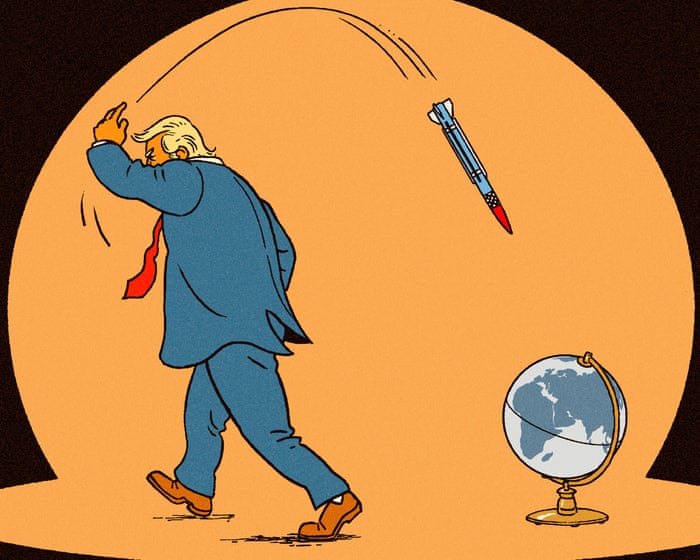
Nas últimas semanas, uma miscelânea de imagens tem passado pela minha mente. Algumas são personagens de filmes que não vejo desde a infância. Outras são fragmentos de literatura ou obras de arte icônicas. O que as conecta é um senso exagerado, quase cafona, de maldade.
Essas imagens parecem representar a carnificina real que meu cérebro tenta processar: corpos retirados dos escombros em Gaza, uma escola cheia de jovens alunos destruída no Irã, mais de um milhão de pessoas no sul do Líbano forçadas a deixar suas casas. (Alex de **Laranja Mecânica** aparece, com os olhos escancarados enquanto um líquido pinga neles, incapaz de piscar para afastar o que queima sua visão.)
O que é tão desconcertante sobre a crueldade é a banalidade com que ela é permitida. Donald Trump pairando sobre este circo de morte e caos. (Billy, o boneco com rosto de palhaço de **Jogos Mortais**, surge, sussurrando: "Eu quero jogar um jogo.") Trump desafia as tentativas de enquadrar suas ações em qualquer estratégia coerente. Suas guerras, o assassinato de inocentes e até a ameaça a civilizações inteiras estão remodelando o mundo — mas sem que ele esteja orquestrando algum grande plano. Ele é movido por pouco mais do que impulsos momentâneos e ressentimentos.
A aparente falta de visão ou ideologia de Trump é frequentemente mal interpretada como algo que o torna menos perigoso do que os autoritários do passado, que se tornaram nosso modelo para o mal. Considere o debate sobre se Trump pode ser chamado de "fascista". "Você não pode ser um fascista", argumentou Barton Swaim do **Wall Street Journal**, "sem de forma alguma pretender ser um." Trump é inepto, inconsistente, "desconcertante e exasperante", afirma Swaim — mas não um fascista.
Trump também não adere ao estilo ou afeto do modelo fascista clássico: ele não realiza comícios da mesma forma, não usa uniformes ou faz discursos inflamados de varandas para multidões agitando bandeiras. Ele não (ainda) derrubou totalmente a constituição ou desmantelou a democracia. Ele parece uma figura cômica confusa, um homem cuja alma é exposta em explosões raivosas nas redes sociais ou em discursos divagantes e inconscientes. Ele fala sobre guerra com o Irã enquanto é ladeado por um coelho da Páscoa gigante, posta imagens de si mesmo como Jesus. Ele "sempre acaba recuando". (Como um Wheeler da fantasia sombria **O Mágico de Oz 2**: gritando, rindo, perseguindo — depois estremecendo e recuando quando sua presa revida.)
Mas não é isso que o mal é? Uma projeção no mundo não de grande intenção, mas de mesquinharia e medo? As consequências da violência importam menos do que a validação que vem de infligi-la. A constante auto-glorificação de Trump, seus rancores contra rivais políticos, sua fúria por ser desafiado pela imprensa, a vingança que promete ao regime iraniano — tudo são formas de apagar e evitar um terror permanente de humilhação e obsolescência. (Como o Saturno de olhos selvagens de Goya devorando seu filho.)
É nessa mesma pequenez que reside o mal insaciável. Em 1931, após o partido nazista de Adolf Hitler disparar nas pesquisas, ele foi entrevistado pela repórter americana Dorothy Thompson para a **Cosmopolitan**. "Quando entrei no salão de Adolf Hitler no hotel Kaiserhof", recordou Thompson, "eu estava convencida de que estava conhecendo o futuro ditador da Alemanha. Em cerca de cinquenta segundos, eu tinha certeza de que ele não era. Bastou esse tempo para medir a insignificância chocante deste homem que pôs o mundo em polvorosa."
"Pense em Benito Mussolini", escreveu a jornalista Barbara Grizzuti Harrison no **LA Times**, "de botas altas, mandíbula quadrada, bombasticamente estridente, posando na pequena sacada de seu escritório na Piazza Venezia, em Roma — aquele cumprimento fascista notavelmente estúpido e braço rígido, a oratória absurda. Pense naquele homem engraçado, aquele bufão consumado", e lembre-se de que "só porque algo é bobo não significa que não seja perigoso."
Tendemos a imbuir a história e seus eventos graves com uma seriedade e lutamos para aplicar as lições do passado ao presente porque é difícil para a mente humana reconhecer o mal quando ele aparece de uma forma ridícula. É assim que ele se aproxima sorrateiramente de nós. É por isso que olhamos para trás e nos perguntamos como tais atrocidades foram permitidas. A resposta é que o mal raramente chega com a intenção clara e as marcas óbvias de um vilão. Em vez disso, ele vem através de indivíduos quebrados cujo poder emana de um desejo incontrolável de se tornarem inteiros, independentemente do custo.
Junto com o absurdo de Donald Trump está o fato de que ele tem acesso a armas nucleares e um apetite sociopata pela escalada — ecoando a linha de Milton: "Melhor reinar no Inferno do que servir no Céu."
O mal é uma mistura de frivolidade, indiferença e fragilidade, bem como implacabilidade, insaciabilidade e brutalidade. Considere a série de filmes **The Purge**, onde os EUA legalizam todo crime por 12 horas para purgar a escuridão da sociedade. No entanto, para os personagens, simplesmente cometer violência não é suficiente. Eles vestem trajes elaborados, usam maquiagem berrante e tocam música alta, transformando o horror em uma performance.
O filme revela que o crime por si só não é satisfatório sem o espetáculo — a afirmação de que o verdadeiro poder reside em tratar pecados graves de forma trivial, como uma forma de jogo. Não é apenas o ato, mas a licença para realizá-lo. Da mesma forma, não basta que o ICE separe famílias e desarraigue vidas; a crueldade deve ser celebrada, como visto em imagens de Trump ao lado de jacarés usando bonés do ICE, estilizadas como um pôster de filme intitulado "Alcatraz dos Jacarés".
Não há como apaziguar ou minimizar esse tipo de maldade jubilosa. Ela não pode ser descartada como não ideológica ou carente de estratégia e, portanto, administrável. A crueldade e a violência desenfreadas que Trump desencadeia e permite, tanto em casa quanto no exterior, se alimentam de tudo que veio antes. Elas devem ser confrontadas com ferocidade e urgência — ou consumirão tudo. Como Patrick Bateman diz em **American Psycho**: "Minha dor é constante e aguda, e não espero por um mundo melhor para ninguém. Na verdade, quero que minha dor seja infligida aos outros. Não quero que ninguém escape."
Perguntas Frequentes
Perguntas Frequentes sobre a Declaração: A Presidência de Trump Personifica o Mal; É Absurda, Assustadora e Cruel
Perguntas de Nível Iniciante
P1: O que significa dizer que uma presidência personifica o mal?
R1: É um forte julgamento moral, sugerindo que as políticas, retórica e ações do governo são vistas não apenas como ruins ou equivocadas, mas como representando fundamentalmente crueldade, corrupção e um desrespeito às normas democráticas e à dignidade humana.
P2: Por que algumas pessoas chamam a presidência de Trump de absurda?
R2: Críticos apontam para a comunicação não convencional, alegações falsas ou exageradas e momentos que quebraram a postura presidencial tradicional, que eles viram como caóticos e que minavam a seriedade do cargo.
P3: O que era assustador em sua presidência?
R3: Muitos consideraram os ataques às instituições, o incentivo à violência política, o manejo da pandemia de COVID-19 e as tentativas de anular os resultados da eleição de 2020 como ameaças profundamente alarmantes à democracia e à segurança pública.
P4: Você pode dar um exemplo do que os críticos chamam de políticas cruéis?
R4: Um exemplo frequentemente citado é a política de tolerância zero que levou à separação de famílias na fronteira EUA-México, onde milhares de crianças foram tiradas de seus pais.
Perguntas Avançadas e Nuanceadas
P5: Chamar uma presidência de mal não é apenas retórica partidária? Como isso é diferente da crítica política padrão?
R5: Os proponentes dessa visão argumentam que vai além do desacordo político. Baseiam-se em um padrão que veem como único: a intencionalidade em alimentar divisões sociais, o alegado incentivo à violência, o enriquecimento pessoal e a quebra de normas que, acreditam, visaram grupos vulneráveis e corroeram a confiança na própria verdade.
P6: Os apoiadores de Trump viam sua presidência dessa forma? Por que ou por que não?
R6: Geralmente, não. Os apoiadores frequentemente viam seu estilo como uma ruptura necessária de um "pântano" corrupto, sua retórica como "dizer as coisas como são" e suas políticas como positivas e justificadas. Eles viam as críticas como elitistas ou impulsionadas pela mídia.
P7: Quais são os principais argumentos históricos ou filosóficos usados para apoiar a caracterização de mal?