There was a time when prime ministers seemed to be on their way out almost as soon as they arrived. The big strategic decisions the country faced were avoided or delayed. Public finances kept wobbling, yet efforts to simplify the tax system failed because of powerful interest groups, including farmers. Reforms to social security were announced with great fanfare, then watered down. Politics was driven more by bitterness and rivalry than by practical action. All the while, populists waited in the wings.
This isn’t a sneak peek into a future history book about today’s Britain. It’s a description of the French Fourth Republic, which struggled after a difficult start in 1946 until 1958, when the exhausted system handed power to General Charles de Gaulle to create a new order—effectively putting itself out of its misery.
Keir Starmer didn’t go so quietly. He fought against the fading light until Andy Burnham’s victory in Makerfield forced him to accept the inevitable. For our current political chaos, we have to look abroad for comparisons, because British history can’t offer them. According to Anthony Seldon, author of The Impossible Office?, which covers 300 years of the premiership, there has “never been a period like the present.”
Yes, there were decades in the 18th century (1760–1770) and the 19th century (1827–1837) when we went through prime ministers at a similar rate. But the six—and soon likely seven—PMs since 2016 are “unique” when you also consider the wider turnover at the top. There have also been eight chancellors and nine foreign secretaries—and that’s before any reshuffle after Starmer.
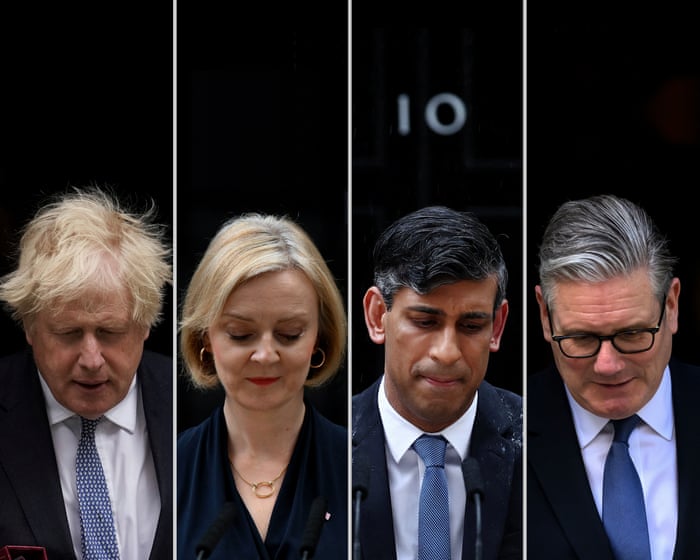
Cameron, May, Johnson, Truss, Sunak, Starmer, and now almost certainly Burnham: look at that list, and your first thought isn’t about anything solid actually happening—just the sheer frenzy of it all. That’s no coincidence.
Gus O’Donnell, the former cabinet secretary, has seen three transitions “up close”: Thatcher to Major, Blair to Brown, and Brown to Cameron. During the “access talks” with the opposition leader before the 2010 election, David Cameron told him about the changes he wanted in Whitehall. Then, O’Donnell said, “He asked me: ‘And what can I give you?’ I told him: ministers who stay in the same job as long as possible, so they have a real chance to get on top of their brief.”
O’Donnell sounded weary as he recalled trying to keep big strategies on track while ministers kept changing jobs. Pensions is one area that desperately needs a long-term approach: people are supposed to plan, save, and build up rights over a lifetime. Yet, O’Donnell remembers, at one point there were “nine pension ministers over five years.”
An obvious but often overlooked consequence of changing prime minister is that a huge number of other ministers change too. Any new PM naturally wants to shape their own cabinet, and no politician clever enough to reach the top will ignore the chance to use junior government roles to reward loyalists and keep troublemakers in check.
At the head of this team of newcomers will be an inexperienced leader—advised by a new inner circle of advisers, most of whom are also new to the workings of British power. As Cath Haddon from the Institute for Government think tank points out, there comes a point where ineffective PMs have to go. But she also worries about making the person in the job ineffective by not giving them “the time needed to learn, govern, and see projects through.” As “the conversion rate from prime ministers under pressure to prime ministers out the door” increases, she thinks the second part of that equation is becoming “underpriced.”
The evasions hidden in Labour’s one-word manifesto ti…Change has happened, but the lessons haven’t been learned. Throughout this leadership crisis, everyone is demanding the same thing: “faster, less gradual change.” Excitable lobby reporters and passionate party activists—who now have the final say on who becomes prime minister—sometimes forget that big speeches alone don’t change much. Real reforms only happen after credible plans are drawn up, consultations are used to confirm principles and adjust for practicalities, laws are rewritten, and resources are secured and managed effectively.
“You need to do the work,” says Haddon. “And that inevitably takes time.”
The threat of being removed from office can cause almost as much distraction and disruption as actually being removed. Damian Green was a close ally of Theresa May when she lost her majority in the June 2017 election, raising questions about her survival that hung over her final two years in power.
“Theresa was clearly in trouble then—it became much harder to do anything long term,” Green recalls. In the early months of her premiership, she showed interest in big social challenges and tackled difficult subjects, like domestic violence, that too many others had avoided. But now, survival was the priority, tied to just one issue. Suddenly, her only defining job was to “get a Brexit deal.”
To give her a fighting chance, May and Jeremy Heywood, then the cabinet secretary, made an unusual move. They moved Green from the Department for Work and Pensions to a newly created role as first secretary of state, effectively deputy prime minister, and gave him control of nearly everything else.
“I was in charge of all cabinet committees handling domestic policy—at one point, 28 of them—to take the load off Theresa’s shoulders,” said Green.
As a loyalist, Green pushed through worthwhile but lower-profile priorities for his boss, like restrictions on modern slavery. But no deputy has the influence or authority that a prime minister can use to break deadlocks, and progress on bigger challenges, including social care—a personal passion of Green’s—came to a halt.
Today’s frequent bouts of political upheaval were foreshadowed 30 years ago. John Major lasted longer than May: six and a half years. But within two years, the pound collapsed on Black Wednesday. After that, the fight for survival was constant and often uncertain. Jill Rutter, a former civil servant, worked in his No 10 policy unit. That’s the team responsible for figuring out how to turn prime ministerial ambitions into reality, but the circumstances weren’t ideal.
After Major was forced to call a confidence vote on one step in the Maastricht process, Rutter recalled that the unit’s director, Sarah Hogg, gathered the politically appointed half of her team and explained that if things went wrong, they’d soon be out of a job.
“No 10 felt very embattled, extremely suspicious, with enemies everywhere. Often, the only concern was getting back on track,” said Rutter. It’s harder to find smart solutions when you’re “walking on eggshells all the time.”
Causes like peace in Northern Ireland, which Major personally invested in, were advanced. But the prime minister “can’t and really shouldn’t need to be directly on top of everything,” said Rutter. Most of the time, it should be enough for “No 10 to know things on their behalf” and steer the broader system in line with their wishes.
The potential for such “good delegation,” Rutter added, can break down either because the prime minister’s instincts are too unclear for staff to be confident about what they want, or because other ministers get in the way.Staff members start to see themselves as working for a temporary boss, go their own way, and stop keeping Downing Street informed. The Starmer administration faced the first issue from the very beginning. Then the second one set in.
Starmer wasn’t wrong to warn that all this chaos would have financial consequences. As economist Paul Johnson said: “The sad truth is we are in hock to the bond markets… We are already paying many billions more in debt interest than we would be if markets were charging us the same as they charge other countries. And it’s notable that the premium really started at that moment of maximum instability – the Truss premiership.”
[Image description: David Cameron, with his wife, Samantha, and three children, bids farewell to Downing Street. Photograph: Graeme Robertson/The Guardian]
Starmer’s problem, however, is that he is no longer seen as a credible solution to the chaos. Just like May’s early promise of “strong and stable leadership,” his vow to “end the chaos” has become a bitter joke.
So what is it about Britain in the 2020s that has made being prime minister an impossible job, after a long period following Major when leadership crises were the exception rather than the norm? Could it be the same kind of thing that has led the country, for example, to sink untold billions into building a national high-speed rail network, only to cut it back to the point where it just connects Birmingham to London?
We are also a society that worries about public debt, yet avoids setting an end date for the arbitrary and unaffordable pensions triple lock. We have an economy that struggles under a confusing tax code, but can’t or won’t simplify it. Even modest moves towards making the wealthy pay a bit more are followed by retreats, like we saw with the (misleadingly named) “family farm tax.” Nearly all politicians now say they’d like to spend much more on defence, but almost none can explain where the money would come from.
The obvious explanation for the paralysis on real issues and the uncontrolled political chaos on the surface is economic. Stagnation since the financial crisis has, without doubt, made the math of public policy tougher. But many earlier generations also saw the country’s economic situation as exceptional.
The inflation of the 1970s is one example, the unemployment of the 1980s another. In fact, author and historian Anthony Seldon points out that when the elderly Winston Churchill returned to power in the growing and fully employed economy of 1951, newspapers screamed that ration books, balance of payments problems, and the need to fund the Korean war made for the most overwhelming “prime ministerial in-tray” in history.
[Image description: Liz Truss, left, her husband, Hugh O’Leary, and daughters Frances and Liberty, leave Downing Street in October 2022. Photograph: Alberto Pezzali/AP]
Yet back then, politics was remarkably stable. In that year’s election, a record 97% of the votes were split fairly evenly between Clement Attlee’s Labour Party, whose leadership spanned 20 years, and Churchill’s Tories, who led for a 15-year stretch.
What’s changed, I think, is that the simple class divide of postwar society has been replaced by a variety of deep, overlapping splits: cultural divides like Brexit, values divides such as Gaza, and generational divides between older homeowners and younger tenants.
Historian Sudhir Hazareesingh tells me that the real roots of the French Fourth Republic’s problems were similar – too many separate divisions were running through politics at once, with polarised attitudes to the Cold War, the constitution, the colonies, and the social role of the church all splitting the electorate in different ways.
Today, with all these hostilities amplified by social media, bringing together and then holding a coalition requires a mix of political talents. Boris Johnson’s “levelling up” agenda was one attempt, but he completely lacked the dedication to see it through.
The big shortcoming with Starmer has been in understanding and imHe settled on the view that public opinion is hopelessly reactionary, and tried to win people over with cultural conservatism, rather than pushing the kind of economic radicalism that could have bridged cultural divides. He made a cynical bet that the people who should have been his natural supporters had nowhere else to go, no matter how much he provoked them. Now he’s finished, and doubts are creeping in about whether anyone can build a governing coalition without relying on nationalism.
But that conclusion is too bleak. Margaret MacMillan, a historian who studies leadership, says the key is to “appeal to people’s better natures” and be honest with the public about the need for effort, maybe even sacrifice, and above all time to achieve great things. She sees Mark Carney doing at least some of this in her native Canada, and notes his popularity is holding up well.
Back in France, when the Fourth Republic gave way to the Fifth, Gaullist rule was imperious and sometimes narrow-minded—but it worked. It found a way through many problems that had seemed impossible to solve. Bitter conflicts lingered and occasionally erupted, but instead of just drifting, problems were now tackled head-on.
The political chaos slowed down dramatically, and the French earned their reputation for building roads, bridges, railways, and other infrastructure. The key to unlocking the forward-looking policies the country needs isn’t to remove politics from everything, but to do politics properly. Andy Burnham should take that lesson to heart. Tom Clark is a contributing editor at Prospect magazine.
Frequently Asked Questions
Here is a list of FAQs about why Britain seems so hard to govern and why it keeps losing Prime Ministers
BeginnerLevel Questions
Q Why does Britain keep changing Prime Ministers so often
A Mostly because of internal party battles If a partys own MPs or members are unhappy with the leader they can trigger a vote of no confidence If the leader loses that vote they have to resign even if they won a general election just a few years before
Q Is it the British public that is firing these Prime Ministers
A Not directly The public only votes for their local Member of Parliament The MPs in the winning party then choose the Prime Minister So the PM is usually fired by their own party not by a national election
Q What is a vote of no confidence
A Its a formal vote in Parliament If the majority of MPs vote that they no longer trust the government the Prime Minister must resign or call a new general election Its the nuclear option for removing a leader
Q Can the King just fire the Prime Minister
A No The monarch is politically neutral and must follow the advice of the elected government The King has no power to remove a Prime Minister
IntermediateLevel Questions
Q Why cant a Prime Minister just finish a full fiveyear term
A The British system is designed for strong singleparty governments but it gives the ruling party huge power to remove its own leader If the party thinks the PM is unpopular or failing they will quickly replace them to try and save their own seats The rules are easy to change so a PMs job security is weak
Q What is the Falklands Factor and does it matter anymore
A The Falklands Factor refers to a boost in popularity a leader gets from a foreign policy success or war In the past it saved Margaret Thatcher Today it matters less because modern crises are domestic and complex and voters punish leaders quickly on social media
Q Is the problem just the Conservative Party or is this a British problem