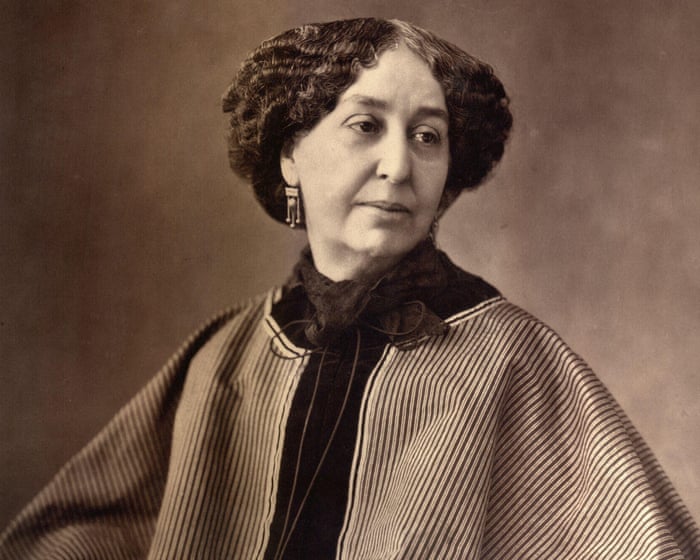
If we are truly facing a reading crisis—whether you attribute it to TikTok or podcasts—it makes sense that literary biography might be especially worried about its survival. After all, who wants to read the life story of an author whose books nobody reads anymore?
This anxiety, whether justified or not, echoes in the background of some of the more striking claims made by Fiona Sampson at the beginning of her new biography of the 19th-century pseudonymous writer George Sand. Sampson describes Sand as “one of the most famous writers in the world, at a time when books had something of the glamour that would later surround, say, Hollywood movies.” Best known for her 1832 novel Indiana, whose young heroine leaves a loveless marriage to an older man, Sand’s life “reveals … the nature of all lives as self-invention.” This is partly because she famously wore trousers: “by suiting up as a garçon she was, criss-cross, acknowledging that to be a writing woman is a little off-centre: is queer,” Sampson writes, calling Sand “one of the boldest precursors of that perhaps final hope modernity holds out: that we might choose what we become.”
You don’t have to agree with all of that to appreciate the engaging story Sampson unfolds, blending elegant research with empathetic insight. She convincingly suggests that Sand—born Aurore Dupin in 1804 to an aristocrat and a sex worker in Paris—was shaped from an early age by conflicting identities. Uprooted as a child to a manor in rural France, she was raised by her grandmother after her father’s death when she was four. Returning to Paris as an adult, she reinvented herself as a cross-dressing, cigar-smoking writer. After courageously winning custody of her children from an abusive husband, she embarked on love affairs with the pianist Frédéric Chopin, the actress Marie Dorval (or so rumors claimed), and the writer Alfred de Musset. Her relationship with Musset later inspired the sensational autobiographical novel Elle et Lui (1859), a kind of autofiction before the term existed.
Alongside her fiction, Sand has been celebrated for her extensive correspondence, including a 12-year exchange with Gustave Flaubert. Sampson highlights a letter in which Sand sympathizes with a new bride’s horror on her wedding night. This letter is often quoted to portray Sand as anti-sex, but Sampson points out its practical advice: “Tell [the bridegroom] to spare his pleasure a little and wait till his wife is gradually brought to him to understand it and respond to it.” Sampson explains that Sand was no innocent, having grown up in the countryside surrounded by mating wildlife—an example of the imaginative speculation that characterizes Becoming George, with mixed results. For instance, regarding Sand’s mother’s marital strife after losing a child, Sampson writes: “She’s every woman who feels her man isn’t supporting her in the extremity of grief …”
This universalizing approach sometimes feels too eager to connect with modern readers. At one point, Sand is compared to a “yummy mummy,” and her teenage habit of reading aloud to her grandmother is explained as “the closest equivalent to crowding on to the sofa to watch appointment TV together.” Sampson’s use of the present tense keeps the narrative moving briskly, as if worried we might lose interest. Paragraphs often begin with abrupt shifts, jolting our attention back to the story. “But that’s three decades in the future,” Sampson writes, resetting the scene. “On this summer evening in 1823, Aurore is just …”The same trick appears on the facing page: “But not yet. For now she’s a young mother who needs all the confidence intimacy can provide.” Yet a feeling grows that we are being energetically told a story without ever quite understanding why. While Sampson worries that Sand’s colorful life overshadows her art, the book’s approach does little to correct that. Its subtitle, The Invention of George Sand, suggests a dual focus—both on her writing and her self-creation—but it is the latter, the life story, that dominates, with much of the material drawn from Sand’s own five-volume autobiography. In the end, Sampson’s claim that Sand was “one of the great novelists of the nineteenth century” receives little support, as the biography races through nearly two dozen of her 70-plus titles in just two pages near the end. A chance to assert Sand’s contemporary relevance is missed: her 1837 novel Mauprat, a tale of a rough antihero softened by love, likely inspired the recent sensation Wuthering Heights—but this connection goes unnoticed, and Sampson dismisses it as an “unlikely fantasy.”
Even for Sampson, Sand’s importance seems to lie less in her writing than in what she represents as a woman overcoming the odds of her sexist environment—and no wonder, given that the diarist Edmond de Goncourt eulogized Sand’s talent after her death in 1876 by suggesting an autopsy would have shown her clitoris to “somewhat resemble our penises.” You can see what Sand was up against. However understandable this biography’s intentions may be, there is a gap at its heart. Becoming George: The Invention of George Sand by Fiona Sampson is published by Doubleday (£22.00). To support the Guardian, buy a copy at guardianbookshop.com. Delivery charges may apply.
Frequently Asked Questions
Of course Here is a list of FAQs about Becoming George The Life of Mrs W T Fullerton by Fiona Sampson written in a natural tone
General Beginner Questions
Q What is Becoming George about
A Its a biography of a 19thcentury English novelist named Mary Ann Evans who is better known by her pen name George Eliot The book focuses on how she created and lived through this male identity to be taken seriously as a writer
Q Wait isnt George Eliot a famous author Why did she use a mans name
A Yes she wrote classics like Middlemarch In the Victorian era women writers were often dismissed or limited to writing light romances By becoming George she ensured her serious intellectual novels would be judged without the bias against female authors
Q Is this a fiction novel or a biography
A Its a nonfiction biography Fiona Sampson uses letters diaries and historical records to tell the true story of George Eliots life and choices
Q Ive never read George Eliot Do I need to know her work to enjoy this book
A Not at all The biography tells the compelling story of her lifeher relationships her struggles and her daring decision to live unconventionally It might make you want to read her novels afterward
Deeper Analytical Questions
Q How does the book explain her choice of the specific name George Eliot
A Sampson delves into the symbolism George was a solid respectable English name Eliot was possibly chosen for its simplicity and slight ambiguity Together they created a persona that was authoritative and neutral allowing her work to stand on its own
Q Did she only use a pen name or did she actually live as a man
A This is a key point She didnt dress as a man in daily life Becoming George refers to her full adoption of a male literary identityin her professional life in her correspondence with publishers and critics and in the public imagination She lived socially as Mary Ann Evans but professionally as George Eliot