The first sign something was wrong was the blurred text in Gary Williamson’s book. His vision had deteriorated suddenly—just the day before, it had been fine. Williamson, 18, thought he might just be tired or run down. He had arrived in Gibraltar after two weeks of traveling through Europe, sleeping rough and not eating or drinking properly. “I’ll go get some water and something to eat,” he recalled thinking. “Maybe it’s nothing. I’ll see how I am tomorrow.” But the next day, he woke and his sight was bad again. He cautiously took out his book to test his eyes. “It’s actually getting worse. I can’t read it now. The lines were starting to blur.” He had relied on a map to get that far. “I remember thinking: that’s going to become useless very soon. I need to work out what I’m doing.” He needed to get home.
It was 1990, and Williamson didn’t think to call home for help. With no money left—he had reached Gibraltar four days earlier hoping to find work—he decided to hitch a lift, thinking a UK-bound lorry was his best bet. He went to the gates where haulage lorries left the port, dropped his backpack by the roadside, and waited. None stopped for him. He began, he says, “panicking a little bit, thinking: what do I do? It was harder than I thought it would be.” Around 6 p.m., he gave up and returned to the patch of sandy ground behind a sandwich stall over the Spanish border where he had been sleeping. Before bed, he wished for a lift the next day and that his eyesight wouldn’t worsen. When he woke, it had.
As Williamson washed in a public toilet block, a tourist asked if he was okay, gesturing at his face. “I’m like: what do you mean?” His face was covered in insect bites from the sand dunes, and when he looked in the mirror, he couldn’t see himself. “That was the moment the recollection of my own face, as well as other people’s faces, started to go.” He remembers touching his face all over, as if mapping it in his mind.
Back by the roadside, sitting on his backpack with his thumb out and ignored by passing lorries, Williamson noticed large shadows flying overhead. “This is part of how my eyesight works now—I can see shadows better than I can see people. I was looking down. There’s a shadow and I think it was either a bird or a large dragonfly. There were a couple right above me, and I remember seeing the patterns and that blur, but I couldn’t define what was just half a metre above my head.”
Was he worried about his health and what might be causing his loss of sight? Not hugely, he says. “What I focused on was needing to get home: this is the problem, and I’ve worked out one solution.”
On the third day of waiting, an American backpacker approached him. “He trundled up, not a care in the world, chucked his rucksack down and sat on it next to me.” They started talking. Williamson felt overwhelming relief at having someone to talk to. By holding himself together and focusing on his mission, he hadn’t realized how frightened and isolated he had felt. Before his eyesight failed, he was confident and outgoing, but he was already losing some of that. “I remember him wearing bright colours, but I can’t remember his face, because I couldn’t see it. I just remember his blond hair.”
Williamson explained he was having vision problems and trying to get home to the UK. The young backpacker, who was headed to Madrid, replied, “Wouldn’t you be better off waiting where the English wagons go?” The area where Williamson had spent days waiting, the American said, was for lorries bound for mainland Europe.”He says, ‘Look, they’re all Spanish.’ I said, ‘I can’t see them.'”
Williamson followed the backpacker’s directions to the UK-bound lorries, and within 20 minutes one had stopped for him. “A northern voice asked: ‘Are you alright? Do you want a lift?'” The lorry was headed for Bolton, about 35 miles from Williamson’s home in Clitheroe, Lancashire. “I even feel it now,” he says, “the relief at that moment you feel rescued.”
The European trip was supposed to be a big adventure. Williamson had gone to art college after school, but dropped out. Then he joined the navy, but left that too. “I’d been flitting around quite a bit. I thought: what do I want to do with life?” He was working in a supermarket when he and a friend decided to go to France, then work their way around Europe. “I think it was one of those drunken talks in the pub,” says Williamson, but they set off in the autumn.
In Paris, they had been sleeping rough in the gardens around the Eiffel Tower when his friend decided to leave. “He just said: it’s not for me. But I remember waking up at sunrise and you’ve got the Eiffel Tower at your feet, and I thought: no, I’m not giving this up.” He travelled through France and northern Spain, then to Portugal and back into Spain. Gibraltar, he thought, being a British territory, might offer his best chance of work. He spent about four days there, doing touristy things and trying to get a job in a supermarket and on building sites, while sleeping rough, before his sight deteriorated.
Now, at 53, Williamson’s sight hasn’t changed much since those few days in Gibraltar. “My peripheral vision is terrible, my central vision is just a blur. If you’ve ever watched the film Predator, where the alien is blended into the background, that’s what my eyesight is like. If people stand still, I can’t see them, but if they start to move, you get this mismatch: the blur moves.”
At the time, all Williamson could focus on was getting home. He wasn’t thinking too far ahead, and didn’t feel too anxious about what his loss of sight would mean for his life; he thought it could be sorted out once he saw a doctor. The lorry driver—Williamson can’t remember his name—was chatty and friendly, in his 50s, and reminded Williamson of some of the men back home. On the way, he pointed out places of interest—film locations, the Pyrenees—but Williamson couldn’t see them.
When they parked up on the first night, Williamson remembers that he got out of the cab and started staring at a wall. The driver asked him what he was doing. “I said, ‘I’m trying to work out what this is.’ He told me there were big beetles on the wall. I was like: I can’t see them. It’s moments like that where I started to realise how bad my sight was.” That night, the driver locked Williamson in the back of the lorry. “It could have been a horror film,” he says with a laugh. “He didn’t trust me enough, obviously, to sleep in the cab.” But it felt like a step up from sleeping rough.
“I say to myself: this won’t beat me. One of the reasons I took up photography was to prove I could.”
The driver was on his way to Granada to pick up a cargo of cucumbers; once loaded, they headed through Spain and back to Britain. Wanting to overtake a car on a long straight road, the driver asked Williamson to look out of his window to see if anything was coming. “I went, ‘You’re clear.’ The way my vision works, I’ve got two big blind spots in either eye. As he pulled out, a red flash comes past us, just out of my blind spot, beeping its horn.” The red car careered off the road onto the sandy verge before righting itself. The lorry driver screamed at Williamson. “He was like…””We nearly hit that, we could have killed somebody!” I didn’t see it. I remember the shock and horror. Until then, his worsening eyesight had been confusing, but now it felt more alarming. “My eyesight could have killed somebody.”
They reached the UK after three days on the road. The driver dropped Williamson off in Manchester, where he spent the night with a friend before heading home to his mother in Clitheroe. He spent three weeks in the hospital undergoing tests and was diagnosed with the genetic condition Leber hereditary optic neuropathy. His uncle had it too, and although Williamson grew up near him and knew he struggled, he wasn’t really aware of it: “His wasn’t as bad as mine.”
It was a shock to hear the diagnosis and that there was no cure. But, “on that same day, I also got the best advice I could have been given. They told me a small percentage of people get better. It might stabilize, it might not get any worse, but don’t hang around waiting: live your life to the full. They said you need to live your life as though your sight isn’t coming back.”
Williamson’s friends were going off to university, learning to drive, starting their lives. “You start to think: I’m not going to get a job that I want to do. I’m not going to be able to live on my own. I’m going to struggle to meet somebody.” He moved back in with his mother for a while, but her care felt overwhelming, so he moved into a house share where he started to regain some independence.
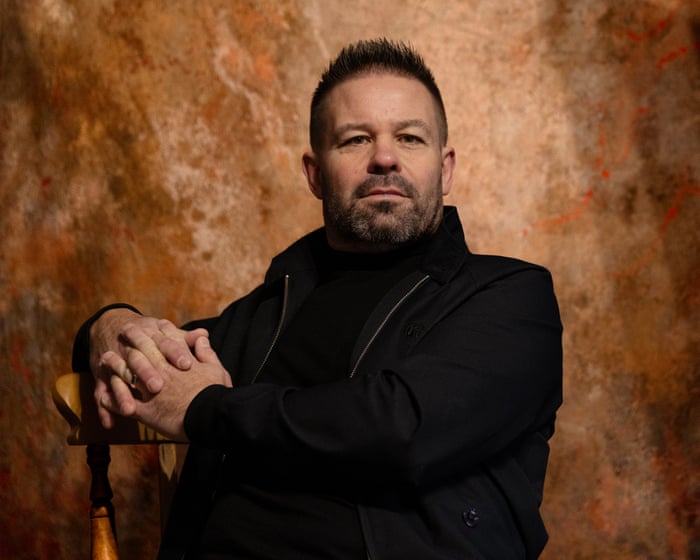
Williamson began going to a youth disability group for support. Before long, he was running programs himself, training other youth groups around the country to provide access for disabled young people. “That really bolstered my self-esteem, because I felt useful, listened to, and empowered.” For 25 years, Williamson was a youth worker, until Conservative government cuts devastated the sector, but he still works in disability services for his county council. He is also a photographer—which always surprises people, he says.
The onset of his condition usually happens in early adulthood. “If it was going to happen to me at any time, that was possibly the best time. I’d still got my life ahead of me.” Despite his initial fears, he did find work he enjoyed, and he and his wife have been together for nearly 20 years; between them, they’ve got four children and a grandchild. There have been struggles—his emotion is obvious when he talks about missing his son scoring a goal in football, or the time his wife asked him to get a tin of something from the supermarket, and he exhausted himself trying to find it with his magnifier amid a wall of identical tins, while another shopper swept in and picked a can off the shelf as if it were nothing. “That’s how easy it is for some people.”
It can be “a drain,” he says, “dealing with people’s stupid comments. I’ve become stronger to the world, and I think I’ve become prouder of myself. Things can get you down, but I don’t let them, because I always say to myself: this won’t beat me. I think one of the reasons I took up photography was almost to prove I could.”
When he shot on film, he would blow his photographs up to see them, but now they’re digital it’s much easier. He works in black and white, partly because he also developed color blindness, but mainly because the contrast helps. “I see blurs, and I’ll try to work the world out through blurs.” He responds to movement in his photography and particularly enjoys making portraits, which allow him to connect with people. One of the things he misses most wFor someone with sight loss, “the ability to see other humans’ faces provides reassurance that everything is okay—through a look or a smile.” On his screen, he can zoom in on his portraits to capture as much detail as possible in people’s faces.
“The one thing I wanted to be when I was at school was an artist,” Williamson says. Now, “I’m achieving things, and I’m creating art.” Nearly 40 years after dropping out of art school, he has realized his dream.
Frequently Asked Questions
Of course Here is a list of FAQs about the harrowing scenario of being suddenly struck blind while traveling alone far from home with no resources
Immediate Crisis Safety
Q1 What is the very first thing I should do if I go blind suddenly
A Stop moving and stay put Your immediate priority is to prevent injury Do not try to navigate unfamiliar surroundings Find a wall a bench or a clear spot on the ground to sit down and assess the situation safely
Q2 How do I get help if I cant see to use my phone
A Use voice commands Say Hey Siri or Okay Google to activate your phones assistant Then give clear commands like Call emergency services Call or Open my accessibility settings If your phone is locked or unresponsive call out for help from people nearby
Q3 Who should I call first
A Local emergency services should be your first call They can send paramedics to ensure you are medically stable and connect you with local social services or police who can assist on the ground
Practical Logistical Problems
Q4 I have no money How will I get food shelter or medicine
A Emergency services and local police can connect you with social services homeless shelters or charitable organizations in the area These organizations exist to provide immediate crisis support including food vouchers a bed for the night and essential medication
Q5 How do I get home without money or sight
A This is a complex process that requires official help Social workers or consular officials will work with you to 1 Contact familyfriends who may be able to send funds 2 Work with airlines on medical repatriation or compassionate fares and 3 Arrange for a travel companion or medical escort if necessary
Q6 How do I manage my luggage passport and tickets
A Once you are with a helper ask them to securely gather all your belongings They can help locate your passport which will be crucial for identification and any travel arrangements Do not let your belongings out of your immediate vicinity
Medical Legal Concerns