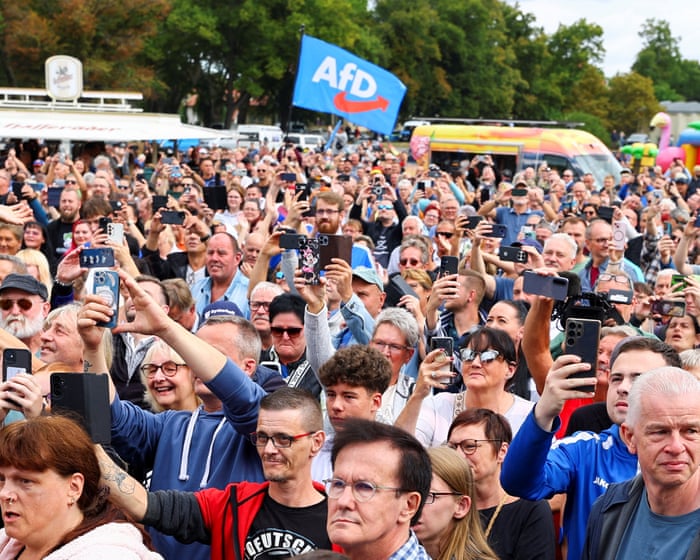
It was in the summer of 2004 that I stopped understanding my own people. I was standing on a sweltering market square in Aschersleben, the town where I was born, beautifully located on the northern edge of the Harz mountains. A large crowd of angry people had gathered in front of a stage to protest the welfare reforms—or, as many saw them, welfare cuts—introduced by the Social Democratic-Green coalition government under Chancellor Gerhard Schröder. They chanted “We are the people!”, waved hand-painted signs, and seemed completely beside themselves.
I had gone to secondary school nearby, volunteered at the local hospital, and interned at the local newspaper: I knew this place. And yet I found myself confused. What, exactly, did these deeply upset people want—standing on a freshly renovated, almost idyllic market square? Weren’t things going reasonably well for them? Where did this burning resentment toward the west come from? Wasn’t the east-west divide supposed to be fading by now?
More than two decades later, similar questions can once again be asked.
Eastern Germany is facing a blue wave—or rather, a blue flood. In the state election in Saxony-Anhalt on 6 September, the far-right Alternative für Deutschland (AfD), whose party color is blue, is almost certain to become the largest party. Opinion polls consistently put the AfD above 40%, while the governing Christian Democrats (CDU) trail at around 23%. The Left party, once dominant in the east, has fallen to just 13%, and the Social Democrats (SPD) are struggling to clear the 5% electoral threshold.
If only three or four parties enter parliament, the way would be open for Germany’s first-ever state government led solely by the AfD. The established parties would find themselves stranded on the other side of the much-invoked political “firewall” against cooperation with the far right—and, for the first time since 1945, a party containing openly extremist factions would hold governmental power in a German federal state.
The AfD would exercise considerable authority over policing, the judiciary, education, and cultural affairs—areas the party seeks to fundamentally “re-nationalise”, for example by reducing funding for memorial sites commemorating Nazi crimes and revising school curriculums to place greater emphasis on what it regards as the achievements of German history.
For me—and, I suspect, for many East Germans who have left their homeland—the rise of these developments did not come as such a surprise. During my infrequent visits home over the past 10 years, it was clear that something fundamental was shifting.
When we celebrated the milestone birthday of an old school friend in early 2024, a group of longtime friends flew in to spend a cold January weekend together in Hettstedt. Yet while we cheerfully reminisced about old times, the friend’s family, whom I had always remembered as lively and eager to debate, just sat by, saying almost nothing. I was puzzled. Only later was I told that my friend’s mother—the heart of the family—had forbidden any political discussion. She feared that the guests who had come from afar would be deeply unsettled by how openly people now voiced views that had once been considered taboo.
Saxony-Anhalt has always been a state with a difficult identity. Despite an extraordinary cultural heritage—it is the home of Martin Luther, George Frideric Handel, Friedrich Nietzsche, and the Bauhaus—it lacks a clearly defined regional character. Assembled from various territories of Prussia after its dissolution in 1947, it was abolished during the socialist German Democratic Republic and then re-established after reunification in 1990.
Home to almost 3 million inhabitants at the time, Saxony-Anhalt entered the new era with tremendous optimism—only to suffer a brutal crash landing in the spring of 1991. East Germany’s state-owned industries were to be rapidly privatised by theThe Treuhand agency was meant to make them competitive in a market economy. But after decades of central planning and chronic shortages, the socialist combines could barely survive the massive shock of economic and monetary union. Instead of the “flourishing landscapes” Chancellor Helmut Kohl had boldly promised, the entire region slid into an unprecedented downward spiral.
The metalworking and chemical industries in southern Saxony-Anhalt were hit especially hard. In the spring of 1991, hundreds of thousands lost their jobs. Over the rest of the decade, many areas outside the main cities saw industrial dismantling, mass unemployment, and large-scale outmigration.
Younger people, particularly well-qualified women, began leaving the region. For my own generation, graduating around the turn of the millennium, moving away seemed like the only real option. At the same time, the state steadily pulled back from shrinking rural areas, closing schools and hospitals, and relocating courts and police stations. Even the democratic political parties, which were always much less rooted in eastern Germany than in the west, became increasingly invisible.
The echoes of these massive changes have grown louder again over the past 35 years. On average, East Germans remain considerably poorer than their western counterparts. They have much less wealth, inherit far less, and often face significantly weaker career prospects. A lingering feeling of being “second-class citizens” has become deeply entrenched, even among generations born long after reunification.
I can understand these feelings, and I can see how the AfD has tapped into this widespread sense of abandonment—through social media, local WhatsApp groups, football clubs, and neighborhood pubs. The anger no longer gathers helplessly in the town square; instead, it has found new energy and far greater reach in the digital world, and at the ballot box.
What I can’t understand is that the people I grew up with are failing to see how hollow the AfD’s promises are. The slogans this party offers are not solutions. Many of the measures it advocates would only make a bad situation worse. How are businesses or hospitals supposed to recruit the skilled workers they desperately need if the main party also calls for large-scale “remigration”? How can anyone build a positive vision of the future while also expressing admiration for the Nazi Reich or the GDR? It seems like a case of suicide out of fear of death, as Bismarck supposedly said.
Whether on a sun-drenched market square in the summer of 2004 or at a wintry family gathering in 2024, one thing became unmistakably clear to me: there are no simple answers or quick fixes. In Saxony-Anhalt, as elsewhere, the challenge will be to give people with sometimes very different views and values a genuine sense that they are included on a shared path toward a common future.
Marcus Böick is assistant professor in modern German history at the University of Cambridge.
Frequently Asked Questions
Here is a list of FAQs based on your statement covering the situation from basic definitions to deeper political analysis
General Background Questions
Q What exactly is the German far right you are referring to
A The main party is Alternative for Germany It started as an antieuro party in 2013 but has since moved sharply to the right focusing on antiimmigration antiIslam and nationalist policies Parts of the party are officially classified by German intelligence as extremist or suspected extremist
Q Why is this considered a breakthrough Havent they been in parliament for a while
A Yes theyve been in the federal parliament since 2017 The breakthrough refers to winning a state election and becoming the strongest party there This is a first for the far right in postwar Germany It gives them the power to block certain decisions and sets a dangerous precedent
Q Which state are we talking about
A The state is Thuringia The AfDs candidate Bjrn Hcke is considered one of the most radical figures in the party The state election in September 2024 put them in first place
Q Why is this a disaster that has been building for decades
A Its the result of longterm neglect After German reunification in 1990 eastern states like Thuringia faced high unemployment a brain drain of young people to the west and a feeling of being treated as secondclass citizens Many people feel left behind by mainstream politics and the AfD has successfully channeled that anger and frustration for years
The Political Cordon Sanitaire
Q What is the firewall everyone is talking about
A Its an unwritten rule among all mainstream democratic parties that they will never form a coalition or pass laws with the help of the AfD Its a pact to isolate the far right and keep them out of government
Q Will the AfD actually get to govern now