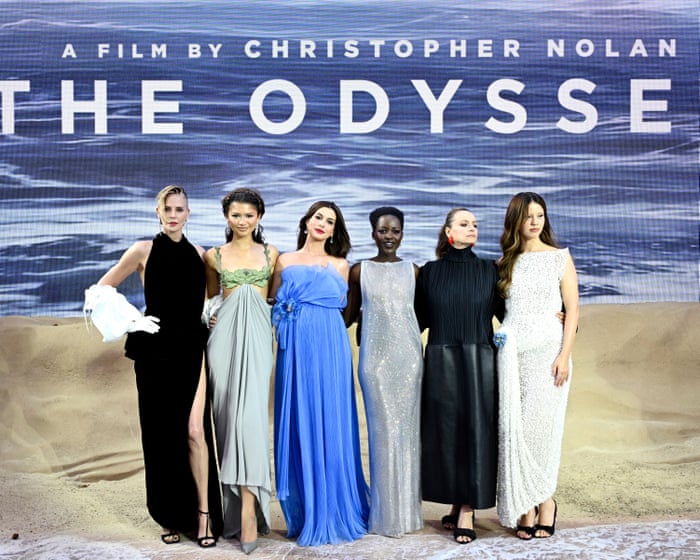
Elon Musk was a man on a mission. Sure, he’s supposedly focused on colonizing Mars, or the moon, or maybe—if you give him enough time to shift the goalposts—just a really, really tall mountain. But this spring, a more urgent task came up: a follow-up to his early 2026 campaign of posting white supremacist rhetoric. This time, he set his sights on taking down Christopher Nolan’s The Odyssey, which he decided was the latest attempt by “woke Hollywood” to spread racial hatred (toward white people, of course) and win Oscars in the process. Musk told the trade publication Variety that Nolan was “pissing on Homer’s grave,” referring to the author of the epic poem the film is based on.
The Odyssey: jaw-dropping action, dark magic, and dolphin cameos – discuss with spoilers
Read more
As the final stages of the movie’s promotional campaign ramped up, Musk posted dozens of times on his own social media platform, complaining about the casting of Lupita Nyong’o (a Black woman) and Elliot Page (a trans man). He often spread false claims that the casting was done just to meet new Oscar requirements. (As explained here, those new Oscar diversity rules are very flexible and are often satisfied by studio-wide programs that have nothing to do with casting. The Odyssey didn’t need to hire Oscar winner Nyong’o to be eligible for awards.) Musk may be a divisive figure at best, and large parts of the population don’t take him seriously. But he still commands enough attention and admiration from a vocal minority that plenty of online accounts soon started repeating his willful misunderstanding of Hollywood and The Odyssey. Many of them hilariously and abruptly focused on the 2004 movie Troy—which the right flank of social media suddenly decided was a beloved masterpiece, even though it was a much bigger distortion of Homer’s epic poem The Iliad.
This story has an ending even more predictable than a Musk-branded rocket crash: after weeks or months of right-wing outrage over the failure to cast an all-Greek cast for a movie that also features a cyclops, sea monsters, and a witch who turns men into pigs, The Odyssey has become one of the biggest hits of the summer. It’s already made over $260 million and is well on its way to outgrossing Troy when adjusted for inflation. (In raw dollars, it’s already made more in the US.) The rallying cries of “go woke, go broke” have been drowned out by demand to see Nolan’s blend of old-fashioned Hollywood spectacle with less traditional filming, editing, and, yes, casting.
It’s easy to point out that any doom-saying about The Odyssey‘s prospects stubbornly ignored a long list of factors. These include, but aren’t limited to: arguably the most popular movie director working today; a cast packed with big names across generations and races; the fact that casting some non-white actors doesn’t exactly scream “strictly enforced diversity” when three of the most prominent stars are Matt Damon, Anne Hathaway, and Tom Holland; and, in the week before release, terrific reviews.
It would also be simple, if a bit self-congratulatory, to point out that for general audiences, supposedly “woke” film critics seem to act as a strong counterbalance to anti-woke clicktivism. That’s why The Odyssey (95% positive reviews on Rotten Tomatoes) has been immune to controversy, whether real or imagined, while other right-wing targets like Supergirl (53% positive), criticized for its star vaguely acknowledging the difficulties of being a woman, or Snow White (39% positive), criticized for its star being mixed-race and not deferential enough to the source material, have had their defenses significantly weakened.
There’s probably some truth to that, though it might have less to do with critics and more with an increasing preference for backing winners. The online buzz that seems to affect movies more than ever isn’t so much about wokeness as it is about a movie’s perceived status.A movie like The Odyssey or Obsession does better than expected, which creates more buzz about its success, leading to even better results. On the other hand, a movie like Supergirl can get labeled a failure as soon as the first box office numbers come in—basically, about 12 hours after its release.
Still, culture warriors love to claim victory wherever they can. They point to movies like Supergirl or Snow White as proof that audiences don’t want women as superheroes, or princesses who aren’t white, or whatever other generalization they can come up with. But that gloating doesn’t always tell the full story. For example, after Snow White’s opening weekend, the Hollywood trade publication Deadline—not exactly a left-wing outlet—looked more closely at the movie’s box office. It turns out that, compared to the average 63-37 split between “blue”-voting and “red”-voting counties for family film ticket sales, Snow White had a 60-40 split, meaning it actually performed slightly better than average in red areas. Its mediocre numbers didn’t seem particularly political. “There was no red theater blockade due to any perceived controversies with Snow White,” analyst Steve Buck told Deadline at the time.
[Image: Margot Robbie in Barbie. Photo: Courtesy Warner Bros. Pictures/AP]
Even some of this group’s most high-profile “I told you so” moments don’t really hold up over time. Ten years ago, the so-so numbers for an all-female reboot of Ghostbusters led to no sequels, right-wing culture warriors declaring victory, and a return to the drawing board for a more respectful legacy sequel, 2021’s Ghostbusters: Afterlife. The result? A modest addition of $1.1 million at the domestic box office (so basically flat attendance, maybe a little less when you account for five years of inflation) and a slight drop internationally, for a small overall decrease. A 2024 follow-up performed almost identically. Maybe those nearly identical numbers just show the baseline level of interest in a new Ghostbusters movie, rather than a judgment on women in ghostbusting. After all, movies like Barbie, Superman, Wicked, and Sinners—all of which faced various forms of right-wing grumbling about “wokeness”—have been big hits in recent years. And this isn’t just about right-wing protests. Scream 7 sparked angry online chatter from the left about a boycott because Melissa Barrera, star of the previous two films, was fired for speaking out about Palestine’s suffering at the hands of Israel. That didn’t seem to affect real-world results, as the movie quickly became the highest-grossing Scream yet (and without the help of good reviews to boost it further).
[Sex, beds, and grisly executions: what Christopher Nolan’s The Odyssey changed, invented—and left out. Read more]
Of course, these are still just individual movies. But broader studies also suggest that audiences aren’t especially put off by diverse casts—and may actually be drawn to them. Earlier this year, UCLA’s annual Hollywood diversity report found that movies with casts that are 40 to 50% Black, Indigenous, and people of color (the right wing’s dreaded BIPOC) had the highest median domestic and international box office. This matches the fact that about 45% of the U.S. population is BIPOC. The same was true in the previous year’s report. Basically, it’s hard to find solid evidence that people are avoiding movies because of “wokeness.” It just doesn’t seem to be something most normal people think much about.
None of this will stop the next wave of partly manufactured, partly deluded right-wing outrage. We should be better at ignoring it by now, but given its fringe origins, people like Elon Musk are well-positioned to amplify it into our feeds, no matter how few people it actually represents. Meanwhile, self-styled “tell it like it is” goofs like YouTuber the Critical Drinker will go back to pretending they just review movies.Analyze culture instead of trying to stir up outrage over a Black actor who won an Oscar playing a beautiful character. The scene will feel more like Circe (Samantha Morton) gently turning Odysseus’s men back into humans after she had transformed them into grunting pigs. “Back to your disguises,” she says dryly, referring to their human form. But maybe after this “woke” version of The Odyssey becomes a blockbuster hit, those disguises will be a little harder to keep up.
Frequently Asked Questions
Here is a list of FAQs about the topic Go woke get rich why rightwing hate campaigns dont hurt box office sales
BeginnerLevel Questions
1 What does go woke mean in this context
It means movies or shows include diverse casts progressive social themes or stories that challenge traditional norms
2 So do these movies actually make money
Yes many do Films like Barbie Black Panther and Captain Marvel earned over a billion dollars each despite facing backlash from some conservative groups
3 Doesnt a hate campaign hurt ticket sales
Not usually The hate campaign often backfires by generating free publicity sparking curiosity and rallying the target audience to support the film out of defiance
4 Why do some people think woke movies flop
Critics point to a few highprofile failures and blame wokeness But box office data shows that bad storytelling or poor marketingnot diversityis usually the real cause
5 What is a rightwing hate campaign
Its an organized online effort by conservative activists or media to reviewbomb boycott or spread negative memes about a film they consider too progressive
IntermediateLevel Questions
6 How do hate campaigns actually help box office sales
They create a Streisand Effect the more people try to suppress or attack something the more attention it gets Curious audiences go see the movie to decide for themselves
7 Can you give a specific example of a movie that benefited from a backlash
Barbie Rightwing critics called it antiman and woke garbage The controversy drove massive conversation and the film grossed over 14 billion worldwide
8 Are there movies that did flop despite being woke
Yes The Marvels underperformed but analysts blame superhero fatigue poor marketing and a messy scriptnot its diverse cast Correlation isnt causation
9 Do hate campaigns ever actually work
Rarely They can suppress opening weekend numbers if the movie is already weak but they rarely kill a