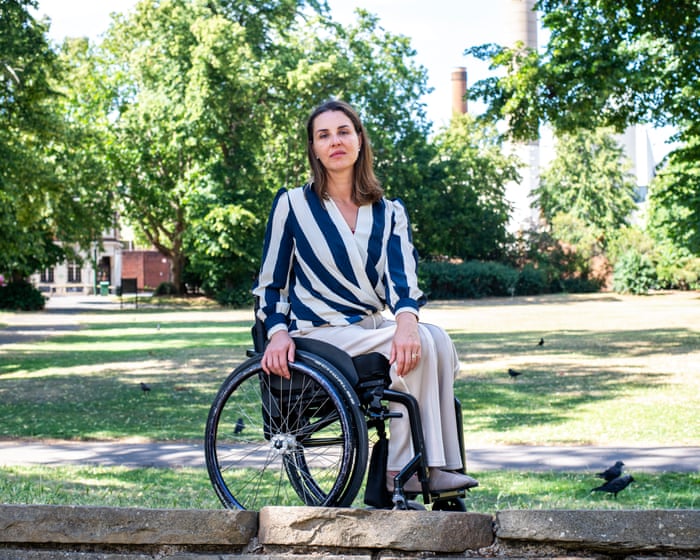
When Hannah Babalola boarded KLM flight 598 on May 26, she was exhausted. A Paralympic athlete, she had just finished competing at an event in Cape Town, South Africa, and was hoping for a smooth journey back home to Chicago.
At 37, Babalola is an experienced traveler. She used to be a wheelchair racer and now competes in marathons. Over the years, she has flown to dozens of countries without any major issues.
The first leg of her trip home was a nearly 11-hour flight to Amsterdam. After boarding, the captain and crew told her she wouldn’t be able to use an onboard wheelchair, known as an aisle chair. These narrow wheelchairs help people with disabilities reach the toilet during a flight. The crew said that if she needed to use the bathroom, she would have to do it without the wheelchair. If that wasn’t possible, they told her she would have to leave the flight altogether.
Babalola was shocked—aisle chairs are usually available on wide-bodied aircraft. She stood her ground, even though she became more and more upset. The crew gave several reasons for their decision, including the captain’s concern that the chair might be unsafe during turbulence. They also wrongly told her that she hadn’t booked the flight as a disabled passenger. (Disabled passengers are advised to request special assistance at least 48 hours before a flight, which Babalola had done.) She had a round-trip ticket and had received assistance as a disabled passenger without any trouble on her outbound journey.
“They made me feel like I wasn’t human. The humiliation was unbearable.”
“It was the first time anything like this had happened to me on a plane,” Babalola says. “They made me feel like I wasn’t human.” The crew called the police and security, but both refused to take any action against her since there was no evidence she had done anything wrong. Desperate to get home, she finally agreed not to use the toilet during the flight. “The humiliation was unbearable,” she says.
What happened to her is not an isolated case. When the Guardian first reported on Babalola’s story, many emails came in from others who had similar experiences.
According to data published by the World Health Organization in 2023, about 16% of the global population—around 1.3 billion people—experiences significant disability. The UK’s Civil Aviation Authority outlines passengers’ rights to accessible air travel, including help moving through airports, boarding, and getting off planes. But this assistance has limits. It only applies to people flying from UK airports on any airline, and for return flights to the UK on UK or EU airlines.
The National Centre for Accessible Transport published a report in July 2025 called Invisible Barriers: How public attitudes affect inclusive travel. It found that people with impairments or access needs that don’t fit certain models often have to fight to get their needs met. Those interviewed for the report said they faced negative treatment while traveling because of assumptions and stereotypes about disability. The report looked at different types of transport, including planes, and found that disabled travelers sometimes have to put up with abuse from other passengers, and that transport staff often have a limited understanding of disability. One wheelchair user quoted in the report, who was traveling by plane, was denied assistance because they had limited mobility—they could stand up and walk a little, but still needed help.In certain situations, they could stand, but they couldn’t get down the plane stairs without help. A crew member said, “Well, you can stand, you can get off, you can go down the stairs.”
Sophie Morgan is a British TV presenter, writer, and disability rights campaigner. She co-founded Rights on Flights and actively advocates for disabled people who travel by air. She has been paralyzed from the chest down since a car accident when she was 18. She started campaigning after airport staff broke her wheelchair many times during flights.
“They just don’t care. One plane captain told me I should wear a diaper on board,” she says. “I honestly think that if airlines could ban us from flying, they would. It makes me sad that the same problems from three years ago are still happening now. It feels like one step forward and 200 steps back. When I first started campaigning, I thought, ‘They just need to be told.’ But actually, they know very well—they just don’t care. Where are we? Nowhere. One plane captain told me I should wear a diaper on board.”
Sarah Richardson has a condition called arthrogryposis multiplex congenita, which causes serious joint and bone problems. This makes travel, including flying, very difficult. For her MBA research, she interviewed 36 disabled travelers from around the world. Half of them said they faced problems “almost always.” None reported having no problems at all.
More than 83% of her respondents said they felt stressed and anxious when traveling. They also limited food and drink before flights to avoid using the onboard toilet. Some even wore diapers on flights in case they couldn’t access the toilet.
“I was really shocked by what I found in the interviews,” Richardson says. “Travel systems just aren’t designed for people with disabilities, and things have gotten worse with automation.” During her research, she found that as travel systems become more automated to improve efficiency and profit, accessibility for disabled travelers is treated as an extra service rather than something built into the design. “Travel systems are designed for average bodies, and toilets aren’t made for people with disabilities. It’s especially scary on long-haul flights.”
On a recent flight, she asked to move to an empty seat with more legroom, but was told she could only switch if she paid an extra $300. “When you’re up in the air, you’re a hostage. Disability isn’t a niche market. We’re part of the community. But being disabled is seen as unimportant, not cool, not interesting,” she says.
Hasan Adeel says he is often moved from his wheelchair to his plane seat in an inappropriate way. He has muscular dystrophy and flies often to visit family and speak at conferences about his disability. He says he is frequently handled incorrectly when being transferred between his wheelchair and his seat. “I’ve never used an airplane bathroom because I can’t get through the door,” he says. “I feel that for airlines, rules matter more than humanity. But you can’t argue with the airlines, or they won’t let you on the plane.”
On one trip, Adeel landed in Doha, Qatar, and asked staff to help him move from his seat to his wheelchair. He was left waiting for 20 minutes. “They said they had never transferred someone like me before but would try,” Adeel says. “First, they moved me to a narrow aisle chair, and then into my wheelchair. They didn’t know the right way to transfer someone with my disability, and it wasn’t done professionally.”Hours before I travel to the airport, I stop drinking water because I know I won’t be able to use the toilet on the plane.
Payal Shrishrimal, an artist living in India, is determined not to let the major challenges of air travel get her down. She has muscular dystrophy and, at 41, has far outlived the life expectancy of 20 that she was given as a child. “On one trip, when I was flying home after recovering from surgery, the crew started whispering about me and my disability. They kept asking why I was using a wheelchair, and it made me feel very nervous and humiliated … Two or three hours before I leave home to go to the airport, I have to stop drinking water because I know I won’t be able to use the toilet on the plane. Once, I was even asked to pay for my wheelchair to be transported, even though there are supposed to be no charges for that.”
A common complaint among wheelchair users is that when their chairs are stored in the hold in good condition, they are returned damaged and broken upon landing. One man found his electric wheelchair badly damaged when he arrived in London on an Emirates flight on May 18. He relies completely on the chair and, because of the damage, has been stuck at home. “I have effectively been trapped inside my home, unable to attend medical appointments, shop on my own, or carry out normal daily activities,” he says. “This situation has caused significant distress, loss of independence, emotional suffering, and disruption to my life.” He received no response from the airline, and neither did others who wrote to Emirates trying to support him.
After the Guardian contacted Emirates, the airline agreed to take action. A spokesperson said: “We sincerely apologize for the inconvenience he experienced. We are in direct contact with him and have arranged a temporary mobility device. We are also looking into options to replace his wheelchair as a permanent solution, and will continue to support him until the issue is fully resolved.”
Even powerful and high-profile people report terrible experiences when flying. Samanta Bullock, Brazil’s former number one wheelchair tennis player, now lives in the UK. She founded Bullock Inclusion, which creates social projects in fashion and sport to promote inclusion for everyone, and aims to change attitudes to improve the lives of people with disabilities. Last month, she flew to New York to take part in the UN’s 19th Conference of States Parties to the Convention on the Rights of Persons with Disabilities, which works to advance the rights of people with disabilities. She and her team had organized a fashion show for the event and discussed with officials how best to promote disabled people’s rights. But when she arrived at JFK airport for her flight back to the UK, British Airways staff told her she couldn’t board without a carer to take her to the toilet, because the flight crew wouldn’t be able to help her. This would have meant buying an expensive extra ticket.
“I have traveled my whole life and never had this experience before,” she says. “Eventually, they said they could transfer me to an American Airlines flight. I thought about not accepting the transfer and fighting it. But I was so tired from my trip and just wanted to get home, so I agreed to the change.”
A British Airways spokesperson said: “We want to ensure a smooth flying experience for everyone, and we’re sorry that our customer had a negative experience on this occasion. We are aware our customer has e…”She expressed concerns about her experience, and we have reached out to her to discuss it further. “We serve hundreds of thousands of customers who need extra help every year, and while we are committed to improving our service, we work hard to support accessibility needs throughout their journey.”
“I fly with my rights in my pocket, but our rights keep being violated. We need to call this a crisis.” Morgan says that because cases like Bullock’s keep happening, she will continue to fight. “I fly with my rights in my pocket, but our rights keep being violated. We need to call this a crisis.”
As for Babalola, she is still fighting KLM. When The Guardian asked the airline to comment on her case, KLM said in a statement: “We regret that an incident happened involving one of our passengers on the flight from Cape Town to Amsterdam on 26 May. Out of respect for the privacy of both the passenger and our crew, we feel it is not appropriate to discuss the details of the situation.”
Babalola has now hired a lawyer to help her. “I need to take legal action, because otherwise this abuse of power against disabled people will continue. The experience I had on that KLM flight was distressing, degrading, and humiliating. I felt intimidated by the flight crew.” On 19 June, she received another letter from KLM, saying it was important to the company that all passengers are treated with “the utmost respect and dignity.”
“We are disappointed that we fell short of that expectation,” the airline added. It went on to apologize for the fact that she did not receive the help she requested and included “sincere apologies” for her experience. The letter concluded: “We once again apologize for Ms Babalola’s experience on board flight KL598 and are making efforts to ensure that such a situation does not happen again in the future.”
None of the people interviewed for this article are holding their breath.
Frequently Asked Questions
Here is a list of FAQs based on the prompt written in a natural clear and direct tone
FAQs Why Air Travel Feels Degrading for Disabled Passengers
Beginner Basic Questions
1 Why would a flight attendant tell me to wear a diaper Isnt that a huge violation of privacy
Yes it is This happens because some crew members assume a disabled person cant get to the lavatory safely They focus on safety but forget that forcing someone to soil themselves is humiliating and violates basic dignity You have the right to say no
2 Ive heard disabled passengers are treated badly on planes Is that true
Unfortunately yes its a common complaint Many disabled travelers report being treated like cargo or a burden Problems include damaged wheelchairs being left on the plane for long periods and being told they cant sit with their companion The diaper comment is just one extreme example of this degrading attitude
3 What does degrading treatment actually look like in this context
Its being treated as an inconvenience rather than a paying customer Examples include being patted down without explanation having your wheelchair broken and no one apologizing being told you cant use the bathroom because it will cause a delay or having staff speak about you to your companion as if you arent there
4 Is there a law that protects me from this kind of treatment
Yes The Air Carrier Access Act in the US says airlines cannot discriminate based on disability They must provide equal access Being told to wear a diaper is a clear violation of that law as it treats you differently and less respectfully than other passengers
Intermediate Common Problems
5 What if I actually need to use the bathroom but cant walk to it Whats the right solution
The airline should provide an onboard wheelchair and a crew member to assist you to the lavatory door You are not required to hold it or wear a diaper If they refuse they are failing their legal duty to provide reasonable accommodation
6 Why do airline staff sometimes seem so clueless about disability needs
Training is