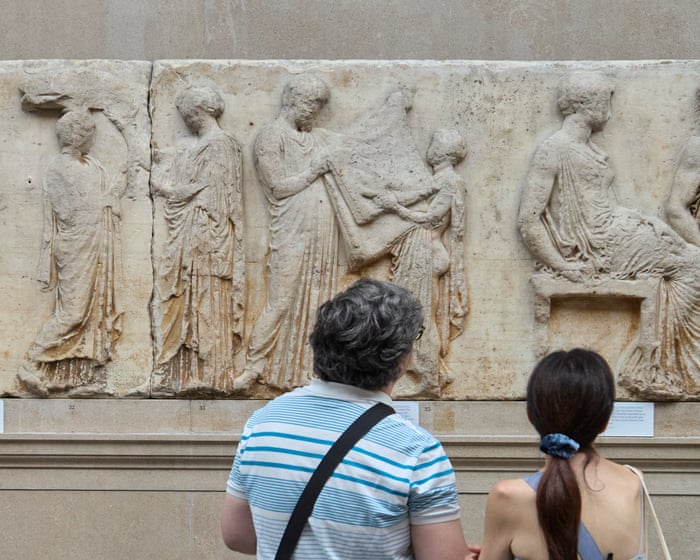
For the first time in nearly 1,000 years, the Bayeux Tapestry is back in Britain. Its arrival is a significant cultural moment and a reminder that, even in an age of social media and ubiquitous screens, historic objects still capture the public imagination. The British Museum describes the tapestry as one of the “wonders of the medieval world”. But the museum already houses many wonders, including one that is instantly recognisable: the Parthenon sculptures, chiselled away and illegally removed from Athens to be taken to Britain more than two centuries ago by Lord Elgin. There are striking similarities between the two pieces. Both were conceived as single works, intended to be seen and understood as a whole. In the case of the Parthenon sculptures, that relationship is also architectural: they were created as inseparable elements of the monument itself. Nobody would seriously contemplate cutting what survives of the tapestry in two and displaying half in London and half in Bayeux, and claiming this was an adequate way to understand it. Yet that is exactly what happened to the Parthenon sculptures. A single masterpiece was divided, and its surviving parts are now principally split between London and Athens. The sculptures tell a story of unique historical importance. Not only of gods and heroes, but also of ordinary civil life in ancient Athens. They gave a visual expression in stone to the religious, civic and political identity of fifth-century Athens. The Parthenon frieze, in particular, remains one of the world’s most compelling representations of the collective life of the city from which democracy emerged. It is a powerful celebration of Athenian democracy. Unlike the sculptures, the Bayeux Tapestry survives as one continuous work, measuring nearly 70 metres. It too tells a story, from the events preceding the Norman Conquest to the battle of Hastings and the death of Harold. Its wonder lies not just in the individual scenes, but in the way they are experienced together as a whole. View image in fullscreen The Parthenon gallery at the Acropolis Museum in Athens. Photograph: Louisa Gouliamaki/Reuters The case for reunification is not an argument for emptying the world’s museums. The Parthenon constitutes a specific and exceptional case. The issue is not merely one of possession or legal title. It concerns the restoration of the physical, aesthetic and conceptual integrity of a dismembered monument of outstanding universal value. The surviving sculptures should be viewed together, at the same time, within sight of the monument for which they were created. The Acropolis Museum was designed specifically to make this possible. Greece cannot accept any arrangement that would require it to recognise the British Museum’s ownership of the sculptures, or a scheme that would mean we “borrow” parts of our own monument. And the British public is increasingly on Greece’s side. A nationally representative poll published last year found that a majority supports the return of the sculptures to Greece. More strikingly, 72% agreed that they are best understood as part of a single ensemble with the Parthenon. For decades, Greece has been in dialogue with Britain to achieve that goal. In recent years, my government has held detailed discussions with the leadership of the British Museum about how reunification might be achieved. I was, therefore, surprised at the recent suggestion from the Museum that the Bayeux Tapestry loan might provide a template for an agreement over the Parthenon sculptures. I do not believe it does. France has lent the artwork as an undivided whole, and that work will return to France as an undivided whole. The Parthenon presents the reverse situation: integral parts of the monument were forcibly removed and dispersed. Our objective is their permanent reunification. Unesco’s Intergovernmental Committee for the Return of Cultural Property to Countries of Origin has repeatedly called upon the UK to engage with Greece on this matter in good-faith dialogue. Reunification could become the foundation of a broad and enThrough cultural partnership between our countries, we can create new opportunities for exhibitions, scholarships, conservation, and exchanges between Greek and British museums. Together, we could build a new model of cultural cooperation between two democratic nations and allies that share deep values and ideals. That is the goal.
In 2023, before becoming prime minister, Andy Burnham called for the sculptures to be returned “no strings attached,” adding: “Let’s use culture to change how Britain is seen around the world.” I could not agree more.
At a time when democratic principles are being challenged around the world, restoring the unity of a monument so closely tied to the birth of democracy itself would send a powerful message. Greece remains ready. What is needed now is the political will and courage to take the decisive step, to reunite the sculptures and turn a historic dispute into a unique act of cultural friendship.
Kyriakos Mitsotakis is the prime minister of Greece.
Frequently Asked Questions
FAQs The Parthenon Sculptures Debate
1 What are the Parthenon sculptures
Theyre ancient Greek marble statues and carvings that were originally part of the Parthenon temple in Athens built about 2500 years ago
2 Where are they now
Most of them are in the British Museum in London The rest are in the Acropolis Museum in Athens
3 Why are they called the Elgin Marbles
Because Lord Elgin a British ambassador to the Ottoman Empire removed them from Athens in the early 1800s and brought them to Britain
4 Did Elgin have permission to take them
He claimed he had a permit from the Ottoman authorities but historians still argue about whether it was valid or covered what he actually took
5 Why does Greece want them back
Greece says the sculptures are a core part of its cultural heritage and belong together in Athens where they can be seen in their original context
6 What does Britain say
The British Museum argues the sculptures are legally its property and that theyre more accessible in London where millions of visitors can see them
7 Why does the article mention the Bayeux Tapestry
The author is making a point Britain would never allow a cherished piece of its own heritage to be cut up or sent abroad so it should understand why Greece feels the same way about the Parthenon sculptures
8 What would reuniting the sculptures mean
It means bringing all the surviving pieces back together in one place most likely the Acropolis Museum in Athens so the monuments story can be told as a whole
9 Whats the strongest argument for returning them
That the sculptures were created as one unified work of art and splitting them between two countries breaks up a masterpiece that only makes full sense together
10 Whats the strongest argument against returning them
That the British Museum legally owns them and moving them could set a precedent that empties museums of disputed treasures from around the world
11 Has Britain ever returned items like this
Yes in some cases for example it has returned human remains and some looted artifacts to their countries of origin But it has never returned a collection as large and famous as the Parthenon sculptures