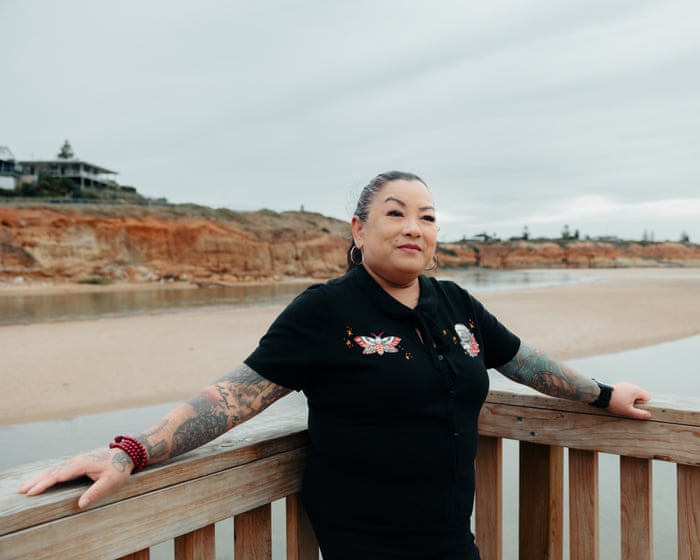
In 1975, my parents saw an ad in their local Australian newspaper. As the Vietnam War was ending, thousands of orphaned children were being evacuated. As part of the American-led Operation Babylift, the Australian government was looking for families to adopt them. My parents decided to do it.
I arrived in Adelaide in April in a shoebox. I was so tiny that my umbilical cord was still attached. My parents knew that the document they were given—with a January birthday and the name Le Thi Ha—couldn’t be mine. But with the chaos of the evacuation, there was no way to find out more.
Even though my parents divorced when I was two, I had a happy childhood. I had an older sister, who’d been adopted at five, three brothers, and parents who loved me. As a child, I wasn’t curious about my adoption. Even if I had been, Mum didn’t have any answers. She’d been told that my birth parents were probably dead, and if I’d stayed in Vietnam, I’d have died too. My teenage years were harder. I was the target of racial slurs and tried to hide my Asian heritage, getting heavily tattooed and dyeing my hair.
Having my daughter Jade in 1995—the first person I knew I had a biological connection with—changed everything. I’d stare at her for hours, unable to comprehend that this baby was from my blood. I’d look in the mirror and think: “Jade looks like me, but who did I look like?” Those questions only grew as I had my sons and second daughter.
In 2004, Mum and I took our first trip to Vietnam. I was surrounded by people who looked like me. I swung between joy at the connections I felt and depression at the endless unanswered questions. In 2015, a group of Operation Babylift evacuees from around the world met in Vietnam. We were offered the chance to take a DNA test, and I was excited at the possibility of finding biological relatives. Seeing 12 cousins listed on my results felt monumental. But they weren’t interested in our connection.
In early 2024, I saw that a TV show was helping people solve family mysteries. Claire, the producer I spoke to, sent me a new DNA test, but the show then lost its funding. Months later in July, I remembered I hadn’t seen my test results. I asked my daughter Brooklyn to log in. She said, “Mum, you’ve got a brother.” There was the name “Glenn” and beside it “brother.” I began rocking back and forth, shouting, “Oh my God.” I couldn’t believe this was real. I searched on Facebook and saw a face so like mine, I was speechless. Frantically scrolling, I found a post about his birthday. Seeing both his age and the fact he’d been born in April—the month I arrived in Australia as a newborn—I froze. He wasn’t just my brother; he was my twin.
The joy, disbelief, and shock came with a million questions. How were we separated and why? How was it possible to be 49 and discover I had a twin who lived a 2.5-hour flight away in Brisbane? I messaged Claire, who said she could reach out to him. Waiting for news was torturous. I jumped every time the phone rang.
In November, he finally called. We spoke for two and a half hours. I was the one to tell him we were twins, which he found as incredible as I did. Two months later, shaking with nerves, I went to meet him. Then I was in his arms, sobbing, and didn’t want to let him go. We’d shared a womb and were finally reunited. In those two days, I could barely tear my eyes away from Glenn, constantly reaching out to touch him and remind myself he was real.In the weeks that followed, we kept in touch and talked often, but eventually, our contact slowly faded. His wife reassured me that he was just trying to come to terms with everything.
I’m frustrated that no one has owned up to the fact that we were separated from our parents. I don’t know what lies ahead. I’ve come to realize that reunions don’t always lead to a perfect, happy ending. But I’ve also found out how resilient and determined I am. Last year, I spoke at the Department of Home Affairs for Refugee Week. Sharing my story felt healing. I want other adoptees to know that they matter. We all deserve to be heard.
As told to Kate Graham
Do you have an experience to share? Email experience@theguardian.com
Frequently Asked Questions
Here is a list of FAQs based on the experience of finding a longlost twin at age 49
General Emotional Questions
1 How did you even start looking for a twin at that age
It usually starts with a gut feeling or a medical mystery In my case I had a health issue that didnt add up and a doctor suggested I might have a twin I took a DNA test as a lark and a few weeks later I got a notification that I had a close relative matchmy twin
2 What was your first reaction when you found out
Total shock Its like your brain shortcircuits You go through a mix of disbelief euphoria and confusion I think I laughed and cried at the same time for an hour Its a massive identity shift
3 Did you feel an instant connection when you met
Its weird but yes We didnt have that awkward getting to know you phase It felt more like meeting a friend I hadnt seen in 30 years We had the same mannerisms the same laugh and we finished each others sentences It was surreal
4 Is it normal to feel angry or resentful about the time lost
Absolutely Its part of the grief process You mourn the childhood you didnt share the birthdays and graduations you missed Its okay to be angry at the circumstances or the adults who kept you apart but you have to work through it to move forward
5 How did your families react
It was a whirlwind for them My kids were amazed but a little protective of me My spouse was incredibly supportive but admitted it felt like I was bringing a stranger home It took time for them to see my twin as an extension of me
The Twin Experience Science
6 Did you look exactly alike
It was like looking in a mirror but 30 years older We had the same face shape the same eyes and even the same weird birthmark The biggest difference was style and posture which wed developed independently
7 Did you have the same habits or quirks
It was scary We both hated the texture of mushrooms we