As Joni Mitchell once put it, many city planners around the world have “paved paradise and put up a parking lot.” The European Prize for Urban Public Space aims to show that cities don’t have to stay stuck in the automotive age forever.
The prize’s latest shortlist, announced on Wednesday, highlights architectural projects that turn car-focused infrastructure into spaces that help city residents cope with the extreme heat brought on by climate change. These include roundabouts transformed into splash pools, main roads turned into green havens, and parking lots converted into gardens.
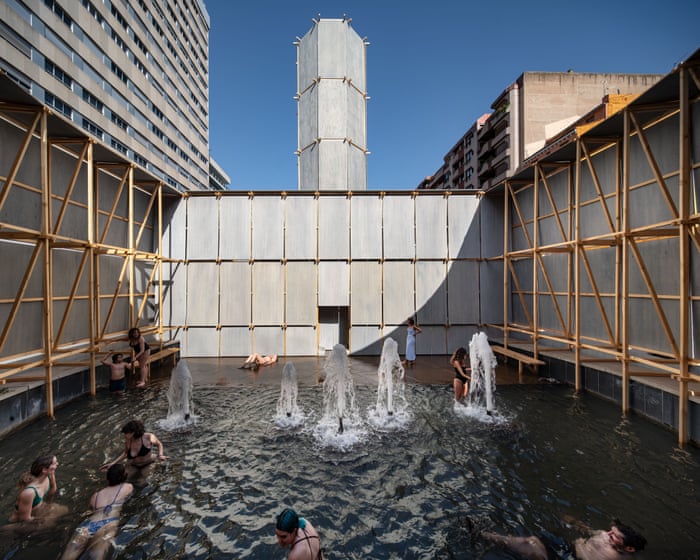
One of the most striking finalists among the five is Leopold Banchini’s Round About Baths in Logroño, northern Spain. The Swiss architect’s project aimed to breathe new life into what he called a “lost space” on one of the city’s main roads—a concrete island with a broken fountain.
Inspired by 19th-century public baths, Banchini’s studio used untreated timber panels to build a simple structure directly on the fountain. The existing water basin became a shallow pool, while cast-iron flower pots were repurposed as fire bowls to heat a steam room.
“We’ve given up so much public space to cars, and if you live in a city with kids, you’re constantly worried they’ll be hit by a passing vehicle,” Banchini said. “It restricts our movement so much that we almost don’t notice it anymore.”
However, those hoping to see the roundabout baths in person will be let down: Banchini’s structure was only up for a week as part of the city’s Concéntrico architecture festival in June 2025—showing just how hard it is to permanently change car-centric infrastructure.
“If we had built something more permanent, we would have had to deal with safety concerns,” said Banchini, noting that bathers could only reach the roundabout via a crosswalk on one side.
“The rules around car traffic are tough to change, and any requests usually have to go all the way up to municipal authorities,” he added. “And politicians are really afraid to touch anything involving cars, because they worry it will cost them votes.”
The creators of another Spanish finalist, Barcelona’s Plaça de les Glòries Catalanes, had more success: the three roads that used to feed traffic into the Glòries cloverleaf interchange were partly moved underground to make room for open green space.
Antwerp’s Zuidpark came from a similar effort to remove cars from city areas. Located in the southern Zuid district of the Belgian city, this 800-meter green space now covers what used to be a large free parking lot.
In 2015, city officials launched a competition to create a public space on the site. “I’ve worked on projects like this for 25 years, but this park had to be completely different from anything we’ve done before, and that’s because of the climate issue,” said Bart Van Gassen of Tractebel, the urban architecture firm that won the contract.
The company decided to dig out 70% of the new park’s area and add a 1.5-meter top layer of soil to help trees and bushes grow faster. Two years after opening in 2024, Zuidpark now has double rows of 500 new trees that offer shade during heatwaves.Adding a deep top layer of soil has helped plants in Zuidpark thrive. Photograph: Isabelle Pateer
“The planting is really taking off,” said Van Gassen. “We have projects we built 10 years ago where the trees are still smaller than the ones here.” He also mentioned that recent research from the University of Antwerp showed temperatures inside the park are significantly lower than in other parts of the city.
Climate breakdown is causing not only intense heatwaves but also extreme rainfall, which Zuidpark aims to handle with lowered areas called “rain gardens,” designed to capture rainwater. These spaces, filled with old bluestone blocks found during construction and plants that thrive in wet conditions, have become popular spots for children to play in.
Still, cars haven’t disappeared completely: a new parking garage, which is no longer free, now sits across four levels beneath Zuidpark’s northern and southern sections, with entrances located outside the park.
“You could criticize it because it’s still a parking garage with 2,000 spots right near the city center,” said Van Gassen. “From a sustainability standpoint, maybe it should have been built further out. But then again, without parking, we might not have been able to create the park at all.”
Also in the running for the prize, which is awarded every two years, are the Leça Green Corridor in northwest Portugal and Peace Park in Vicenza, Italy.
The winner of the award, organized by Spain’s Centre de Cultura Contemporània de Barcelona along with six other European architecture institutions, will be announced on October 15.
Frequently Asked Questions
Here is a list of FAQs about reclaiming streets from cars in Europe written in a natural tone with clear direct answers
General Definitions
Q What does reclaiming the streets actually mean
A It means taking space that is currently given over to carslike parking lanes wide intersections or entire roadsand redesigning it for people This could mean adding bike lanes wider sidewalks outdoor cafes green spaces or playgrounds Its about shifting the priority from moving cars to creating spaces for people to live walk and socialize
Q Why are European cities doing this now
A There are several reasons tackling climate change by reducing emissions fighting air and noise pollution improving public health by encouraging walking and cycling and making cities safer by reducing traffic accidents There is also a growing desire to make city centers more pleasant places to live not just places to drive through
Q What is the 15minute city and how does it relate to this
A The 15minute city is the idea that residents should be able to reach all their daily essentialslike groceries school work and parkswithin a 15minute walk or bike ride from home Reclaiming street space is a key tool to achieve this because it makes walking and cycling safer and more pleasant encouraging people to use local services instead of driving
Q Does this mean cars are being banned completely
A No not usually The goal is rarely to ban cars entirely The aim is to reduce car dominance not eliminate them Most plans focus on making driving less convenient for short trips in dense areas while still allowing access for residents deliveries emergency vehicles and people with disabilities
Benefits Impact
Q What are the main benefits of removing cars from city centers
A The benefits are huge You get cleaner air quieter streets fewer traffic accidents and a big boost to local businesses because people are more likely to stop and shop when they are walking It also creates public spaces that improve mental and physical health for residents
Q How does this affect local businesses Wont they lose customers who drive