It’s not exactly surprising that elements of the MAGA movement have embraced Andrew Tate. What’s strange is that Democrats don’t seem interested in holding the Trump movement accountable for it.
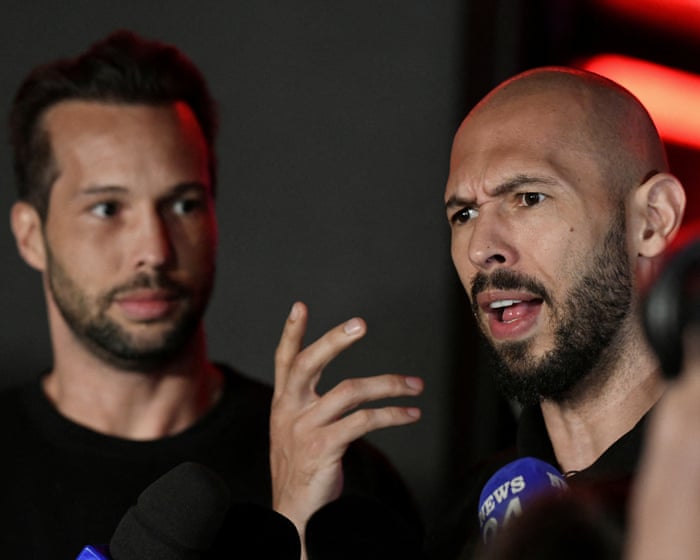
Andrew Tate—a misogynistic influencer accused by numerous women around the world, and now by British prosecutors, of rape, strangulation, assault, sex trafficking, possession of child abuse images and extreme pornography, along with other forms of gender-based violence and exploitation—was arrested in Miami last week, along with his brother and sidekick, Tristan. Or I should say, they were rearrested. The men had already been charged in Romania, where they were under house arrest until, after some conveniently timed diplomatic moves by the Trump administration, they were allowed to leave the country and settle in the US. When asked whether the Trump administration had secured their release from Romania, the Tates’ lawyer said, “Do the math. These guys are on the plane.” Now, finally, they are awaiting extradition to the UK, where they are dual citizens.
The Tate brothers have long made a living by making provocative, contemptuous statements about women online. But in June, Heidi Blake of the New Yorker published a lengthy investigation that focused not on what the Tates have said, but on what they are alleged to have done—detailing a long and documented history of alleged sex trafficking, violence, and sexual assault, along with a disturbing pattern of police mismanagement, incompetence, and indifference that allowed the men to go free. The Tates denied any wrongdoing in that article; their lawyer called the new British charges “garbage.” But if anyone thought the Tates’ misogynistic influencer career was just empty talk, Blake’s investigation offered strong evidence to the contrary: she painted a picture of men acting exactly the way they talked.
In a world where people took misogyny as seriously as they claim to, the Tates would have been shunned and condemned long ago for their hatefully sexist rhetoric and alleged violence against women. In this world, they got rich and ingratiated themselves with powerful figures in the Republican Party.
Tate fits naturally into a MAGA right that has united its many factions—from Christian conservatives to Silicon Valley eugenicists, beer-chugging barstool regulars, conspiracy theorists, and the male hosts of multi-hour podcasts—around a foundation of male supremacy. Contempt for women is the unifying force on the American right, more consistent across the movement’s competing styles than even hatred of immigration or devotion to the interests of capital. Donald Trump cemented the presidency, after all, when he was revealed to have bragged about “grabbing” women “by the pussy” and still kept his base of support. In the decade that followed, his domineering, narcissistic, vulgar style of masculinity—and the belittling, hateful treatment of women that comes with it—has come to be seen on the right as a feature, not a bug. Other men in the MAGA movement now imitate Trump’s style of misogyny with gleeful competitiveness. The coalition welcomes men who collect harems of women to bear their children, those who have been repeatedly accused of sexual abuse, and those who denounce women’s right to vote. In this environment, Andrew Tate is not an exception. He is the rule.
But just because Tate’s style of masculinity is popular on the right—where sex is seen as elevating men’s status at women’s expense, where women’s aspirations to education, skilled work, dignity, public participation, or even basic decency are mocked, and where mistreating women is a key way for men to earn respect from other men—does not mean it’s popular with the public. Tate’s version of vulgar, open, and preening misogyny has a following among Republican politicians and unlikeable teenage boys. It does not have a following among the majority of Americans.Why aren’t Democrats turning the Tate brothers into symbols of MAGA’s hateful, bizarre cultural project—or of Trump’s alleged personal ties to sexual misconduct, or the antisocial, anti-democratic, and anti-equality stances of the MAGA movement? After all, rape might be the most fundamentally anti-democratic act: a violent rejection of equality in the most intimate way. You could imagine an opposition to Trumpism built on anti-rape principles that lead to pro-democracy ones. Or, less ambitiously, you could imagine an opposition that simply links Trump’s pathetic narcissism to the sleazy Tate brothers and their manosphere followers. It seems like an easy win.
The fact that the Democratic Party isn’t doing this shows how deeply male supremacist thinking has seeped into the conventional wisdom of political strategists—and how even the most basic, remedial feminist ideas are now seen as toxic by those same forces. One explanation for why Democrats aren’t exploiting the Tates’ ties to Trump is as simple as it is grim: they don’t want to alienate the Tates’ base of manosphere content consumers.
It’s become a cliché to say Democrats are losing men—a demographic trend treated as a much bigger crisis than the GOP’s parallel loss of women. Factions within the Democratic consultant class have made recruiting “manly men” candidates their single mission. After the 2024 election, major party players raised a massive $20 million for a “Speaking with American Men” project, aimed at luring men back to the party. California Governor Gavin Newsom, a likely 2028 presidential candidate, has launched his own podcast, where he’s embraced some right-wing cultural positions, like on trans rights. The party is running white male candidates who say cartoonish things like it’s okay “to be a manly man”—as if anyone was confused.
This desperate, frantic effort to re-masculinize the party at any cost led to the recruitment of Graham Platner, the ex-Marine who dropped out of the Maine Senate race earlier this month after being accused of rape (he has denied the allegations). Major Democratic players did the right thing in that case, calling on Platner to drop out en masse. But many still believe in the strategy that elevated him in the first place: prioritizing men over women, treating men’s votes and support as somehow more legitimate and valuable than women’s.
In this sense, there’s another reason some Democrats won’t seize on the Tate issue: even if they don’t condone his alleged violence, they might not entirely disagree with his most basic principle—that men are better and more important than women.
Moira Donegan is a Guardian US columnist.
Frequently Asked Questions
Here is a list of FAQs based on the premise of the question written in a neutral and informative tone
FAQs Why are Democrats staying quiet about the Tate brothers
1 What is the main point of Moira Donegans article
The article argues that Democrats are staying quiet about the Tate brothers because its a politically awkward topic Andrew Tates popularity especially among young men highlights a failure of liberal politics to offer a compelling alternative Speaking out could alienate potential voters or draw attention to a problem they dont have a clear solution for
2 Who are the Tate brothers and why do they matter in politics
Andrew and Tristan Tate are controversial influencers known for promoting hypermasculinity misogyny and a hustle culture lifestyle They are popular with a large young male audience They matter politically because their rise reflects a real cultural shift and a growing distrust of mainstream institutions including the Democratic party
3 If the Tates are so bad why wouldnt Democrats just condemn them
The article suggests its not that simple Calling them out directly could
Boost their brand Giving them more attention might make them seem like a forbidden figure
Alienate young men Many young men who arent hardcore fans still feel drawn to Tates message of selfimprovement Criticizing him could feel like criticizing them
Highlight a lack of alternatives Democrats dont have a popular positive message for young men that competes with the Tates toxic but simple worldview
4 Is this just about the Tates or a bigger problem
Its about a bigger problem The article uses the Tates as a case study for a wider issue the Democratic partys struggle to connect with young men The silence isnt just about two individuals its about not having a clear answer for the loneliness economic anxiety and sense of disenfranchisement that makes figures like the Tates appealing
5 What does the article say Democrats should do instead of staying quiet
The article implies that Democrats need to do more than just condemn They need to build a positive compelling vision for masculinity and success that addresses the real needs and anxieties of young menthings like purpose community and financial stabilitywithout resorting to misog