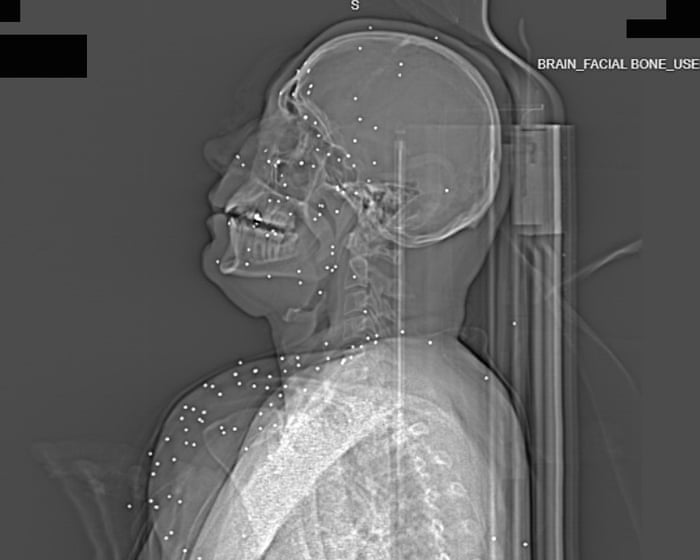
White dots shine like constellations across Anahita’s* face. Some gleam from within her eye sockets, others are scattered over her chin, forehead, and cheekbones. A few float in the dark expanse of her brain.
Each dot represents a metal sphere, about 2-5mm in size, fired from a shotgun and revealed by an X-ray camera for a CT scan. These projectiles, known as “birdshot,” spray widely when fired from a distance, losing momentum. At close range, they can crack bone, blast through the soft tissue of the face, and easily pierce the delicate globe of the eyeball. Anahita, in her early 20s, has lost at least one eye, possibly both.
The image of Anahita’s head is one of more than 75 sets of medical images—primarily X-rays and CT scans—shared with the Guardian from a hospital in a major Iranian city. They were taken over a single evening during the regime’s January crackdown on protesters. The plain, grayscale images tell their own story of the deadly violence inflicted on protesters and onlookers by Iran’s Islamic Revolutionary Guard Corps (IRGC).
They provide further evidence of events described by doctors and protesters across Iran, where guards switched from traditional crowd control methods to opening fire with high-caliber assault rifles and shotguns. The records show a pattern of people being shot in the face, chest, and genitals—a trend also seen during the 2022 “Woman, Life, Freedom” protests. Collectively, they illustrate the scale of the bloodshed, revealing dozens of life-threatening injuries arriving at a single hospital in a midsize city within just a few hours.
A composite image shows 10 X-rays of people’s heads in profile, with pellets embedded like white dots. This small selection is from patients shot in the face with metal birdshot pellets. Medical analysts say such injuries likely cause blindness, disfigurement, and in some cases, permanent brain damage and disability.
Many images reveal catastrophic, potentially fatal injuries even with immediate surgery. One scan shows a large-caliber bullet embedded in the neck of a young man named Vahid*, his trachea pushed aside as blood pools and tissue swells. Scans of a middle-aged man show a bullet suspended in his brain alongside a large bubble of gas inside the skull, indicating devastating brain injury. Medical experts describe it as “likely not survivable.” Two more young men have large-caliber bullets lodged near their spines. A scan of a young woman shows a deformed bullet that appears to have entered her ribcage under the right arm, torn through her lung—where gas and blood have built up—and come to rest near her spine.
“If you’re firing those kinds of weapons at people, you are trying to kill them,” says a trauma imaging expert.
As part of a joint investigation by the Guardian and fact-checking platform Factnameh, the images were assessed by a panel of health and ballistics experts outside Iran, including an emergency medicine doctor, a radiologist, and a trauma imaging specialist. An independent Iranian former ER doctor also reviewed them, noting the software used is consistent with that of the hospital in question and that the images show no signs of tampering. Descriptions of the likely injuries are based on the doctors’ assessments, though they caution that without full medical records and multiple imaging sets, they cannot make definitive diagnoses for individual patients.
Dr. Rohini Haar, an emergency doctor, adjunct professor at UC Berkeley, and medical adviser to Physicians for Human Rights, reviewed the files and says the cases are “shocking” in their number and severity. “Using live ammunition and large-gauge bullets against so many individuals is… extremely unusual and notable, even globally.”X-rays from patients injured during the Iran protests show severe gunshot wounds. Top left: a bullet in the brain; top right: a full metal jacket bullet lodged near the spine; bottom left: a full metal jacket bullet in the neck; bottom right: a deformed bullet in the chest.
A radiologist and trauma imaging expert who reviewed the images says these patients represent “absolutely a mass casualty situation. Even for our large hospitals in the US… that would be a mass casualty alert that would overwhelm hospital resources.”
Medical experts note that such images only reflect patients doctors believe they can save and who have survived long enough to receive detailed scans. For example, most people shot in the head with a high-caliber round “wouldn’t have gotten to a CT scan.” During a mass casualty event, hospitals must prioritize life-threatening but treatable cases that don’t require extensive resources, meaning these scans represent only a small fraction of the injured from that night.
Iran is one of the few countries where armed forces and police use metal birdshot. While a single pellet causes less damage than a bullet, it can still be catastrophic. At long range, pellets spray indiscriminately into a crowd. Even one pellet can cause severe harm—X-rays show cases where just one or two pellets in the skull, likely from a longer range, pierced the eye and settled in the socket. At close range, hundreds of pellets can penetrate a person, destroying surrounding soft tissue.
A chest X-ray of a patient shot at close range shows birdshot pellets distributed throughout the right chest cavity.
A member of the surgical staff described one victim: “Her face was covered in blood, and her younger brother was shaking uncontrollably… the eye could not be saved.”
X-rays of a patient named Ali reveal more than 174 metal pellets packed into his right chest cavity, indicating an extremely close-range shot. His right lung has partially collapsed and is surrounded by leaking blood and gas. Medical experts say that even with immediate, extensive surgery, his risk of death would be very high.
“People think birdshot is less deadly than live ammunition. It’s not,” says the expert. “When you’re firing at point-blank range, all those metal balls are penetrating—they’re like 100 tiny bullets.”
Beyond the violence of the injuries, the X-rays reveal a pattern: case after case shows patients shot at short to medium range in the face, chest, and genitals.
The Guardian has reviewed records of 29 patients shot in the face with birdshot. One, a middle-aged woman named Safie, is shown in a CT scan with a necklace chain visible against her neck. Metal beads are also visible, buried deep in her brain tissue. Scans document medical efforts to save her, including a craniotomy to relieve pressure from her swelling brain. Later images show some pellets removed, but more than 20 remain in her head and neck. It is unknown whether she survived.
An X-ray shows a woman shot in the crotch, with about 200 metal balls embedded in her upper thigh and pelvic area.
At least nine people have been shot in the genital or pelvic area with birdshot, or in three cases, with high-caliber rifles. One middle-aged woman was shot in the groin with nearly 20 pellets.A woman has metal pellets distributed throughout her thighs and pelvic area. A 35-year-old man has similar injuries, with birdshot scattered across his groin. According to a medical analysis commissioned by the Guardian, these injuries could cause serious disfigurement and severe damage to the genitals, perineum, rectum, and urinary bladder. The analysis concludes that long-term effects could include bladder and bowel incontinence, sterility, and impotence.
In nine patients, high-caliber bullets remain embedded in the body and are clearly visible in scans. In another seven, the bullet itself is not visible, but ballistics and medical experts agree the injuries—such as a femur shattered along a clear path with metal fragments—are extremely likely to have been caused by a high-velocity bullet. Images showing projectiles were analyzed by two independent ballistics experts, who identified the bullets as full metal jacket rounds consistent with those fired from assault rifles like the AK-47 or KL-133—weapons used by Iran’s IRGC. Full metal jacket bullets often retain their shape on impact. “These are lethal-purpose weapons,” says ballistics expert NR Jenzen-Jones, director of Armament Research Services, who assessed some of the images.
In reviewing the images, one medical analyst described them as “the kind of injuries you would see in wartime: those are chest shots with a military weapon.” He added, “If you’re firing those kinds of weapons at people, you are trying to kill them.”
Haar notes, “These are not the kind of little bullets that we usually see even in policing in the US. These are a whole different level of weapon.”
The X-rays add to a growing body of testimony from doctors on the ground treating these injuries, who describe the damage as catastrophic. Many report performing dozens of surgeries to remove the eyes of those struck, including teenagers and children. One verified medic, Dr. Ahmad*, shared comments from a surgical colleague who treated a large number of penetrating eye injuries. His youngest patient was a 14-year-old girl brought in by her parents and brother. “Her face was covered in blood, and her younger brother was shaking uncontrollably,” he said. The parents explained the family was at a demonstration when security forces began firing from the roof of a civilian building. “She was shot directly in the left eye, causing devastating damage. The injury was so severe that the eye could not be saved and had to be surgically removed.”
Ahmad says he has spoken to colleagues across the country who “report a recurring pattern of deliberate gunshot injuries targeting specific organs, most notably the eyes and heart, and less frequently the genital region. These injuries commonly involve penetrating eye trauma, globe rupture, severe intraocular bleeding, retinal damage, and permanent vision loss.” He states that this pattern “strongly suggests an intent to cause permanent disability rather than unintended harm” and is “difficult to reconcile with random gunfire in chaotic environments and instead points toward deliberate targeting of vital and symbolically significant body parts.”
Another verified doctor inside Iran says those arriving in the emergency department ranged from grandparents to toddlers. “They came in with gunshots and also pellets in different locations on the body—to the chest, the abdomen, limbs, genitals… basically the entire body. Live ammunition wounds from pistols, AK-47s,” he says. Among the older patients was a grandmother in her mid-60s, brought in with…She was brought in by her family. She had been caught in the violence while trying to pick up her granddaughter and was shot at point-blank range with a shotgun loaded with pellets.
“Pellets had spread all across her body,” the doctor says. Staff performed CPR twice, but the woman died.
“I am still trying to cope with it,” he says. “You can only witness so much.”
*Names have been changed.
Frequently Asked Questions
FAQs Xray Evidence of Injuries from Iran Protests
BeginnerLevel Questions
1 What do the recent Xrays from Iran actually show
The Xrays show severe bone fractures and internal injuries primarily to the head eyes chest and limbs of protesters Medical analysis indicates these injuries are consistent with being struck by highvelocity projectiles like pellets or rubber bullets aimed at critical areas
2 What does deliberate targeting of vital body parts mean
It means that the projectiles used were not fired randomly or at the ground to disperse crowds Instead the pattern of injuriesespecially to eyes skulls and chestssuggests a tactic of aiming directly at these areas to cause maximum often permanent damage
3 Why are Xrays important evidence
Xrays provide objective medical proof of injuries that cannot be easily disputed They document the type location and severity of trauma creating a permanent record that can be used for medical treatment legal accountability and historical documentation
4 Who is analyzing these Xrays
They are being analyzed by forensic experts radiologists and human rights organizations These professionals compare the images with known weapon types to determine the cause and intent behind the injuries
5 What kind of weapons cause these specific injuries
The injuries are consistent with lesslethal crowdcontrol weapons such as metal pellets fired from airguns rubbercoated metal bullets and tear gas canisters fired directly at people At close range these can be deadly or cause catastrophic harm
Advanced Practical Questions
6 How can an Xray prove intent to harm
While an Xray alone doesnt prove intent the pattern and concentration of injuries across many victims do When hundreds of Xrays show similar precise injuries to eyes and headsareas not accidentally targeted in crowd dispersalit strongly indicates a systematic practice not incidental harm
7 What are the longterm health consequences for survivors with these injuries
Survivors face permanent disabilities including blindness traumatic brain injury loss of limbs or function chronic pain and severe psychological trauma Many require multiple surgeries and lifelong medical care
8 What is the difference between lesslethal and nonlethal weapons
Nonle