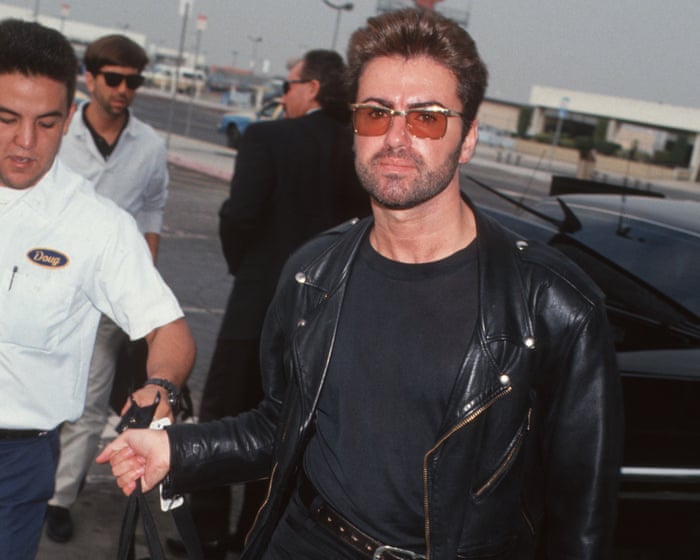
The George Michael album that never was started with defiance and ended in grief. It was 1992. Stuck in a bitter legal fight with Sony Records, Michael decided to stay busy and assert his independence by making an album of songs to be performed by several of his musical heroes—including Aretha Franklin, Janet Jackson, and Sade Adu—under the alias the Trojan Souls. He worked on the project for months, until his Brazilian boyfriend, Anselmo Feleppa, died of AIDS in March 1993. After that, Michael lost interest in music, and the album was never revived.
Tracks from those sessions have since leaked online, along with behind-the-scenes footage filmed by Michael’s close friend and informal advisor, Andros Georgiou. For years, Georgiou has been trying to get unauthorized clips removed from YouTube and TikTok. Now, just months before the 10th anniversary of Michael’s death, he is releasing 90 minutes of unedited video as Trojan Souls—not exactly a film, but an unfiltered look at Michael in his creative prime. “I thought these fans were making money from my rights, so I decided to stop fighting and just put it out there,” Georgiou says. He hopes it will offer a glimpse into what he calls, with typical exaggeration, “the greatest album never made.”
Georgiou titled his self-published 2012 memoir Rock: The Luckiest Man in Pop. The “luck” refers to the fact that his father and Michael’s father were cousins who emigrated from Cyprus to England together in 1953. That meant Georgiou grew up alongside one of the greatest artists of his generation. They stayed close until a bitter falling out in 1998—more on that later.
View image in fullscreen
‘He had a 48-track studio in his mind’ … Michael at work. Photograph: Courtesy Andros Georgiou
Always loyal to his childhood friends (another, David Austin, now runs his estate), Michael gave Georgiou creative opportunities. They first worked together as Boogie Box High, whose cover of the Bee Gees’ “Jive Talkin’” became a Top 10 hit in 1987. They also co-founded Aegean Records in 1996. Georgiou was a regular companion on the road. When they were in Tokyo during the Faith tour, Sony gave Georgiou a state-of-the-art Hi8 video camera, which let him make high-quality home movies.
Georgiou describes the origins of the Trojan Souls as dramatic as a heist. When Michael released Listen Without Prejudice Vol. 1 in 1990, he was so tired of his sex-symbol image that he disappeared from the public eye: no appearances in videos or on album covers, no interviews, no concerts. “He wanted to make music, but he didn’t want to play the lying game anymore,” Georgiou says. Michael believed Sony punished him by not promoting the album enough. The singer felt trapped.
“Being arrested was the beginning of the end. He laughed it off, but it seriously affected him.”
In January 1992, Michael and Georgiou flew to LA for some winter sun. But Michael soon got bored and suggested they go to Dave Stewart’s Chapel Studios in Encino to quickly record a cover in the spirit of Boogie Box High. They chose the 1979 disco hit “Ain’t No Stoppin’ Us Now”—a symbolic choice, since Gene McFadden and John Whitehead originally wrote it to criticize their own label, Philadelphia International. Michael decided they should return in July to start an album, recruiting vocalists he had loved growing up. According to Georgiou, only David Bowie politely declined. He says the name came to him in a dream: The Voice of Reason by the Trojan Souls. “From the Trojan horse,” he explains. “The soldiers came in and then came down fighting.”
Back in London, Georgiou was contractually required to offer the project to Sony first, despite the bad blood. “Of course they said no. I called George and he said, ‘Fuck Sony!’ I said, ‘I’ll be home in two hours with a deal, trust me.’” Georgiou called an A&R at Warner and rushed over. “Rob Dickins, the chair, was there. He said, ‘What do you want?’ I said a million pounds. He said, done.” In October, Michael filed a lawsuit against Sony, claiming that his contract was unfair.as an unreasonable restraint of trade. “He wanted to get back at Sony any way he could,” says Georgiou.
Despite the project’s bitter beginnings, the three songs in the film have a bright, funky energy. “He was so happy,” Georgiou says. “For the first couple of months, we probably had the best time of our lives making this record.” The lush ballad One Day I’ll Know was meant for Stevie Wonder, and the shimmering Maybe It’s Not Your Time was intended for Bryan Ferry. The instrumental track Wendy Melvoin’s Song featured virtuosic rhythm guitar from one half of Wendy and Lisa, in the hope that she would bring her former employer Prince on board.
Obsessed with protecting his mystique, Michael was never officially filmed playing an instrument or building a track. “If you’re a fan,” says Georgiou, “this is your first chance to see how he directs everyone in the studio.” It’s fascinating to watch how precisely Michael drills his world-class musicians—Melvoin, keyboardist Chris Cameron, bassist Deon Estus, and Lynn Mabry’s backing singers—through take after take, even grabbing Estus’s bass guitar at one point to show him what he means. To the listener, the takes might sound the same, but Michael was always chasing the perfect sound he heard in his head.
View image in fullscreen
Collaboration … Elton John and Michael in the early 1990s. Photograph: Photoshot/Getty Images
“He had a 48-track studio in his mind,” says Georgiou. He recalls how, even when they were kids, Michael used to break down songs by their favorite artists and explain how he would have changed this or that. Or how, when they were working at Sarm West in Notting Hill, Michael would get in the car with a cassette of a basic backing track and have a melody written by the time he got home to Hampstead.
“He was quite a frustrating person to work with because he had a strange creative process,” says Sathnam Sanghera, author of Tonight the Music Seems So Loud: The Meaning of George Michael. “He would often sing at musicians and say, ‘This is what I want it to sound like.’ I’ve talked to a lot of musicians who worked with him, and almost all of them said the same thing: ‘At the time, it drove us fucking mad.’ But looking back, they can see that of all the people they’d worked with, he was the most talented. He just had these amazing ears.”
“This is just the beginning of something that could have been amazing”
The fragments heard in Trojan Souls are tantalizing, but only the Elton John collaboration This Kind of Love was ever finished. By the start of 1993, Feleppa was fading fast. “It was terribly difficult for him to finish anything, so we went from track to track,” Georgiou says. “And then it got too much for him.” Leaving work unfinished wasn’t unusual for Michael, though. “George had a history of losing interest,” says Sanghera. “A lot of projects never came to fruition: Listen Without Prejudice Vol 2, the Daft Punk collaboration, the duets album …”
A few years later, Georgiou’s friendship with Michael also ended. On 7 April 1998, Michael was arrested for “engaging in lewd conduct” in a public toilet in LA’s Will Rogers Memorial Park, and the closeted star was outed to the world. “Basically, it all went wrong when he was arrested,” Georgiou says. “He laughed it off, but it seriously affected him mentally, and that was the beginning of the end.”
When I interviewed Michael in 2004, he connected the incident to losing his mother to cancer a year earlier. Having finally worked through the creative drought caused by Feleppa’s death to make 1996’s Older, he was crushed by grief once again. “Really since 1991, when I found out [Feleppa] was HIV positive, all I’d done was either wait for someone to die or grieve,” he told me. “It was just so easy to feel picked on and angry and nihilistic.”Close the image in fullscreen before a bitter falling out … Georgiou and Michael. Photograph: Courtesy Andros Georgiou
Michael’s constant cruising on Hampstead Heath caused a rift. Georgiou saw it as self-destructive, and Michael resented his friend’s judgment. “I couldn’t understand the risks he was taking,” Georgiou says. “He was loud and proud, which I totally respected, but you can’t keep doing what you’re doing.” He says the breaking point came when Michael suddenly told him to drop Aegean’s entire roster. “The next day I just thought, you know what? Screw you. And I walked out.”
Another version of events is that Georgiou crossed a line by telling his story and giving family photos to Hello! magazine. Either way, Michael told me, “Losing that relationship absolutely crushed me. Everything I took for granted in my 20s, I lost.” Georgiou says they tentatively reconnected in 2016 and planned to meet up in the new year. “It took a lot. We’re both Greeks at heart, with our arrogance and pride. And then he died. Even talking about it now, I can’t believe it.”
The Trojan Souls material wasn’t completely shelved. “Ain’t No Stoppin’ Us Now” was released on Aegean Records in 1998, as one of the first commercially available MP3s, and Michael re-recorded “This Kind of Love” without Elton not long before his death – Sanghera calls it “his one great unreleased song.” As for the rest, we can only guess. Could “The Voice of Reason” have been a success?
“I think it could have worked as a duets album, because 90% of George was his voice,” Sanghera says. “He was at his creative peak. This could have been ‘Listen Without Prejudice Vol 2’ if his lover wasn’t dying, if he hadn’t sued Sony. But I think he would have needed another two years for a fully finished album. This is just the start of something that could have been amazing.”
Georgiou has often been viewed with suspicion by Michael’s fans for making money off his closeness to a pop genius. Now he’s preparing a rewritten memoir, a related film, releasing more footage on his website, and even a duet version of “This Kind of Love” if he can get Elton John’s approval. But then again, these are his videos, and Trojan Souls was his project too. Given his long estrangement from Michael, the home videos capture not just an unfinished album but a deeply missed friendship. “It’s my legacy in a way,” he says. “I was there for nearly 40 years. What a time!” Trojan Souls is available for streaming at trojansouls.com.
Frequently Asked Questions
Here is a list of FAQs about the untold story of George Michaels secret duets project The Greatest Album Never Made
BeginnerLevel Questions
1 What is The Greatest Album Never Made
Its the nickname for a secret unfinished duets album George Michael worked on in the late 1990s and early 2000s He recorded songs with a huge list of famous artists but he never finished or released it
2 Why was it a secret
George Michael was very private about his creative process He wanted to experiment without record label pressure or media hype so he kept the project hidden from everyone except the artists and a few close collaborators
3 Who was on the starstudded lineup
The rumored lineup includes massive names like Aretha Franklin Elton John Whitney Houston Stevie Wonder Sting Paul McCartney and even a track with Boyzone
4 Why was the album never finished
There are a few reasons George Michaels legal battles with his record label in the 1990s his focus on other solo projects and his growing perfectionism He reportedly felt the songs werent good enough to release
5 Has any of the music ever been heard
Very little A few tracks leaked online and one songThis Is Not Real Lovewas released in 2006 But the vast majority of the duets remain in a vault or were erased
AdvancedLevel Questions
6 How do we know this project actually existed
Through interviews with collaborators plus George Michaels own mentions in rare radio interviews Legal documents from his Sony lawsuit also reference a secret duets album
7 What specific songs were recorded for it
Confirmed tracks include
A duet with Aretha Franklin
The First Time Ever I Saw Your Face with Whitney Houston
A cover of The Long and Winding Road with Paul McCartney
A song called Cowboys and Angels with Stevie Wonder
Many other titles are still unconfirmed
8 Did George Michaels label try to stop the project
Yes His bitter feud with Sony