In the quiet countryside south of Grantham, three huge steel barns rattled in the wind. Gathered loosely around them were 15 landowners, land agents, and a couple of young investors—all expensively dressed men, many looking skeptical. It was June 2022, and Sir Charles Raymond Burrell, the 10th Baronet, was explaining how buying 1,525 barren acres (617 hectares) of prairie-like wheat and bean fields could transform farming and nature conservation, not just in South Lincolnshire, but across Britain and beyond.
Burrell, known to everyone as Charlie, led the group on a walk from the barns next to the unappealing modern farmhouse—a red-brick giant with small windows like piggy eyes. We started by crossing a field of broad beans. Less than a century ago, this had been a patchwork of ten smaller fields. As we walked over the hard, cracked ground, we didn’t see a single insect. Later, near a verge, a couple of butterflies flew by. As for people, we didn’t meet anyone else during our two-and-a-half-hour walk along footpaths and field edges. “This is a ruined landscape,” said one of the guests, architectural historian Matthew Rice. “Not because of the soil. Because there are no people here. I’m sorry there aren’t enough stoats, but I’d like to see some children here too.”
What is a farm? Most of us still picture a storybook image from childhood: cows, pigs, wheat, a pond, a farmer, a family. The farm that had recently operated on this site was more typical of today’s “hard-arsed” farming, as Burrell put it. Boothby Lodge Farm was a business owned by an absentee landlord. No one lived off the land or on it. Tenants rented the farmhouse and worked elsewhere. More than 92% of the land was plowed fields. A contract farmer simply drove in with big machines a few days each year to grow wheat and beans in the poor clay soil. Pheasants were released on the 3% of the farm that was woodland. For a few days each winter, men would pay to shoot them.
Boothby Lodge Farm made £250,000 in profit each year, but half of that came from the “basic payment”—a simple, generous subsidy for owning land that the government planned to stop by 2027. After that, thanks to reforms introduced by Michael Gove when he was environment secretary, farmers would only get “public money for public goods”—meaning their land had to provide clean water, healthy soil, or wildlife-rich hedgerows, none of which Boothby seemed to do.
Hard-arsed farming has been a major driver of Britain’s contribution to the global extinction crisis. Over the past century, England and Wales have lost 98% of wildflower meadows. We’ve also destroyed half of Britain’s ancient woodland, half of lowland ponds, 90% of freshwater wetlands, and 62% of all “farmland” wild birds.
As we walked, Burrell explained how we might reverse this—at least on this farm. In late 2021, the company he co-founded, Nattergal, bought the farm for £13.8 million. It planned to abandon 6,000 years of farming history on this land. No crops would be planted. No fertilizers or pesticides would be added to the fields. They intended to break up the drains that generations of farmers had painstakingly installed to remove rainwater from the fields. The soil would be left to grow weeds. Boothby Lodge Farm was to become Boothby Wildland.
The landowners listened closely to a proposal that would horrify most farmers. They did so because Burrell, with his relaxed charm, sturdy health, and strong hands, looked and sounded like the practical farmer he had once trained to be. This deceptively radical aristocrat also had a major success behind him. On his 3,500-acre Knepp estate in West Sussex, he and his wife, Isabella Tree, had reversed farming history in 2000. After being mocked by neighbors for a decade, they…Half of the couple now ran what had become the poster child for British rewilding. Their farm had turned into a hotspot for rare nightingales, turtle doves, white storks, and purple emperor butterflies. It was a hugely popular ecotourism destination that still produced free-range meat and vegetables, and employed far more people than a typical farm. Most importantly for today’s audience, by rewilding his estate, Burrell had turned a money-losing business into a highly profitable one.
Encouraged by this change, Burrell hoped to expand the Knepp model. He wanted to show that we could farm wildlife and make a profit from it. He believed that our environmental crises couldn’t be solved by governments or grassroots efforts alone. Instead, he argued, we need to show financial markets that restoring nature is good for business. We have to make nature profitable, because only by attracting large investments from the private sector can we reverse the serious decline of the planet’s other species.
Burrell’s project in Lincolnshire was his first major attempt at this, and one of the biggest and most dramatic examples in the country of reversing traditional land management. Giving up farming in a county known as the breadbasket of Britain was almost provocative. It was hard to imagine restoring nature in a landscape so empty of life. But that’s exactly what Burrell set out to do. So, for the past four years, I’ve followed what has happened in and around Boothby Wildland, to see if it could really deliver on Burrell’s ambition and his unusual mix of idealism and business-minded realism. Over that time, some answers have started to appear.
2022
The bleak feeling of Boothby never quite left me that first day. I arrived late and missed the introductions, so it took me several hours to figure out who was who. A sharp-eyed northerner named Jim, who sounded like a self-made businessman, turned out to be William James Lowther, the 9th Earl of Lonsdale, who lives at Lowther Castle and owns 30,000 acres in Cumbria. A trendy young man represented several pop stars looking for an investment that looked good.
Burrell was a friendly guide. Confident but not arrogant, he let his guests speak and listened respectfully. His plan for Boothby was to stop farming its fields over the next three years. After five to seven years, he would bring in free-ranging herbivores. These could be cows, ponies, Tamworth pigs, or even bison. Herbivores are crucial to rewilding projects, he explained, because their dung restores soil life and their grazing stops the land from turning into dark woodland, which isn’t good for many plants and insects.
Burrell was on solid ecological ground, but there were tough questions about the money. His company, Nattergal – Danish for nightingale – already had a slick website that said its purpose was “to create serious focused investment into the restoration of terrestrial and marine ecosystems across the planet.” The company was backed by Peter Davies of Lansdowne Capital, an investment house in London; multimillionaire Ben Goldsmith, who runs a green investment company; and Jeremy Leggett, a solar entrepreneur. The company promised to deliver at least a 4.5% return for investors. “We’re hoping to expand the idea throughout Europe. We’re thinking about a billion-dollar project,” Burrell said casually. He added that his funders were usually people putting a small part of their wealth into “something nice.” “They feel safe because it’s land, and if it goes wrong, they’ll sell the land and get their money back.”
Instead of selling wheat for a modest profit, Boothby Wildland’s business model was based on selling Biodiversity Net Gain (BNG) units. Starting in 2024, the government would require housebuilders and infrastructure projects to create 10% more nature than was on their site before development. If developers couldn’t add nature to their building sites, they could buy credits that wouldBoothby would also sell carbon credits for the carbon saved by stopping plowing and letting scrub and trees grow back. Like all farmers, Burrell still hoped to get some government subsidies, but this time the grants would be for environmentally friendly land management. This included payments for ecosystem services, like reducing flood risk by better managing the small river that ran through the farm. In the long run, his argument was that the return of nature would create a sustainable ecotourism business, just like it had at Knepp.
View image in fullscreen
Wheat fields at Boothby Lodge Farm before its rewilding. Photograph: Jonathan Perugia/Gaia Visual for Nattergal
“What about land losing value when it’s rewilded?” asked one landowner.
“The old idea that land value depends on what you can grow on it is completely gone,” Burrell replied.
“Why not set aside 50 acres for a housing development?” suggested another.
“Not interested,” said Burrell firmly.
“So you’re not going to use the asset at all?”
“No.”
“Why would you do that?”
Burrell argued that land value doesn’t matter if you plan to keep it forever.
“There’s no such thing as ‘forever’,” scoffed another landowner.
Burrell had put up with two decades of hostility from other landowners over Knepp. “The principle is about bringing nature back to this land,” he said. “Everything else follows from that.”
One lesson he learned, he said, was to involve local people. Boothby looked like empty land, but it was surrounded by three pretty villages: Boothby Pagnell, Ingoldsby, and Bitchfield. Burrell and Nattergal’s head of natural capital, Ivan de Klee, had wisely held village hall meetings before announcing the purchase to the media. Compared to the confusion that greeted his “rewilding” project in 2000, by 2022 there was enthusiasm for the idea, boosted in Britain by writers like George Monbiot and Isabella Tree’s book and documentary Wilding, which told the story of the Knepp transformation.
“Everyone said, ‘Don’t say rewilding. People in Lincolnshire hate it.’ But I’m calling it rewilding,” said de Klee, a tall young man who shared Burrell’s ability to stay calm when challenged. De Klee had attended the first village hall meeting with Burrell. “In the first half hour, there were two very loud, very angry people talking about losing food production,” he said. “Then someone from the farming community stood up and said, ‘We might not all rewild, but farming is going to change and we need innovation,’ and half the room quietly applauded. It turned into more of a conversation.”
It felt like there was a bit of stubbornness in Nattergal’s purchase of Boothby. The land seemed completely empty of wildlife, yet many locals were deeply attached to the intensive farming that had made it that way. If Nattergal could make rewilding work here, both ecologically and financially, it could really work anywhere.
A few months later, the barns were still rattling when I joined an autumn walk around Boothby that locals were invited to. About thirty mostly retired people showed up, a good turnout for a sparsely populated area. The wildland had already scored an early success by winning a bid to become one of the government’s first 22 Landscape Recovery Schemes in England, a new subsidy for nature restoration in key wildlife areas. Boothby also had its first employee based at the farm, Lizzie Lemon, site and community coordinator, a friendly local woman who had once worked for the RSPB. Lemon spent much of her time trying to ease local suspicions that Nattergal was a front for a solar farm. “Local people see these hedge fund guys coming in and think it’s all going to go wrong, and then they’ll cover it with solar panels,” she said. Locals vieSome people saw the solar fields as an unwelcome industrialization of their landscape. It didn’t help that Nattergal’s then CEO, Neil Perry, who joined the walk, had a background in solar. Perry saw the emerging “natural capital” market as similar to solar. “No one was listening to pleas to invest in solar – and then suddenly in 2008-09, mainstream money poured in. All the manufacturing quickly moved to China.” But now, he said, the UK could seize the chance to build a domestic industry around biodiversity and carbon credits.
“No solar farms?” asked a visitor.
“No, definitely not,” said Perry. “We’re not doing that here.”
A storm blew in, and we took shelter under a tree. There were so many acorns beneath the oaks that it felt like walking on marbles. Some of these acorns would soon become the wildland’s first naturally regenerated trees. As we waited for the storm to pass, the walkers questioned de Klee.
“All your weed seeds are going to blow into our village,” said one woman.
“There will be some weed drift,” said de Klee, without missing a beat. “We have a 50-metre buffer between us and our neighbors, just like at Knepp. That won’t stop every seed from drifting, but it will stop most of it. We have plenty of gardeners around Knepp, and their gardens are all very clean and tidy.”
The locals were divided. A quarter were very enthusiastic (“like winning the lottery,” said Clive and Sarah Carr; “Our little girl is five. To have it on your doorstep and grow up with it – it’s going to be amazing for her,” said Jo Elston-Moscrop). A quarter were firmly opposed. (“People think it’s a load of woke nonsense,” said one. “There are a lot of romantic ideas,” said Jan Worts. “Many of the young mothers with children in the village imagine they’ll be skipping through the daisies.”)
To these skeptics, Perry quoted a fact from the Dimbleby report, an influential government paper that set out a national food strategy in 2021: if you take the least productive 20% of farmland out of production, the calorie value of food produced in the UK would drop by only 3%. Perry argued that cereal farms like Boothby didn’t directly produce food for human consumption. The grain was fed to cows and chickens, while the beans ended up as fish meal for Norwegian salmon and came “back to our tables in M&S salmon packets. If biodiversity loss continues and all our pollinators disappear, we’re going to have a much bigger food crisis globally in 10 years.”
Roughly half of the local people seemed undecided. One man I met, Paddy Turner, described himself as “politely suspicious… I don’t like to see it taken out of agricultural land, but at the same time, I see the benefits,” he said. “People don’t like change – that’s the problem.”
View image in fullscreen: Amanda Dixon’s paddock in the village of Ingoldsby borders Boothby Wildlands. Photograph: Fabio De Paola/The Guardian
“I’ve forgotten more about this land than they will ever know, frankly,” declared Amanda Dixon, an elegant, white-haired woman. Dixon and her ex-husband used to own 1,000 acres of Boothby. She still lived on the edge of the farm, in a converted cart shed, with 11 acres including a field of beloved sheep (hated by the rewilding movement). They had farmed the land well, she said: they innovated, raised yields, and did what they could for nature. They planted 20,000 trees in small woods. On some of the better fields, they could grow four tonnes of wheat per acre, “which was then the holy grail of farming.” She felt the land’s productivity was being “talked down” by its new owners. “I do think it should be used for food because we’re going to have to feed ourselves.”
Still, she was open to persuasion. Thirty years ago, nightingales sang from the hedges of Boothby, but they had disappeared with the loss of bushy hedgerows.Habitat. Dixon had told Burrell she would forgive him for losing the farmland, but only on one condition: he had to bring the nightingales back.
It was a wet autumn evening in 2023 when I returned to Boothby. The barns were still rattling bleakly in the wind. Two-thirds of the fields were no longer in production; only 150 hectares would be planted with wheat for the final crop year in 2024. The agronomist hired by the wildland to manage its last crops had achieved yields of 9.2 tonnes of wheat per hectare (3.7 tonnes per acre), using 40% fewer “inputs” – meaning fertiliser – than the previous system. “It turns out we’re quite good at farming this land,” said Lorienne Whittle, the new site manager based at Boothby.
The rewilders had changed their message because locals were upset by media portrayals (including my own) that described this as nature-depleted and rather poor farmland. “We have to be careful not to say this is bad land. This is resilient farming land,” Whittle said. But she also noted they’d been lucky with the weather over the past two seasons, and the cereals hadn’t turned a profit in many recent years. (In 2024-25, British cereal farmers actually lost an average of £27,400 on their crops; they only made money thanks to subsidies and diversification – things like solar panels, barn rentals, and farm shops.)
I met Boothby’s new ranger, Lloyd Park, at the door. Park was a passionate birdwatcher who had worked in traditional conservation for 14 years before switching to rewilding. “Ten years ago, I started thinking conservation has to go in a different direction,” he said. He believed this could be it. Conservation usually meant identifying a special habitat with a certain set of species, then micro-managing the land to preserve them. Rewilding didn’t have a specific target; its goal was to let natural processes thrive and celebrate abundance, whatever wildlife showed up.
As nice as that sounded, Boothby was also a practical project. To earn income from Biodiversity Net Gain (BNG) and other schemes, it had to show rising biodiversity and abundance. So Park and the Boothby Wildland team were stepping in to speed up restoration. They were dumping brash – dead tree branches – in the middle of fields so birds would perch there, and their droppings would spread tree seeds. The riverbed would be filled in, forcing the stream to spread across its old floodplain, bringing water and life to the little valley. The team had also dug eight new ponds, partly funded by Network Rail, which had to provide extra habitat for great-crested newts when its work damaged ponds elsewhere. Three PhD projects were underway on site, including one studying how rewilding boosts insects and aquatic life.
The Boothby Wildland mission also aimed to bring people back to the land; future ecotourism income would depend on that. Lizzie Lemon had been busy: 150 people came to a dance and open day on the hottest day of summer, and 30 locals got a free day out at Knepp (along with a copy of Tree’s book). I arrived to watch the latest workshops where local opinions were gathered. Under “strengths,” locals had listed: getting kids back to nature, paths and disabled access, and “beavers please!” “Weaknesses” was a longer list: footpaths need managing, footpaths mown too late, weeds, greenwashing, sign at gate too small, “what about food production?” and “looks a mess.”
View image in fullscreen
Lizzie Lemon rewilding Boothby. Photograph: Jonathan Perugia/Gaia Visual for Nattergal
Did it look a mess? I took a tour with Whittle in a shiny new four-seater all-terrain vehicle imported from China. Boothby certainly showed a different side from typical British lowlands. Most fields were filled with weeds that farmers usually hate: tall rosebay willowherb with its bright purple-pink blooms, yellow-flowering ragwort, dock, and most of all, thistle. To their critics, these are thugs.Weeds that ruin pastures (and ragwort can be poisonous to horses). Whittle recalled how Boothby’s contract farmer said, “I’m not taking my combine off your land without washing it down thoroughly,” as if the rewilding site was a place full of infectious weeds.
The dumped brush gave it an abandoned look, but if you looked closely, you could see signs of life. A maze of vole trails was etched into the long grass. A stoat ran into the field ahead of us, and there was a small flock of starlings overhead, along with a kestrel, a buzzard, and two red kites. Already, there was much more food for all these animals.
More traditionally, one area was being planted with trees under a scheme where the government provided generous subsidies for new native woodland, and another field was managed as a hay meadow. They had spread green hay in 2022, and it was already full of yellow rattle – a flower that feeds on grasses, making room for more floral diversity. “It’s our Lincolnshire steppe grassland,” said Whittle proudly. When we stopped, swallows swooped around our vehicle. “This is lovely,” said Whittle. “We’re actually having a wildlife moment! It’s quite rare on the Boothby site.”
Skip past newsletter promotion
Free newsletter | Weekly
Sign up to The Long Read
Lose yourself in a great story: from politics to psychology, food to technology, culture to crime
Preview latest
Enter your email
Sign up
After newsletter promotion
2024
A few months later, in February 2024, Boothby hosted another workshop, attended by 18 farmers and landowners, about its controversial next step: bringing back beavers. The wildland team planned to use a digger to rewiggle the river – recreating “natural” meanders that had been removed by years of intensive farming, which had turned it into a canal-like drainage channel. They would also build the largest beaver enclosure in Britain (because the government still didn’t allow releasing this returning native species into the wild in England). They were prepared for hostility. Many farmers were very wary of beavers: they had heard how their dams had flooded valuable farmland in Scotland and didn’t want them let loose anywhere else.
Nattergal’s purpose, in the dry language of finance, was “to make nature an investable asset class.” On the ground, though, it felt like a cozier place. The farmhouse windowsills were now piled with treasures found on the land: fossils, Roman pottery, coins, horseshoes, musket balls, pipes, cow teeth, and a child’s toy lead horse. The kitchen was busy with staff and volunteers. And that winter, ranger Lloyd Park was delighted to have seen a big flock of fieldfares, woodcocks, waxwings, two short-eared owls, regular barn owls, and had heard a kingfisher for the first time.
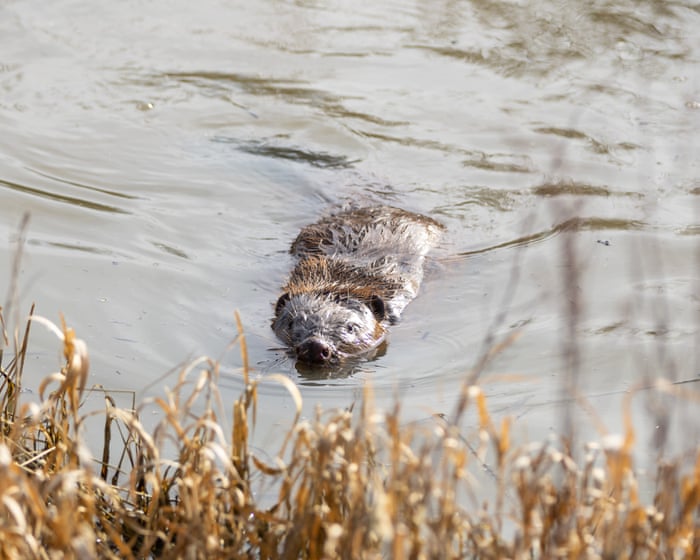
De Klee gave the farmers the lowdown on beavers. Their benefits were plentiful: they would build dams, create new wetlands on Boothby’s 2km stretch of river, and slow the water flow, ensuring a steady supply of river water in summer and reducing floods in winter.
With his winning, straightforward honesty, de Klee noted that there had been 27 beaver releases into fenced enclosures across England during the previous year, and half of them had a beaver escape. He paused. The farmers looked amused. “Every one has been caught and taken back,” said de Klee. “We have no interest in beavers escaping onto your land because we need them here to do this work.” One landowner also happened to have a 60,000-acre estate in Scotland. They had shot 120 beavers because they were flooding good cattle pastures. But the other farmers were keen to learn more about the beavers: how often do they breed? (Every year.) How do they affect fish? (Studies show their dams and pools increase fish numbers.) Do they eat eggs of ground-nesting birds? (No.) What about otters? (They live together.)
“What about the hat trade coming back?” one joked.
“My mum would be delighted,” said de Klee.Klee. “It would go with her mink coat.”
The farmers were led down to the river to see where the beavers would be released. They seemed reassured not just by what they heard, but also by what they saw—things like hedge-laying, mink-trapping, and restoring a wildflower meadow. These were familiar, comforting activities: management and control, practical stewardship, not some wild, free-for-all rewilding.
“Years ago, we were tearing hedges out,” one farmer said. “We were told to tear them out,” Dixon added. I asked what she thought of the beavers. “It’s a very good idea. The fencing will be quite something,” she said diplomatically. “I can’t see why anyone would be against the beavers if they’re going to be fenced in. It’s not like you’re releasing a monster.”
Dixon complained that weed seeds from Boothby were blowing onto her land, but she found that by mob-grazing her sheep in small paddocks and letting the grass grow longer, the seeds didn’t get in. “We’ve adapted,” she said. “You know how people are. Something happens and we all go, ‘Ugh!’ Now that it’s happening, people aren’t worried about it anymore. Of course, it gets more interesting when they put animals on it.” She was looking forward to livestock arriving. “The moment the animals arrive, it’ll be, ahhh. People will start to think it’s not such a bad idea after all.”
In September 2024, twelve people, bent over on a recently cultivated field, tending to the land, looked like a scene from a hundred years ago. Except back then, these workers would have been pulling weeds from between newly sown rows, shaping nature to grow food. But the volunteers at Boothby were putting the weeds back in.
It was another windy day. If you squinted, you could imagine Boothby’s fields as a trendy garden, with a muted palette of sculptural shapes. Tall teasels held their grey heads high. Docks were as rusty red as corten steel. The wildland’s last ever meager wheat harvest had been brought in the previous month.
This particular field had caused controversy earlier in the year because Boothby didn’t use the toxic weedkiller glyphosate on the arable weeds before sowing a wildflower mix (more acceptable “weeds” because they were less aggressive and usually had prettier flowers). “That meant we had this big growth of rosebay willowherb, ragwort, and thistle, which upset a lot of locals,” said Park with a grimace. They had promised wildflower fields. What sprouted up were the aggressive annual weeds that many locals dislike. So the field was cut, plowed again, and resown with a £6,000 wildflower mix. Now volunteers were spreading green hay, collected from Lincolnshire road verges, which would bring in the right kind of floral weeds: perennial wildflowers native to the area.
View image in fullscreen: Fields of ragwort by the village of Ingoldsby. Photograph: Fabio De Paola/The Guardian
Every week, Lemon and Park worked with a regular group of volunteers on various tasks around Boothby. One of the volunteers was Tabitha Thompson, 19. After she did “terribly” in her A-levels, her mother sent her to Boothby. She started by removing old plastic guards from the small plantations scattered around the farm. Then she took apart old pheasant pens. Her favorite task was learning how to lay a hedge. Her volunteering led to a good permanent job with the county’s flood management team. But she still spent holidays at Boothby. “Beavers coming here—I’d love to be involved in that,” she said. The beavers were due next spring.
2025
The beavers didn’t arrive in 2025. Consultations dragged on, expensive fencing was slow to install, and I wondered if Nattergal had lost their nerve—or their funding. Meanwhile, the wildland’s first glamping offer hadn’t been a success. “A field of t…”Thistles in Lincolnshire had limited appeal,” de Klee said with a grimace. Nattergal promised it would bring back ecotourism once there was more wildlife to see.
That summer, I decided to test the experience during an August heatwave. I showed up with my son, Ted, and our tent for a wild camp on Boothby’s glowing fields of thistles. Thistledown lay like a spilled duvet on the dry ground, which was cracked all over, as if we might be swallowed up.
Locals were still complaining about the weed seeds spreading from Boothby’s spectacular crop of thistledown, but this was just the ugly duckling phase of a rewilding site. “It’s the Marmite phase. People either love it or hate it,” said Park. He was in the love-it camp. But it was only a phase, he explained. When pigs are introduced, they’ll root up the thistle roots. Trees and scrub will soon shade the thistles and ragwort until they fade away.
Ted and I walked around this still empty, still rather unlovable, but now strikingly unusual landscape of shoulder-high thistles, teasels, ragwort, and dock. At one point in the distance, Ted spotted a very strange weed poking out from the burnt prairie land of tall brown and bleached gold grasses. It was the antlers of a fallow deer, watching us, its ears turning like satellites in the hot wind. Further on, spreading hedgerows of hawthorn and blackthorn looked like exhausted shoppers, loaded with produce: reddening haws and purpling sloes. Beside the river were barren-looking new ponds dug into the clay and sand by a digger driver de Klee had nicknamed “the Picasso of ponds.” These groundworks had cost £100,000 – cheaper than many similar schemes, but not as cheap as leaving river restoration to the beavers.
Luckily, Boothby had seen some financial successes in recent months. Nattergal had signed a major deal with engineering consultancy Arup, which agreed to buy £1 million worth of high-quality carbon removal credits over the next three decades at Boothby. This price was about three times the market rate for such credits, because the wildland would also provide biodiversity, flood retention, and community engagement. After many delays by the authorities, Nattergal had finally signed a BNG agreement with the local council to offer 338 BNG units. It later added another 1,075 units. BNG prices vary depending on the habitats lost, but typically a 20-house development might only need 1.5 units, for which the developer might pay £25,000 per unit. At that price, Boothby’s 1,413 BNG units could be worth more than £35 million. With major infrastructure planned for Lincolnshire – including pylons, battery storage, and housing – BNG was likely to provide a steady income over the next 20 years.
There was no storybook-style rooster to wake Ted and me, but we were roused at 5:30am by a roe deer barking outside our tent. We ate breakfast as the sun rose over a peaceful but still bleak field of thistles.
2026
On a sunny day in February, a family of four arrived at Boothby in a white van driven from Scotland, eager to explore their new home. “It’s an exciting day,” said de Klee, who now looked like a young colonial explorer with his impressive new moustache. “It doesn’t get better than releasing beavers into this landscape.” Lemon put out a “quiet” Facebook post looking for beaver volunteers. “It went crazy.”
It was amazing, said de Klee, how that B-word “can supercharge interest.” As a very young man, he’d worked on an Indian tiger reserve. “Your job was to prevent destruction,” he said. His work now was so different: “Enabling recovery. That psychological shift is so wonderful and powerful.” That said, the fencing contractors had churned up the ground during the wet winter, and there were local complaints about the ugly fencing and the nearly impassable footpaths. On the other hand, this section of the West Glen valley was full of water again, for the first time in a century or more, glinting silver in the sun.
Frequently Asked Questions
Here is a list of FAQs based on the topic It makes your heart sing Can a pioneering project prove that rewilding actually works
BeginnerLevel Questions
1 What does rewilding mean in simple terms
Rewilding means letting nature take the lead Its about restoring large areas of land so that natural processes happen on their own often by reintroducing missing animal species
2 What is the heart sing project
Its a specific longterm rewilding project that aims to prove that letting nature go wild can bring back wildlife improve the soil and even help fight climate change The name comes from the emotional joy people feel when they see the landscape thriving
3 How do you actually prove that rewilding works
Scientists and rangers measure things like
Biodiversity Are there more birds insects and plants
Soil health Is the ground holding more carbon and water
Animal success Are reintroduced species breeding
Economic value Does it create jobs in ecotourism or carbon credits
4 Does rewilding just mean doing nothing to the land
Not exactly It often starts with stopping harmful human activities but it may also involve actively reintroducing lost animals to kickstart natural systems After that humans step back and let nature do the work
5 Whats an example of a success story from this kind of project
At the Knepp Estate in England the number of nightingales increased by 50 after they stopped farming and introduced freeroaming cattle and pigs Rare butterflies and bats also returned proving the land was healing
Intermediate Advanced Questions
6 What are the biggest problems or criticisms of rewilding
Conflict with farmers Neighbors worry that wild animals will eat their crops or damage fences
Slow results It can take decades to see clear proof of success