After nine months of studying French for 20 hours a week, plus a year living in Strasbourg, I finally felt brave enough to walk into a bookstore and buy something more demanding than Le Petit Prince. I was instantly humbled. A whole new literary world opened up, one I could just barely access with my language skills, and I had no idea which authors were writing what, or what might capture my interest.
A year later, I returned to France for graduate school, following an 11-month stint working for an NGO in southern Chad. Even after two years with the language, I still felt like an intellectual toddler. During my first week of classes, I asked a fluent classmate where I could find French long-form narrative journalism with a literary flair—something akin to the New Yorker. “You have to read XXI,” he said, and a few days later handed me a copy.
Now 18 years old and recently rebranded as Revue21, this thick quarterly is a cornerstone of France’s “mook” (magazine-book) scene and its long-form narrative journalism. It specializes in stories where, as editor Guillaume Gendron explained to me, the writer can be present, acknowledging their own subjectivity and doubts, thereby building a relationship of trust with the reader. Holding the 162-page winter issue, I can feel the effort poured into reporting and writing these pieces. If I’m going to lose myself in something, it won’t be in one of a hundred browser tabs—it will be in the physical pages right in front of me.
This feels especially meaningful today, when we’re all suffering from screen fatigue, generative AI is blurring the line between real and fake, and traditional media everywhere is trapped in a cycle of shortening and simplifying content to chase our dwindling, social media-scattered attention spans. Many worry that reading is dying, heralding a post-literate society and even a decline in intelligence. I feel it too: the cognitive overload from the world’s constant noise, the anxiety of trying to keep up, the anger and despondency from endless, mindless scrolling—reading without truly reading. The burnout that comes from feeling busy yet accomplishing nothing. The urge to just disconnect.
Perhaps the doomsayers need to visit France.
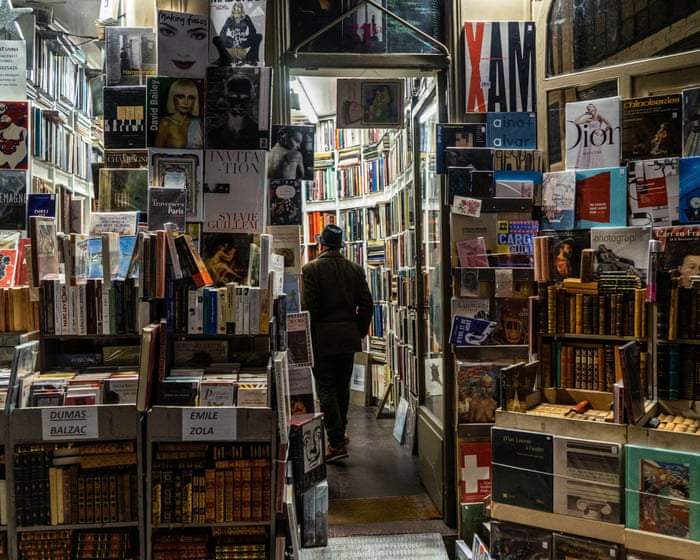
With 3,000 independent bookstores (more in absolute terms than the entire US, despite having only a fifth of the population) and 770 news kiosks across 180 cities, I’m always struck by—and adore—how much France remains a nation of readers. The data backs it up: 350 million books were sold in France in 2025. Adjusted for population, that’s almost three times the US rate (762 million) and nearly double that of the UK (191 million). You see it anecdotally too: the number and quality of books advertised in the Metro, the people reading on their commutes, the way niche publications emerge, endure, or are replaced by new ones. Kometa, Glitz, La Déferlante, Usbek & Rica, Le Cri… There’s even a new English-language entry, Souvenir.
“Print is showing some strong signs of survival,” says Lindsey Tramuta, a Paris-based journalist who recently wrote for the print-only magazine Beau about how magazines have become “an object of fascination—a collectible that carries a point of view and signifies status.” Théo Moy, who left his job at the newspaper La Croix to launch the new left-wing Catholic magazine Le Cri (now on its fifth issue), points to “screen fatigue” and the desire to support a mission as key reasons readers are subscribing to print.
For Le Cri, which launched with 3,000 monthly subscribers and €150,000 in donations, that mission is gathering…Bringing together left-leaning, environmentally conscious young Catholics to amplify their collective voice against the billionaire-backed Catholic far right. When he tells me the magazine has a monthly print run of 20,000, mostly sold at newsstands, I’m impressed—but Moy is more cautious. “We’d need twice that to really start making an impact,” he says.
Kyle Berlin, a former Rolling Stone editor who recently launched Souvenir, points to the long list of writers like Hemingway who began their careers contributing to small literary magazines based in Paris. He also emphasizes that paper simply has its advantages. “Print is a superior technology for the kind of stories I want to tell,” he says, stressing the word “technology.”
“Paper still carries more weight than digital media in France,” says Gendron, who took over Revue21 at the end of 2025 after leading the long-form section at the left-wing daily Libération. He notes that only the left-wing investigative outlet Mediapart holds the reputation of a print publication while being digital-only. Otherwise, in France, “paper is marble.” Marble—solid, timeless, with no need to prove its worth. If you’re holding it, print already has your attention. Due to the slower production cycle, it is inherently more reflective than reactive, more focused on lasting relevance than the immediate rush of going viral.
When I touch print—the glossy cover of Revue21 in the publication’s sunlit offices in the 11th arrondissement, or the two rougher, “eco-friendly” covers of Le Cri that Moy handed me across a brasserie table—I feel as though I’ve touched the solution, or at least one of them. Some writing leaves you informed; other pieces leave you wiser. Print tends to do the latter. I’m aware of the irony of praising the virtues of print through a screen, and how old-fashioned it might sound to insist that print isn’t dead. But beyond France, where it never fully faded away, I believe we’ll be surprised by how swiftly the printed word comes roaring back.
Alexander Hurst writes for Guardian Europe from Paris. His memoir, Generation Desperation, is out now.
Frequently Asked Questions
FAQs Worried About the Decline of Reading Come to France
Q1 What does immersed in print culture mean in France
It means that physical books newspapers magazines and independent bookstores are a visible cherished and active part of everyday life You see people reading in parks on metros and in cafes and theres a strong societal value placed on literature and intellectual discussion
Q2 Why is France often cited as having a strong reading culture
France has deep historical ties to literature and philosophy government policies that support book prices and authors and cultural habits that treat reading as a common leisure activity not just an academic task Events like literary prizes are major national news
Q3 Im worried about my own reading habits declining Whats a simple first step I can take inspired by France
Try the French cafe method spend 30 minutes in a coffee shop with a book Start small Even 1015 pages a day can rebuild the habit The key is making it a relaxed enjoyable ritual
Q4 What are the real benefits of reading physical books more often
Benefits include reduced screen time and mental fatigue improved focus and concentration better sleep deeper comprehension and retention of information and the tactile pleasure that makes the experience more memorable
Q5 A common problem is that I just cant focus or find the time to read Any tips
Time Link reading to an existing habit
Focus Use a physical book turn your phone on Do Not Disturb and set a timer for just 20 minutes
Choice Dont force yourself through a book you dont enjoy Put it down and pick something elsegenre doesnt matter
Q6 How does France actually support this culture from a practical standpoint
Two major policies help the Lang Law fixes book prices to protect small bookstores from giant retailers and there is a reduced VAT rate on books This keeps bookshops thriving and books affordable
Q7 Are French people really reading more or is it just a stereotype
While digital habits are growing globally surveys consistently show the French