The Egyptians had their pyramids. The Anglo-Saxons had their burial mounds. And Americans have their presidential libraries—the main difference being that the leaders the U.S. honors are usually still alive when the libraries open.
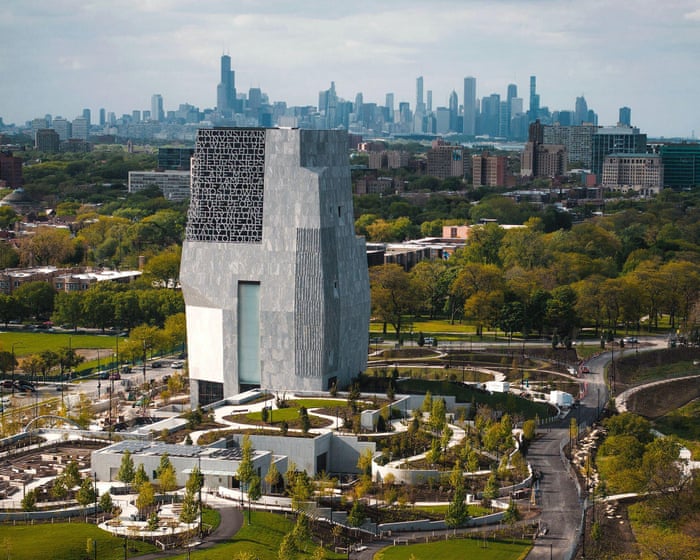
Without a royal family or an official state religion, the American presidency has grown to fill that gap. Over the decades, it has turned into a national cult of personality, complete with its own secular temples dedicated to powerful men. The latest monument of this kind is about to open on Chicago’s South Side, where it stands tall on the skyline as a towering tribute to the 44th president, Barack Obama. He may have seemed humble while in office, but in his post-presidential, Netflix-producing life, Obama has built the largest, most expensive, and most daring complex of them all. Behold the $850 million Obamalisk—or, as it sometimes feels eerily like, the Obamausoleum.
Obama was very, very involved in the design. He wanted to make things more angular and sharp.
Previous presidential libraries have taken many forms, reflecting the values of their creators. Franklin D. Roosevelt started the tradition in 1940, building a library in Dutch colonial style next to his grave in upstate New York, which he hoped would attract “an appalling number of sightseers.” Since then, every president has followed suit in their quest for immortality, dreaming up ever larger museums and archives, designed as sacred places of pilgrimage. Lyndon B. Johnson commissioned a massive brutalist building in Austin, Texas—a fitting symbol, as its architect Gordon Bunshaft noted, for “an aggressive … big man.” Ronald Reagan chose a sprawling California hacienda, complete with a dedicated hangar for Air Force One, while Bill Clinton created a cantilevered metal box in Arkansas—a literal take on his promise to “build a bridge to the 21st century.”
So, how do you symbolize hope, justice, equality, and all the other values Obama championed during his rapid rise to the White House? How do you honor the first Black president in history, in whom so much hope for change was placed, at a time when many of his achievements are being steadily undone?
Welcome to Obamaland … a statue of Barack and Michelle.
“We had the idea of a beacon,” says architect Billie Tsien, whose firm, Tod Williams Billie Tsien Architects, won the design competition for the Obama Presidential Center in 2016, just before the first Trump presidency. “We thought of four hands coming together,” she adds, holding her cupped hands against a colleague’s, as if shielding a flame from the wind.
Above us, sheer granite walls rise steeply from the ground, then taper into a chiseled 70-meter-high monolith. It looks carved and split, towering over the 19-acre campus like a stocky, shortened obelisk. Rising above the low-rise, low-income neighborhood, the building has an ominous feel. Its mostly windowless bulk recalls a menacing sci-fi headquarters, with small angled openings that look like launch points for drones or laser fire. Some have compared it to a flak tower, others to a “Klingon prison.” If it’s a beacon of hope, it seems like one that has been fortified at all costs against the current regime—a defensive bunker meant to protect its fragile values from attack.
“The president was very, very hands-on with the design,” says Tsien, with a hint of regret. “He talked a lot about his love of Brâncuși.” That’s the Romanian sculptor known for his carved, abstract forms. “And he wanted to make things more angular and sharp. To create a shape first, and then figure out what goes inside it, is really the opposite of how we’ve worked before. It was a very unfamiliar exercise.”
At the restaurant, you can order an Obama burger or Michelle’s family chili.
Obama has said he once wanted to be an architect, before he choseHe clearly enjoyed using his sharp mind to shape ideas. “When a client says that, it makes you uneasy,” Tsien admits. “It usually means they have strong opinions, and he definitely did. But he was a very good critic.” She says the Obama Foundation, which runs the center, “wanted something ‘iconic,’ which isn’t how we’ve worked before. I don’t think you can design something to be iconic.” Her face falls when we spot 3D-printed plastic models of the building for sale in the gift shop for $40. Still, the client got what it wanted: this memorable stone tower won’t be mistaken for anything else on your mantelpiece.
In the reluctant search for an icon, inspiration also came from a rock Tsien and Williams picked up on a trip to Ethiopia. It had a similar faceted shape to the building, with letters carved across its surface. Since Obama was one of the finest presidential speakers since Lincoln, it seemed fitting to wrap the facade with his words. The lines, from his speech marking the 50th anniversary of the marches from Selma to Montgomery, now form a sun-shading screen at the top of the tower’s southwest corner. “YOU ARE AMERICA,” you can just barely make out, before the words dissolve into a sea of unreadable letters. “I don’t know why it’s in Latin,” one confused local told me. The lorem ipsum vibe is real.
View image in fullscreen
Memorable menhir … the $40 replicas. Photograph: Oliver Wainwright
The tower is the most visible part of a huge four-building campus, built with blocky gray granite, bronze trim, and concrete interiors, giving the place a somewhat somber feel. There’s a “forum” with an auditorium, gift shop, cafe, and restaurant (where you can order an Obama burger or Michelle’s family chili), and a branch of the Chicago Public Library with a presidential reading room of Obama’s favorite books, where you can sit in his favorite Hans Wegner reading chair.
At times, the Obamamania gets a bit overwhelming—there’s even an Obama tulip variety in the garden, a gift from the Dutch. Numerous art pieces help break up the pervasive grayness, from Mark Bradford’s lively map of Chicago in the atrium to Julie Mehretu’s colorful stained glass window, which shines out from the northern facade at night.
The buildings frame a stately granite plaza on one side, while their backs are tucked into a rolling landscape—designed by Michael Van Valkenburg Associates—that climbs onto their rooftops, including fruit and vegetable planters inspired by Michelle’s garden at the White House. Farther south, past an impressively equipped playground, sledding hill, and bowl-shaped great lawn, is Home Court, a shiny aluminum-clad sports pavilion by Moody Nolan, the largest African American owned design firm in the US. It features an indoor NBA-spec basketball court, decorated with inspirational Obama sayings, like “Yes we can” and “No one does big things alone”—a motto the foundation stuck to when they brought in another architect because Williams and Tsien’s plan got too expensive, with mixed results. The angular metal shed looks like a cheap afterthought, but it will hopefully be a benefit for the community.
View image in fullscreen
Obama-isms … the Presidential Center’s interior. Photograph: Oliver Wainwright
It faces the sledding hill, which was originally meant to house an underground archive, until it was decided that this would be the first presidential library that isn’t actually a library. (That may be why it’s officially called the Obama Presidential Center.) To the concern of some historians, Obama’s is the first entirely digital presidential archive, run not by the National Archives but by his own private foundation, raising questions about its objectivity. Where once there would have been sNow, there are 400 parking spaces (even though Obama promoted public transit, this is still the US). The physical records might not be on site, but the stated goal of turning the presidential library from a scholarly research center into a lively community hub is a worthy ambition. “We didn’t build [the center] to celebrate my ability to bring about change,” Obama says in a promotional video. “We did it to unlock yours.” It’s not just a library, but a “campus dedicated to supporting future change makers.”
He hopes the real transformation will happen inside the mysterious tower, where for $30 a ticket, visitors are taken through four floors of an immersive, interactive Obama experience—a vertical Obamarama. Designed by Ralph Appelbaum Associates, it’s an action-packed journey through the couple’s life story, starting with the civil rights movements that inspired them, their political campaigns, achievements in office, life in the White House, and how you too can “bring change home” (a motto printed on the gift shop bag).
There’s also a full-size replica of the Oval Office, before Trump’s Home Depot-style makeover, where you can wait in line for a selfie at the Resolute desk. Other highlights include campaign memorabilia, from badges to custom Air Jordans, and dollhouse dioramas of various White House rooms—a particularly touching addition, given the damage the building is currently suffering. During the preview days, there were plenty of tissue boxes around.
An elevator finally takes you past a private presidential suite to the “sky room” at the top of the tower, where panoramic windows frame the city under a striking white pyramid-shaped ceiling—the pharaonic chamber at last! It was meant to feel celestial, with blue words by artist Idris Khan falling from the sky. But in a major mistake, the pyramid doesn’t end in a skylight, but a solid white plasterboard ceiling—perhaps an unintended symbol of barriers that still need to be overcome.
From this high perch, looking out through the big concrete letters, you get a good sense of how the Obama center fits into the neighborhood and why it’s been so controversial. Below lies Jackson Park, designed in 1871 by Frederick Law Olmsted, who also created New York’s Central Park. Part of the park was given up for the presidential complex. The decision to build on a public park sparked angry lawsuits, but the foundation insists the project has resulted in more parkland and more trees, thanks to removing a road. Still, the symbolic land grab struck a nerve, especially with so many empty lots nearby.
Beyond the neighboring public housing, you can also see a handful of new luxury apartment towers that have sprung up in the last decade—a result of the Obama gentrification effect that local residents feared the new center would bring. The project has fueled a frenzy of land speculation, driving up rents and pushing out low-income tenants. The center’s projected $3.1 billion economic boost may not yet be reaching those who need it most. Like his presidency, the Obama campus was no doubt created with the best intentions. And, as with his time in office, the impact of this mighty stone monument to hope looks set to be equally mixed.
Opens 19 June.
Frequently Asked Questions
Here is a list of FAQs about the Barack Obama Presidential Center based on the description like a Klingon prison
BeginnerLevel Questions
Q What is the Obama Presidential Center
A Its a museum library and public park complex being built in Chicago to house President Obamas archives and tell his story
Q Why is it being compared to a Klingon prison
A Critics say the main building has very few windows and a heavy fortresslike stone exterior The nickname comes from the dark windowless look of the Star Trek Klingon ships
Q How much does it cost
A The total price tag is about 830 million to 850 million
Q Is it a traditional library with books
A Not in the normal sense Its a digital archive and museum The actual paper documents are stored underground in a temperaturecontrolled vault not on public shelves
Q Where is it located
A In Jackson Park on the South Side of Chicago
AdvancedLevel Questions
Q Why did they choose to make it so windowless
A The architects wanted a fortresslike security design The lack of windows protects the sensitive archives from sunlight improves energy efficiency and creates a dramatic inwardfocused space for exhibits
Q What are the main design controversies
A Beyond the windowless look critics say the massive stone structure feels unwelcoming and out of place in a public park Legal battles also focused on the city giving up public parkland for a private foundation
Q Does the prison look affect how visitors experience it
A Yes The design is meant to be a journey You enter through a dark heavy base and then ascend to bright open spaces on the roof garden The contrast is deliberate
Q What about the security concerns for a former president
A Thats a key reason for the design The thick walls and limited glazing make it harder to breach and the underground archives are blastresistant Its built to Secret Service standards
Q Is the 850 million price tag unusual for a presidential library
A Yes It is the most expensive presidential library ever built far surpassing the Bush and Clinton centers Critics argue the cost is excessive for a